Playbooks

Quick Reference
Breakdown
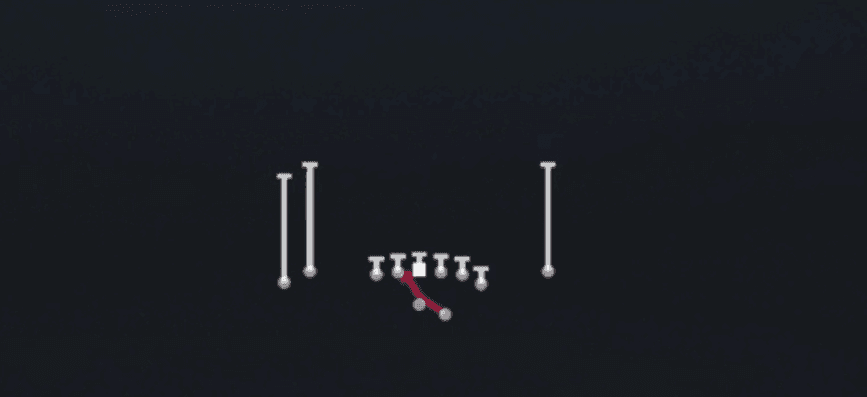
0 1 Trap is a gap scheme run play out of Shotgun Tight Y Off with 11 personnel, designed to pull an interior blocker across the formation to kick out a defender and create a natural running lane for the HB. The diagram shows no route concepts, just five offensive linemen and a lead blocker in front of the HB, confirming this is a pure power run play rather than a play-action or RPO look. The primary read is the trap block itself: the ball carrier should press the point of attack and read the pulling lineman to decide whether to cut inside or bounce outside based on how the defensive tackle reacts to the trap.
Defensive Reads
Look for a defensive tackle who is shooting gaps aggressively pre-snap, since this is exactly the alignment the trap block is designed to exploit. Watch linebacker depth and flow: if the linebackers are stacked tight and reading run keys quickly, they can scrape over the top of the trap and limit the play to a short gain. This play struggles against gap exchange or slanting defensive lines that are coached to read and react rather than fire upfield, since it removes the aggressive angle the trap block needs. Check for a run blitz or extra defender walked into the box before the snap, as this can outnumber the blocking scheme and blow up the play behind the line of scrimmage. Post-snap, track the linebacker closest to the point of attack, since his fill speed will usually determine whether the cutback lane or the designed gap produces the bigger gain.
Usage Tips
Use this play on early downs when you want to establish tempo and force the defense to respect the run before opening up your play action shots later in the set.
Check the defensive line alignment before the snap: if the defensive tackle is shaded hard into the play side gap, the trap block becomes even more effective because his aggressive gap shoot creates the kick out angle you need.
Pair this play with RPO Peek Slant or RPO Alert Bubble from the same set so the defense cannot key on run action based on personnel or formation tendencies.
Avoid calling this against heavy blitz packages that send extra defenders into the A and B gaps immediately, since the trap blocker may not get to his target before penetration disrupts the mesh point.
Use manual control on the HB after the handoff to make a decisive one cut based on the trap block, then get vertical quickly to maximize yards after contact.
Other Plays in Tight Y Off
 Cheat Outside ZoneOutside Zone, Motion, Run Play +1
 Cheat RPO Zone Alert BubbleRPO, Motion, Pass Play +3
 Cheat Slash Wheel CrossWheel, Motion, Pass Play +4
 Cheat Spot Y QuickSpot, Motion, Pass Play +6
 Choice Pivot ReturnOption Route, Pivot, Motion +5
 Deep CrossersCrosser, Pass Play, Block and Release +3
 Double Ins Stack OutOut, Pass Play, In +2
 Doubles ShotPass Play, Post, Out +7
 DuoDuo, Run Play, Power Run
 Fake Jet HB SeamPlay Action, Seam, Motion +6
 Flood DriveFlood, Drive, Pass Play +8
 HB Slip ScreenScreen Pass, Hb Screen, Pass Play +2
 Inside ZoneInside Zone, Run Play, Zone Run
- Jet HB TrapRun Play
- Jet Pass Fk ZoneMotion, Run Play
 Jet Touch PassMotion, Run Play
 Mesh SpotSpot, Mesh, Pass Play +7
 Mesh WhipsMesh, Pass Play, Man Beater +5
 Mtn Mesh SpotSpot, Mesh, Motion +8
 Mtn PA SpinnerPlay Action, Motion, Pass Play +4
 Mtn Slot ChoiceOption Route, Motion, Pass Play +4
 Mtn Spinner HB InsideMotion, Dive, Run Play
 Mtn WR Outside ZoneOutside Zone, Motion, Run Play +1
 Mtn Y-CornerCorner, Motion, Pass Play +4
 PA Go Slot CrossPlay Action, Go, Pass Play +5
 PA Jailbreak ScreenPlay Action, Screen Pass, Wr Screen +3
 PA Slot CrossPlay Action, Pass Play, Crosser +4
 Read OptionRead Option, Run Play
 Redzone ScissorsScissors, Pass Play, Cover 2 Beater +5
 RPO Alert BubbleRPO, Pass Play, Run Play
 RPO Alert OutRPO, Out, Pass Play +1
 RPO Peek SlantRPO, Slant, Pass Play +1
 RPO Peek Slant BubbleRPO, Slant, Pass Play +1
- RPO Zone Alert BubbleRPO, Pass Play, Run Play +2
- RPO Zone Alert GlanceRPO, Pass Play, Run Play +2
- RPO Zone Alert OmahaRPO, Pass Play, Run Play +2
- RPO Zone PeekRPO, Pass Play, Run Play +2
 StickStick, Stick Concept, Pass Play +2
 Switch WR DragDrag, Pass Play, Corner +4
 TE CornerCorner, Pass Play, Angle +2
 Wheel SpotWheel, Spot, Pass Play +5
 Zone Fake JetMotion, Run Play