Playbooks

Overview
Packers Offense and NFL Live Packers Offense are functionally the same playbook. The sibling cut shares all 603 of this book's plays and differs by zero sets, so your audibles, practice reps and tendencies carry over one for one between the two. Pick whichever one your mode surfaces, because there is no schematic reason to prefer either.
What you are actually choosing is a 603 play, Shotgun dominant passing book. Shotgun supplies 399 plays (66%) across 25 sets, which gives you a deep catalog of spread and empty looks in 11, 10 and 01 personnel. Singleback adds 99 plays (16%) across 7 sets as the main under center change up. Pistol contributes 57 plays (9%) across 3 sets, a middle ground that lets you pair a downhill run game with gun style passing. The heavy packages are small: I Form (21 plays, 2 sets), Strong I (12 plays, 1 set) and Goal Line Offense (12 plays, 1 set). Three Hail Mary plays round it out.
The concept list tells you the plan. Drag, Crosser, Slant, Hitch, Flat, Spot and Post give you a full quick game and horizontal stretch menu, and the Cover 3 Beater tags point at specific zone answers. Play Action, Motion and Block and Release concepts add constraint plays that keep a defense from sitting on the quick game. This book suits a rhythm passer who spreads the field from the gun, uses Pistol and Singleback to keep the run honest, and only goes heavy in short yardage with 21, 22, 23 and 13 personnel.
Scheme Fit
The Packers Offense playbook wants an accurate, quick release quarterback who can process leverage from the gun, backed by a slot receiver who wins on slants and drags and a pass catching back who can run the flat and Block and Release routes. A tight end who can both block in 12 and 13 personnel and threaten the seam helps the Pistol and Singleback play action work. Pick it if you are a rhythm passer who lives in Shotgun and wants a huge concept menu, not if your identity is a power run game under center.
Example Plays from this Playbook


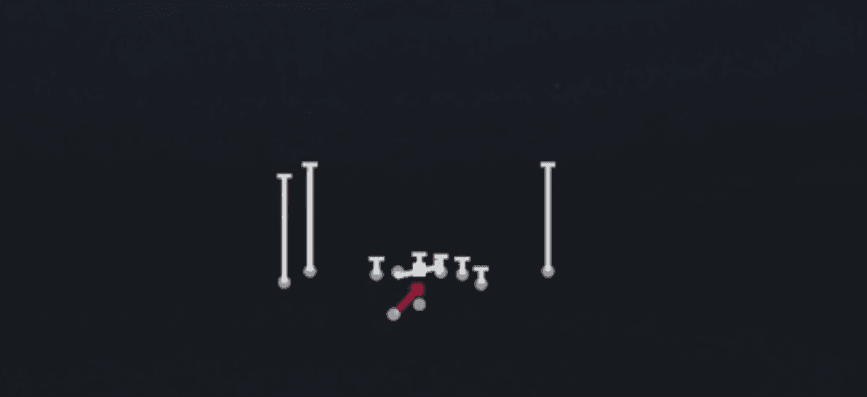

Find plays by concept, not by formation
Search every playbook by tag and personnel grouping, not just Packers Offense.
Strengths
- Shotgun depth is elite: 399 plays across 25 sets means you can run the same Drag, Slant, Spot or Flat concept out of multiple gun alignments and personnel groups, so opponents cannot key a single formation to diagnose the call.
- The personnel range runs from 01 and 10 empty style groupings to 23 and 13 jumbo sets, letting you force the CPU and human defenders into mismatched subs. Go four wide to pull a nickel or dime onto the field, then audible to a heavier set with the same personnel shell.
- Pistol's 57 plays across 3 sets give a genuine run and play action home without leaving a gun style drop, which is useful against defenders who read under center as run and Shotgun as pass.
- The concept spread covers both leverage beaters (Slant, Hitch, Spot) and horizontal stretch (Drag, Crosser, Flat), plus dedicated Cover 3 Beater calls, so you can build an audible package that answers single high zone without relying on hot routes every snap.
- Motion and Block and Release concepts let you diagnose man versus zone pre snap and get a checkdown option late, which pairs well with the high volume quick game in Shotgun.
Weaknesses
- Two thirds of the book is Shotgun, so a defense that sees gun can lean on pass coverage, drop an extra defender into underneath zones and nano blitz without much fear of a punishing downhill run.
- The dedicated power formations are thin: I Form, Strong I and Goal Line Offense total just 45 plays across 4 sets. Opponents can learn your short yardage and red zone tendencies quickly because the menu repeats.
- With only 12 Strong I plays and 12 Goal Line plays, your inside the 5 package has little variety. A user defender who keys the dive or the play action out of those sets can shut down your goal to go calls.
- Singleback carries under center duty almost alone with 99 plays, so if an opponent keys on Singleback personnel as your run tell you have few other under center looks to break the tendency.
- Hail Mary has only 3 plays across 2 sets, so end of half desperation options are minimal and predictable.
Usage Tips
Build your base audible package inside Shotgun with one set per coverage answer: a Slant or Hitch call for press man, a Drag or Crosser call for match zone, a Cover 3 Beater call for single high, and a Flat or Spot call for quick game on 2nd and medium.
On 1st and 10, mix Pistol and Singleback to show run and throw play action off it. Pistol's 57 plays let you keep the same gun style footwork while forcing linebackers to respect the run fit.
On 3rd and 5 or longer, go to 10 or 01 personnel Shotgun sets to spread out the defense, then use motion to confirm man or zone before picking between the crosser and the post based concepts.
On 3rd and 1 or 4th and short, sub into I Form or Strong I in 21 or 22 personnel for plays like FB Dive and Counter Weak, but alternate with play action from the same set so a user linebacker cannot cheat downhill.
Inside the 5, save Goal Line Offense for true short yardage and mix in 13 or 23 personnel Singleback or Strong I looks, because the 12 play Goal Line menu gets scouted fast in head to head games.
Formations in this playbook
 Wing Tight Nasty131 RB · 3 TE · 1 WR9 in book
 Deuce Close121 RB · 2 TE · 2 WR15 in book
 Wing Close121 RB · 2 TE · 2 WR15 in book
 Wing Pair Heavy121 RB · 2 TE · 2 WR15 in book
 Bunch X Nasty111 RB · 1 TE · 3 WR15 in book
 Tight Y Off111 RB · 1 TE · 3 WR15 in book
 Tight Y Off Flex111 RB · 1 TE · 3 WR15 in book
Upgrade to Playbooks Rookie
- Filter every play by tag and concept
- Personnel groupings
- Premium play analysis