Team Hub
NFC North
Green Bay Packers
Team Snapshot
Entering the 2026-2027 season, the Green Bay Packers are a win-now contender: they have a franchise quarterback (Jordan Love) signed through the decade, one of the NFL's most talented rosters after the stunning 2025 acquisition of edge rusher Micah Parsons, and Super Bowl expectations, but they must prove they can survive a loaded NFC North and finally win a playoff game of consequence after a collapse in the January 2026 Wild Card round.
Franchise Difficulty
How hard this franchise is to run well: where the team stands, what the roster gives you, what the cap allows, and what you hold in the draft.
A competent but unfinished roster behind Jordan Love, glaring holes at left tackle, center, and cornerback, a dead-cap figure of $37.6M that constrains maneuverability, a next-year cap room of only $11.2M (22nd), and a first-round pick forfeited to the Cowboys this cycle all combine to make the rebuild genuinely demanding.
Star Players
Scheme Fit
The schemes this team is set to run in-game, and how its roster grades in them.
- West Coast Zone RunoffensivePassable
- Tampa 2defensiveGood
Salary Cap
Green Bay carries $29.9M in room today but faces a sharp tightening to $11.2M (22nd) next season, so every dollar spent this cycle must count.
20 contracts expiring
Depth Chart
Madden Tools Analysis
Five starting spots have weak depth behind the starter.
Biggest gaps behind a starter
- HB
- LT
- RG
- LEDGE
- MIKE
Draft Capital
Green Bay holds 6 picks this cycle across rounds 2 through 7, with no first-rounder after forfeiting it to the Cowboys, leaving the near-term draft as a depth-building exercise rather than a top-of-board splash.
- Acquired: Round 4 from Cowboys, this draft
- Traded away: Round 1 to Cowboys, this draft
- Traded away: Round 6 to Eagles, this draft
Team Ratings
The defense's pass-rush talent, headlined by a 98-overall Parsons, is the roster's clearest strength, while the offensive line, particularly left tackle and center, is the most compromised unit from top to bottom.
Strengths
- REDGE
- RT
- SAM
- SS
- RG
Weak spots
- C
- CB
- LT
- DT
- MIKE
Offense
Defense
Special teams
Roster Needs
- Chigh
Sean Rhyan starts at center ranked 29th among starters league-wide, making this the most urgent upgrade on the offensive line.
- CBhigh
Keisean Nixon leads a cornerback room ranked 29th at the starter level, with the overall depth sitting 22nd, leaving this unit dangerously thin.
- LThigh
Jordan Morgan starts at left tackle ranked 31st in the league, making this the single most critical positional hole on the roster.
- DTmedium
Javon Hargrave and Devonte Wyatt form a serviceable interior, but the starter grade of 25th signals a clear need for a true difference-maker at the position.
- MIKEmedium
Zaire Franklin holds the MIKE spot at a 25th-ranked starter grade, with depth ranked 23rd, meaning reinforcements at linebacker are overdue.
- WRmedium
Christian Watson leads the receiver room at 82 overall, but the unit grades out 26th at the starter level and needs a true go-to weapon opposite him.
- LGlow
Laken Tomlinson starts at left guard with the depth ranked 2nd in the league, so while the starter is aging, the unit behind him is well-stocked.
Cut Candidates
5-Year Outlook
Green Bay hands you a franchise built around a core that is approaching its prime window, with Micah Parsons, Xavier McKinney, Jordan Love, Tucker Kraft, and Edgerrin Cooper all under 28 and capable of sustaining a contention push. The offensive line is the most pressing structural problem: left tackle and center both rank near the bottom of the league, and until those spots are upgraded, Love will be running for his life and the ground game will be limited regardless of Josh Jacobs' talent. Jacobs is a dynamic starter, but he is entering a phase of his career where wear becomes a real consideration, making Kaleb Johnson's development important sooner rather than later. Javon Hargrave is entering the late stage of his career and cannot be counted on as a long-term anchor in the interior, and Kevin Zeitler's twilight status at right guard means the entire offensive line needs a succession plan within the next two seasons. The cornerback room is a genuine liability, with Keisean Nixon and Benjamin St-Juste both carrying aging designations and no elite talent behind them beyond 24-year-old Carrington Valentine. Cap flexibility is modest now at $29.9M and tightens sharply to $11.2M next year, so roster construction decisions in the near term carry outsized consequences.
5-Year Plan
Year 1Plug the foundation leaks
- Release Karl Brooks, Jonathan Ford, Kristian Welch, and Tyrod Taylor to clear roughly $7.1M in combined cap space and simplify the roster.
- Target a starting-caliber left tackle through free agency or trade to address the 31st-ranked starter spot before Love takes another season of pressure.
- Invest available cap room and the Cowboys-acquired fourth-round pick in center and cornerback depth to stabilize the two other high-severity need positions.
Year 2Build around the young core
- Commit to Edgerrin Cooper as the full-time WILL starter and give him every opportunity to justify his Star dev trait in an expanded role.
- Identify a succession plan at right guard as Kevin Zeitler, in the twilight of his career, will need a replacement sooner rather than later.
- Use the second-round pick and one of the remaining picks to add a cornerback or receiver who can grow alongside Love's prime years.
Year 3Sharpen the contender edges
- With committed spending dropping to $289.1M this year, use the relative cap relief to extend Tucker Kraft and lock in the pass-catching core around Love.
- Move Javon Hargrave, who will be deep in the late stage of his career, toward a rotational role and promote Chris McClellan as the long-term starter inside.
- Evaluate Zaire Franklin's MIKE role and begin transitioning that spot toward a younger option as his contract and age curve converge.
Year 4Push the championship window open
- With committed spending falling to $203.0M, pursue an aggressive offseason targeting the cornerback and receiver positions that have been chronic weaknesses.
- Lean on Matthew Golden, Kaleb Johnson, and Brandon Cisse, all of whom will be hitting developmental prime, to carry rising roles in the starting lineup.
- Ensure Micah Parsons and Xavier McKinney remain under contract as the anchors of a defense that must carry the team through the contention window.
Year 5Sustain or reload with purpose
- Assess Jordan Love's contract situation and make a franchise-defining decision about locking him in long-term or beginning a controlled transition.
- Use the three-year total of 20 draft picks accumulated across the plan to ensure no positional group is left without a credible young successor.
- Protect cap flexibility by letting aging contributors age off the roster naturally rather than absorbing large dead-money charges that hampered earlier years.
Young core
Full Roster
| Player | Pos | OVR | Age | Dev |
|---|---|---|---|---|
| Age 27 | REDGE | 98 | 27 |  |
| Age 27 | SS | 92 | 27 | |
| Age 28 | HB | 89 | 28 |  |
| Age 27 | RT | 87 | 27 |  |
| Age 25 | TE | 85 | 25 | |
| Age 36 | RG | 85 | 36 |  |
| Age 27 | QB | 84 | 27 | |
| Age 27 | WR | 82 | 27 | |
| Age 24 | WILL | 80 | 24 | |
| Age 33 | DT | 80 | 33 | |
| Age 26 | WR | 80 | 26 | |
| Age 25 | LEDGE | 80 | 25 | |
Franchise History
The Packers were founded in 1919 in Green Bay, Wisconsin, by Earl "Curly" Lambeau and George Whitney Calhoun, sponsored initially by the Indian Packing Company (the source of the "Packers" name). They joined the American Professional Football Association, the forerunner of the NFL, in 1921, making them one of pro football's oldest continuously operating franchises and the last of the small-town teams of the early NFL. Under Lambeau, who coached through 1949, the Packers became an early dynasty, winning three straight NFL titles (1929-31). After lean years, Vince Lombardi arrived in 1959 and built the most iconic dynasty in league history: five NFL Championships in seven years (1961, 1962, 1965, 1966, 1967), including victories in the first two Super Bowls and the legendary 1967 "Ice Bowl," the coldest game in NFL history. After a long drought, GM Ron Wolf, coach Mike Holmgren, the trade for Brett Favre, and the 1993 signing of Reggie White revived the team, culminating in a Super Bowl XXXI championship. The Aaron Rodgers era (starter 2008-2022) delivered Super Bowl XLV and four MVP awards. Today the team is in the Jordan Love era, who has led Green Bay to the playoffs in each of his first three seasons. In all, the Packers have won 13 NFL championships, the most in NFL history, comprising nine pre-merger NFL titles and four Super Bowls (I, II, XXXI, XLV). Traditions include the publicly owned team structure, the Lambeau Leap (1993), and Lambeau Field, the "Frozen Tundra."
Notable figures
 Curly Lambeau · Co-founder, player, and head coach (1919-1949)
Won six NFL titles as coach and gave the franchise (and its stadium) its identity.
Photo: Walker's Cleaners and Tailor, public domain (Wikimedia Commons)
 Vince Lombardi · Head coach (1959-1967)
Won five NFL titles and the first two Super Bowls; the Super Bowl trophy bears his name.
Photo: public domain (Wikimedia Commons)
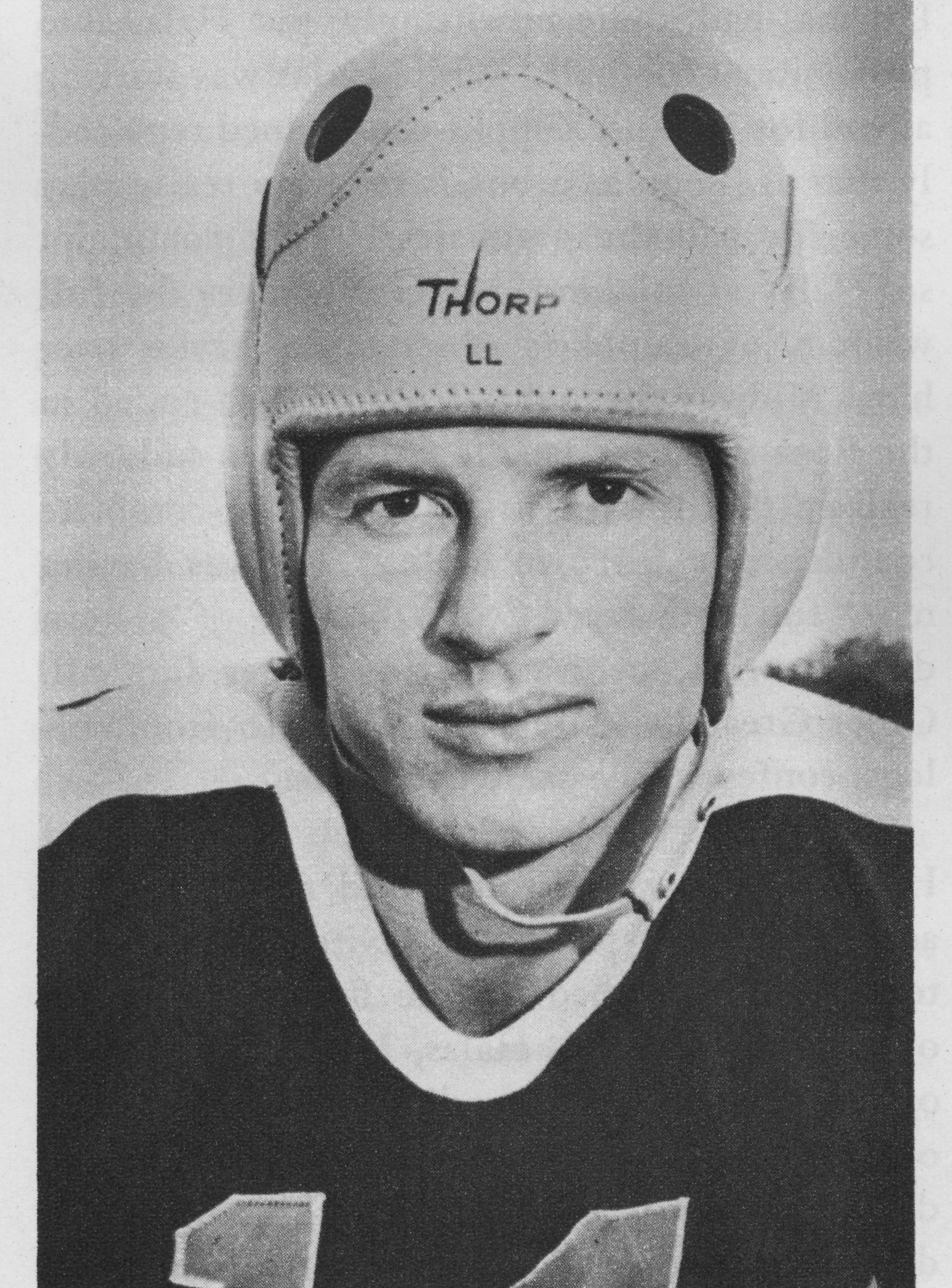 Don Hutson · End/receiver (1935-1945)
Pro football's first great wide receiver; still holds the Packers' career receiving-TD record (99). Number 14 retired; 1941 and 1942 NFL MVP.
Photo: public domain (Wikipedia)
 Bart Starr · Quarterback (1956-1971)
Five-time NFL champion, MVP of Super Bowls I and II, hero of the Ice Bowl. Number 15 retired.
Photo: Vintage Football Card Gallery, public domain (Wikimedia Commons)
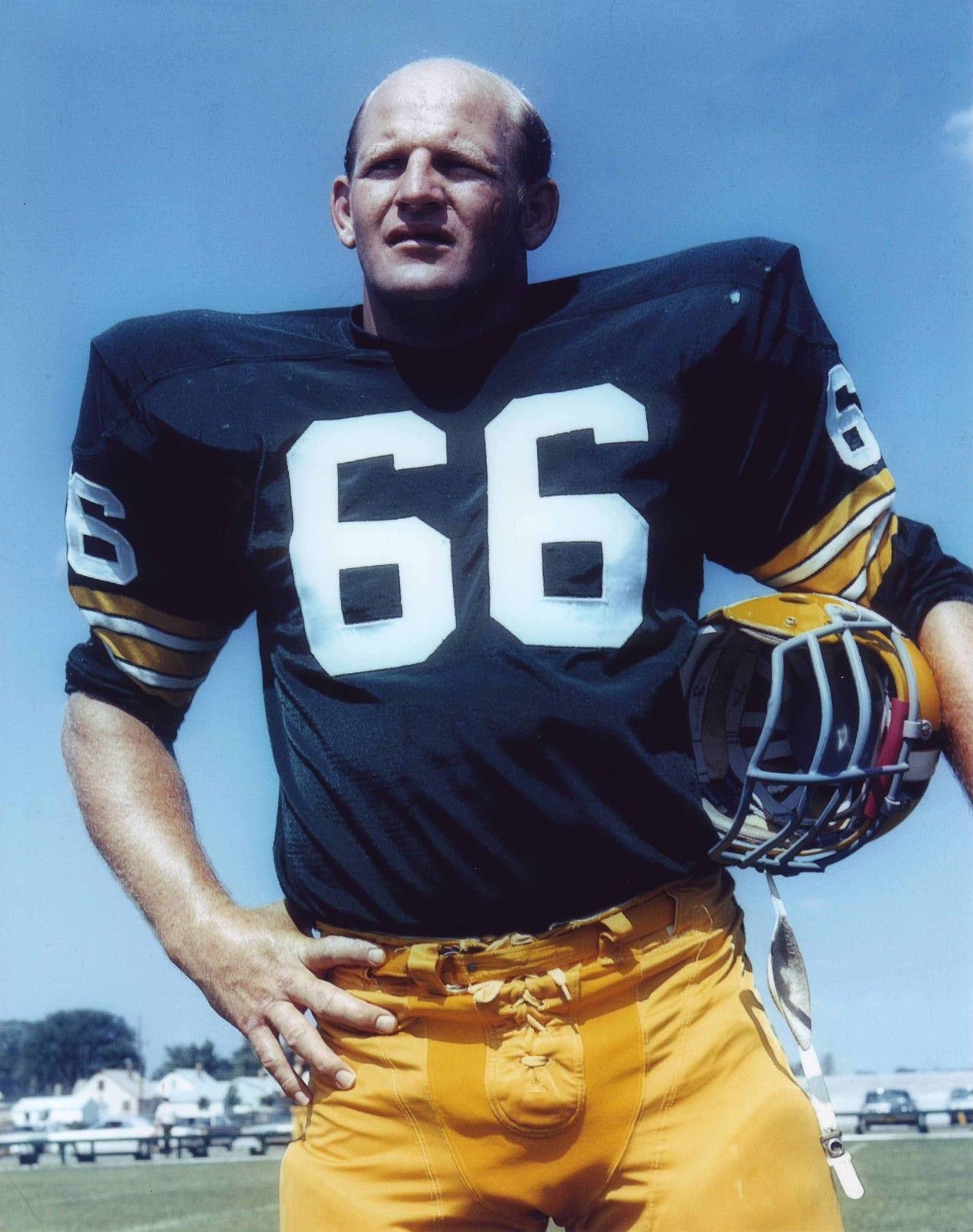 Ray Nitschke · Middle linebacker (1958-1972)
Anchor of the Lombardi-era defense, five-time NFL champion, Hall of Famer (1978). Number 66 retired.
Photo: public domain (Wikimedia Commons)
 Paul Hornung · Halfback ("The Golden Boy," 1957-1966)
1961 NFL MVP and prolific scorer; number 5 unofficially retired.
Photo: Bigmoe797, CC BY-SA 4.0 (Wikimedia Commons)
 Brett Favre · Quarterback (1992-2007)
Three-time MVP, Super Bowl XXXI champion, franchise career passing-yards leader (61,655). Number 4 retired; Hall of Fame (2016).
Photo: David Wilson, CC BY 2.0 (Wikimedia Commons)
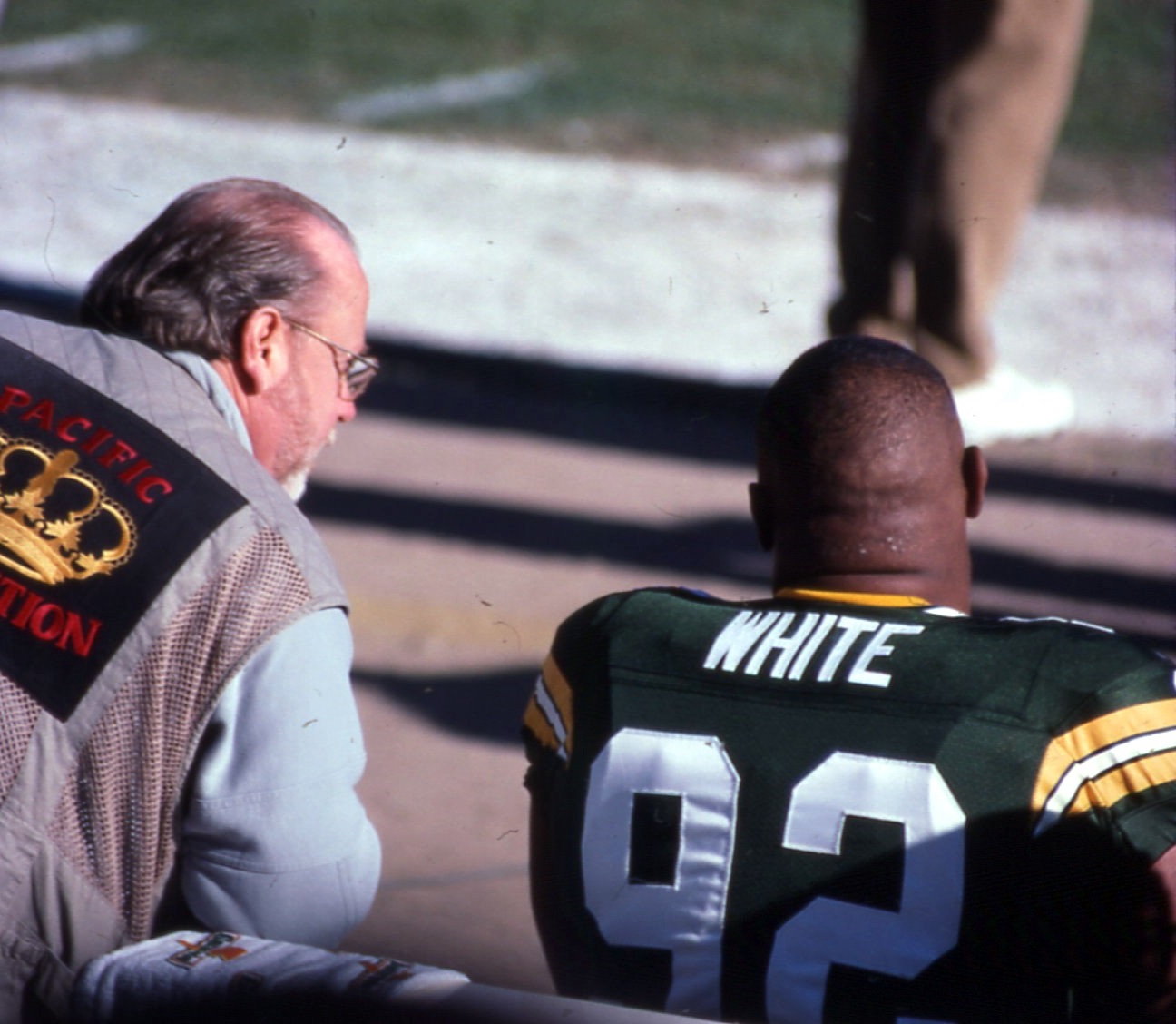 Reggie White · Defensive end ("The Minister of Defense," 1993-1998)
1998 NFL Defensive Player of the Year, Super Bowl XXXI champion. Number 92 retired.
Photo: David Wilson, CC BY 2.0 (Wikimedia Commons)
 Aaron Rodgers · Quarterback (2005-2022, starter 2008-2022)
Four-time NFL MVP, Super Bowl XLV champion, franchise leader in passing TDs (475).
Photo: Chad Davis, CC BY-SA 2.0 (Wikimedia Commons)
Record book
- Passing yards (career)Brett Favre (61,655 (1992-2007))
- Passing TDs (career)Aaron Rodgers (475 (Favre second at 442))
- Rushing yards (career)Ahman Green (8,322)
- Receiving yards (career)Donald Driver (10,137)
- Receptions (career)Donald Driver (743)
- Sacks (career)Clay Matthews (83.5 (official-era leader; sacks official since 1982))
- Interceptions (career)Bobby Dillon (52 (in just eight seasons, 1952-59))
- Points (career)Mason Crosby (1,918)
Team Tips
Playing As
Under LaFleur, a product of the Kyle Shanahan/Sean McVay coaching tree, Green Bay runs a wide-zone running scheme married to heavy play-action, motion, and condensed formations to create explosive plays off run fakes. The offense leans on Jordan Love's efficiency and deep-ball accuracy (101.2 passer rating in 2025, just six interceptions), a committee of vertical-threat receivers (Christian Watson, Jayden Reed, Matthew Golden), and a strong run game. Love is at his best from a clean pocket, so protect him. On defense, new coordinator Jonathan Gannon installs an adaptable, takeaway-focused 3-4 base built around edge rusher Micah Parsons, safety Xavier McKinney, and linebacker Edgerrin Cooper, plus veterans Javon Hargrave and Zaire Franklin.
Playing Against
The most reliable path is to pressure Love and disrupt timing, his footwork and decision-making can degrade under heavy pressure in high-volume passing situations. Test the reworked offensive line (Green Bay lost LT Rasheed Walker; Jordan Morgan steps in) and a thinned receiver room after Romeo Doubs and Dontayvion Wicks departed. Defensively, attack a potentially Parsons-less or rotation-thin front early, Parsons is rehabbing a torn ACL from Week 15 of 2025 and may miss the start of the season, and exploit questions at nose tackle with the run game.

Coaching · Matt LaFleur
Head coach since 2019 (eighth season in 2026) and a disciple of the Mike/Kyle Shanahan and Sean McVay offensive school, LaFleur runs a wide-zone, play-action attack and calls the offense himself. He owns a 76-40-1 regular-season record (.654), signed a multiyear extension in January 2026, and has reached the playoffs in five of his first seven seasons but is 3-6 in the postseason. His 2026 staff features new defensive coordinator Jonathan Gannon (shifting to a 3-4 base) and new special-teams coordinator Cam Achord.
Photo: Schik8337, CC BY-SA 4.0 (Wikimedia Commons)
Coming soon
- Playbook Matches
- Key Plays & Audibles
Upgrade to Team Hub Rookie
- Salary cap breakdown
- Depth chart analysis
- Roster needs & scheme fit
- Cut candidates & 5-year outlook
- Full sortable roster