Playbooks

Quick Reference
Receiver routes
Depth-chart slots are shown as they line up in the base package for this set.
| Player | Side | Route |
|---|---|---|
| HB1 | Right | Pass Block |
| WR3 | Left | Short Out |
| WR1 | Left | Post |
| WR2 | Right | Bubble Screen |
| TE1 | Right | Run Block |
Read progression
- WR2 right, Bubble Screen
- WR3 left, Short Out or WR1 left, Post
Breakdown
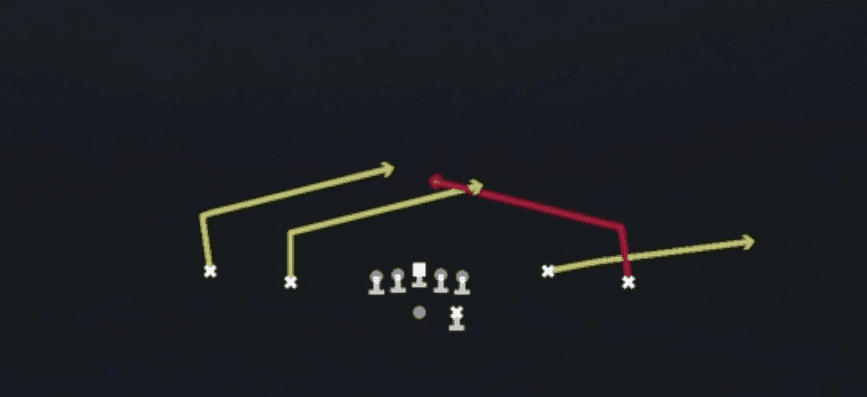
Mtn FL Screen is a motion-based screen concept out of Spread Y-Flex in Shotgun. Pre-snap motion brings a receiver across the formation to sell run action or jet motion while the two outside receivers on the diagram run off the corners vertically and to the sideline, clearing space for the screen. The offensive line and backfield set up a wall in front of the flanker, who works to the boundary as the primary read on this WR screen, designed to beat man and aggressive zone pressure by getting numbers blocked in space quickly.
Defensive Reads
Key the flanker at the snap instead of following the motion man, since the screen is designed to draw eyes away from the actual ball carrier. Watch for a hard crashing defensive end or outside linebacker, since a disciplined edge defender who stays home can blow this play up before the blocks set. If the cornerback on the screen side stays flat-footed and squats instead of biting on the vertical release, this play gets shut down immediately. Zone defenses with a linebacker spying or sitting in the shallow flat area take away the throwing lane and force the quarterback to hold the ball. User the nearest defender to the boundary and get eyes on the flanker pre-throw, since jumping the screen lane as the user defender is the fastest way to blow this play up for a loss.
Usage Tips
Use the pre-snap motion to bait linebackers and slot corners into flowing hard toward the motion man, which opens up the alley for the flanker screen.
Call this against Cover 3 or Cover 1 looks where corners are playing off and safeties are rotating deep, since the underneath defenders will be slow to react to the screen action.
Hot route the vertical release receivers into quick outs or hitches if you see a blitz showing pre-snap, since that removes the clear-out threat and gets you a faster answer.
Pair this with Mtn HB Swing or Mtn WR Mid Screen in your play-calling sequence so the defense has to respect multiple screen looks off similar motion and formation shifts.
Best used on early downs or in obvious run-blitz situations where linebackers are crashing hard, since the screen slips right behind that aggression for a big gain.
Other Plays in Spread Y-Flex
 617Pass Play, Go, Out +6
- All HitchHitch, Pass Play
 Angle Y SailAngle, Sail, Pass Play +6
 Corner StrikeCorner, Pass Play, Block and Release +1
- Cross H DivideCrosser, Deep Cross, Post +4
 Curl FlatsCurl, Pass Play, Flat +1
 Deep AttackPass Play, Go, Out +7
 Double SlantsSlant, Pass Play, Flat
 DriveDrive, Pass Play, Cover 4 Beater +6
 Empty Mtn DaggerDagger, Motion, Pass Play +7
 Empty Mtn DriveDrive, Motion, Pass Play +5
 Empty Mtn FL ScreenScreen Pass, Wr Screen, Motion +3
- Fake Jet HB WheelWheel, Post, Hitch +5
- Fake Jet Mesh WheelWheel, Post, Option Route +6
 Flex Jets Y-SailSail, Pass Play, Cover 2 Beater +6
- FL ScreenScreen Pass, Bubble Screen, Post +2
- Four VerticalsOption Route, Streak, Pass Play
 Four VerticalsFour Verts, Pass Play, Cover 2 Beater +5
 HB DrawDraw, Run Play
 HB Quick BaseDive, Run Play
 HB Slip ScreenScreen Pass, Hb Screen, Pass Play +3
 Hitch SeamHitch, Seam, Pass Play +2
 Inside CrossCrosser, Pass Play, Post +4
 Inside ZoneInside Zone, Run Play, Zone Run
 Inverted VeerInverted Veer, Run Play
 Jet Touch PassMotion, Run Play
 MeshMesh, Pass Play, Man Beater +4
 Mtn DriveDrive, Motion, Pass Play +7
 Mtn Fk Screen WheelPlay Action, Screen Pass, Wheel +6
- Mtn Fk Swing WheelWheel, Swing, Deep Cross +6
 Mtn HB Cross ScreenScreen Pass, Hb Screen, Motion +6
- Mtn HB SwingSwing, Flat, Slant +1
- Mtn HB SwingSwing, Slant, Pass Play
- Mtn H StickStick, Fade, Hitch +4
 Mtn Out H-AngleOut, Angle, Motion +3
 Mtn ReplaceMotion, Hitch, Out +3
 Mtn Shallow HB AngleShallow Cross, Angle, Motion +6
 Mtn Slot FlagsMotion, Corner, Slant +3
 Mtn Sluggo ReplaceSluggo, Motion, Pass Play +4
- Mtn TE Mid ScreenScreen Pass, In, Swing +1
- Mtn WR Mid ScreenScreen Pass, Bubble Screen, Fade +3
 PA CurlsPlay Action, Pass Play, Curl +3
 PA SeamsPlay Action, Pass Play, Seam +1
 QB ZoneDesigned Qb Run, Run Play
 Raider Y-OptionOption Route, Pass Play, Angle +2
 Read OptionRead Option, Run Play
- RPO Alert QB DrawDraw, Qb Draw, Designed Qb Run +5
 RPO Alert ScreenScreen Pass, RPO, Pass Play +1
 RPO Peek SlantRPO, Slant, Pass Play +1
- RPO Read ScreenScreen Pass, Bubble Screen, Pass Play +1
- RPO Zone Alert ScreenScreen Pass, RPO, Pass Play +2
- RPO Zone PeekRPO, Pass Play, Run Play +2
 Slant FlatFlat, Slant, Slant Flat +3
 Slot OutsOut, Pass Play, Angle +3
- Smash CornersCorner, Smash, Pass Play +3
 Smash HB CheckSmash, Pass Play, Cover 2 Beater +3
 Spot N GoGo, Spot, Pass Play +5
 Stick Double SlantSlant, Stick, Stick Concept +3
- WR ScreenScreen Pass, Bubble Screen, Post +2
 WR UnderPass Play, Quick Pass, Shallow Cross +8
 X FollowPass Play, Mesh, Go +8
 Y CornerCorner, Pass Play, Flat +1
 Y CrossY Cross, Pass Play, Crosser +5
- Y Cross(1)Crosser, Y Cross, Pass Play +5
- Y SailFlat, In, Out +3
 Y Shallow CrossShallow Cross, Pass Play, Crosser +5
 Y StickStick, Stick Concept, Pass Play +4
 Z SpotSpot, Pass Play, Cover 3 Beater +4