Playbooks

Quick Reference
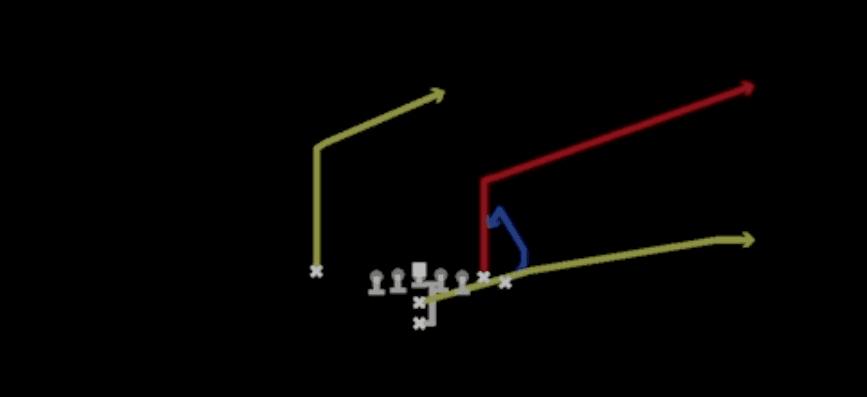
Receiver routes
Depth-chart slots are shown as they line up in the base package for this set.
| Player | Side | Route |
|---|---|---|
| HB1 | Middle | Angle |
| FB1 | Middle | Pass Block |
| TE2 | Right | Curl |
| WR1 | Left | Corner |
| TE1 | Right | Post Corner |
Read progression
- WR1 left, Corner
- TE1 right, Post Corner
- HB1, Angle
- TE2 right, Curl
Breakdown
WR Corner out of the I Form Wing 22 personnel shows a three level route concept to the closed side. The outside receiver stems vertical then breaks hard to the corner, the wing/TE runs a deep out that turns upfield into a corner route of his own creating a natural high low stack, and the backside receiver takes off on a deep drag that clears underneath from the opposite side of the formation. This is a man beater built to attack the flat and deep quarter with two receivers occupying the same zone, forcing a defender to pick one. Primary read progression starts with the outside corner route, works down to the wing's corner breaking behind it, and finally to the drag as the checkdown against pressure.
Defensive Reads
Pre-snap, identify if the closed side corner is aligned inside or outside leverage, outside leverage invites the corner route to break open against the sideline. Check safety depth before the snap, a single high safety cheating to the play side can jump the outside corner route so be ready to check to the wing's route or the drag. Post-snap, watch for a user controlled defender sitting in the flat trying to jump the wing's corner route, if he bites hard the outside corner route stays open longer. Cover 3 with a hard flat defender and a deep third defender staying disciplined can take away both corner routes, look for the drag to bail you out against this shell. Man coverage with no deep help is the easiest shell to beat, the double corner concept overloads a single defender's zone leverage and creates a natural pick situation on the break points.
Usage Tips
Take a pre-snap look at the corner and safety alignment on the closed side, if the corner is playing tight man with no safety help over the top the outside corner route wins immediately on the break.
Against zone shells with a deep half or deep third defender sitting outside, work the progression down to the wing's corner route since it settles behind the shallow flat defender and in front of the deep defender.
Use the deep drag from the backside as your answer versus pressure looks, it clears the underneath zone fast and gives the quarterback a safety valve if the corner routes are covered.
This play pairs well with Curls or TE Post from the same set since both hold safeties and linebackers with similar initial keys before breaking away from the corner concept, keep defenses guessing by mixing in HB Lead or HB Power O from the same personnel to sell run first.
Best used on second and long or third and medium when you need a explosive gain, the double corner look stresses defenses that are playing single high or two deep with soft corners.
Other Plays in Wing
 95 MikeRun Play, Power Run, Designed Qb Run +1
 Close HB LeadIso, Run Play, Power Run
 CurlsPass Play, Flat, Hitch
 FB DiveDive, Run Play
 FB Fake HB TossToss, Run Play
 HB Counter WkCounter, Run Play, Power Run
- HB Inside ZoneInside Zone, Run Play, Zone Run
 HB LeadIso, Run Play, Power Run
 HB Lead DiveDive, Run Play
 HB Power GPower, Run Play, Power Run
 HB Power OPower, Run Play, Power Run
 HB StretchOutside Zone, Run Play, Zone Run
 HB SweepSweep, Run Play
 HB Zone TossToss, Run Play, Inside Zone +1
 Motion Power WeakMotion
 Mtn HB Power OPower, Motion, Run Play +1
 Mtn PA Power OPlay Action, Motion, Pass Play +4
- Mtn PA Sprint HB FlatPlay Action, Flat, Motion +3
 Mtn PowerMotion, Run Play
- Mtn Power WeakMotion, Run Play
 Mtn ZoneMotion, Run Play
 PA Boot FlowPlay Action, Pass Play, Comeback +4
 PA ClearoutPlay Action, Pass Play, Flat +4
 PA Close CrossPlay Action, Pass Play, Crosser +3
 PA Close PostPlay Action, Post, Pass Play +3
 PA Mtn Power OPlay Action, Motion, Pass Play +4
 PA Power OPlay Action, Pass Play, Corner +4
 PA ScissorsPlay Action, Scissors, Pass Play +5
 PA SpotPlay Action, Spot, Pass Play +5
 PA Sprint HB FlatPlay Action, Flat, Pass Play +4
 PA TE LeakPlay Action, Pass Play, Corner +3
 PA U SlidePlay Action, Slide, Pass Play +5
 PA WagglePlay Action, Pass Play, Block and Release +3
 PA X Burst CrossPlay Action, Pass Play, Crosser +3
 Post ShotPost, Pass Play, Deep Cross +2
- RPO Power O Alert X SmokePower, RPO, Run Play +3
 RPO Stretch Alert X LookieOutside Zone, RPO, Run Play +3
 Strong StretchOutside Zone, Run Play, Zone Run
 TE OptionOption Route, Pass Play, Angle +3
 TE PostPost, Pass Play, Drag +3
 WR SluggoSluggo, Pass Play, Man Beater +4
 X FadeFade, Pass Play
 X SlantSlant, Pass Play, Flat +2
 Zone WkInside Zone, Run Play, Zone Run