Playbooks

Quick Reference
In 1 playbook
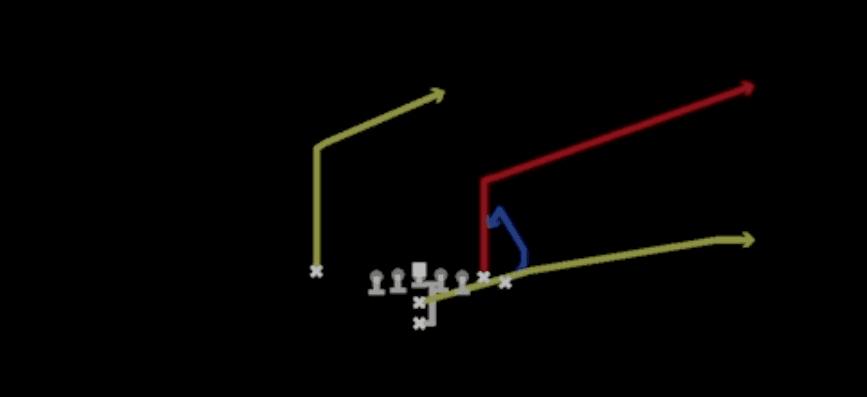
Receiver routes
Depth-chart slots are shown as they line up in the base package for this set.
| Player | Side | Route |
|---|---|---|
| HB1 | Middle | Pass Block |
| FB1 | Middle | Flat |
| TE2 | Right | Deep In |
| WR1 | Left | Deep Post |
| TE1 | Right | Corner |
Read progression
- TE1 right, Corner
- WR1 left, Deep Post
- TE2 right, Deep In
- FB1, FlatCheck-down
Breakdown
PA TE Leak from the I Form Wing set sells play action to the run side while the tight end leaks out to the flat as the underneath outlet. Off the fake, one receiver runs a deep out breaking to the sideline while the backside route works vertically up the seam, and a third route sits at intermediate depth cutting across the field, creating a three level stretch on the play side. The primary read progression starts with the TE leak against overpursuing linebackers, then works to the deep out, and finally to the crossing route if the defense sinks its underneath coverage, making this a play action man and zone beater depending on how the second level reacts to the fake.
Defensive Reads
Watch linebacker depth before the snap: linebackers sitting tight to the line are prone to biting on the play fake and leaving the TE leak wide open underneath. Identify single high safety looks, since Cover 1 and Cover 3 shells with aggressive run support are the most vulnerable to this concept. Track any user controlled linebacker flowing hard to the run fake, that lurk defender vacating the middle is exactly the throwing window this play is designed to create. Cover 2 or Cover 4 shells with disciplined linebackers who sink and stay square will take away both the leak and the deep out, forcing a checkdown or throwaway. Beware disguised blitzes off the edge since the play action drop takes an extra beat, if the defense brings a nano blitz through the TE side gap the quarterback needs to get the ball out fast on the leak read.
Usage Tips
Run this on early downs when you have already established the HB Lead or HB Power O run game so linebackers bite on the play action fake.
Check the safety alignment pre-snap: single high shells with linebackers stacked tight are the best trigger for this call since the TE leak exploits aggressive run fits.
If you see man coverage on the TE, hot route him to a quick out to win immediately off the fake before the leak defender can wall him off.
Pair this with straight dropback passes like Curls or PA Boot Flow later in the series so defenders cannot key on run action versus pass action tendencies.
Use in second and short or first and ten situations where defenses are more willing to load the box, since that hesitation is what opens the leak route underneath.
Other Plays in Wing
 95 MikeRun Play, Power Run, Designed Qb Run +1
 Close HB LeadIso, Run Play, Power Run
 CurlsPass Play, Flat, Hitch
 FB DiveDive, Run Play
 FB Fake HB TossToss, Run Play
 HB Counter WkCounter, Run Play, Power Run
- HB Inside ZoneInside Zone, Run Play, Zone Run
 HB LeadIso, Run Play, Power Run
 HB Lead DiveDive, Run Play
 HB Power GPower, Run Play, Power Run
 HB Power OPower, Run Play, Power Run
 HB StretchOutside Zone, Run Play, Zone Run
 HB SweepSweep, Run Play
 HB Zone TossToss, Run Play, Inside Zone +1
 Motion Power WeakMotion
 Mtn HB Power OPower, Motion, Run Play +1
 Mtn PA Power OPlay Action, Motion, Pass Play +4
- Mtn PA Sprint HB FlatPlay Action, Flat, Motion +3
 Mtn PowerMotion, Run Play
- Mtn Power WeakMotion, Run Play
 Mtn ZoneMotion, Run Play
 PA Boot FlowPlay Action, Pass Play, Comeback +4
 PA ClearoutPlay Action, Pass Play, Flat +4
 PA Close CrossPlay Action, Pass Play, Crosser +3
 PA Close PostPlay Action, Post, Pass Play +3
 PA Mtn Power OPlay Action, Motion, Pass Play +4
 PA Power OPlay Action, Pass Play, Corner +4
 PA ScissorsPlay Action, Scissors, Pass Play +5
 PA SpotPlay Action, Spot, Pass Play +5
 PA Sprint HB FlatPlay Action, Flat, Pass Play +4
 PA U SlidePlay Action, Slide, Pass Play +5
 PA WagglePlay Action, Pass Play, Block and Release +3
 PA X Burst CrossPlay Action, Pass Play, Crosser +3
 Post ShotPost, Pass Play, Deep Cross +2
- RPO Power O Alert X SmokePower, RPO, Run Play +3
 RPO Stretch Alert X LookieOutside Zone, RPO, Run Play +3
 Strong StretchOutside Zone, Run Play, Zone Run
 TE OptionOption Route, Pass Play, Angle +3
 TE PostPost, Pass Play, Drag +3
 WR CornerCorner, Pass Play, Angle +2
 WR SluggoSluggo, Pass Play, Man Beater +4
 X FadeFade, Pass Play
 X SlantSlant, Pass Play, Flat +2
 Zone WkInside Zone, Run Play, Zone Run