Playbooks
Scheme Playbook
Balanced Run Offense
SchemeOffenseOverview
The Balanced Run Offense is a 429 play generic scheme book built to win with the ground game first and keep the pass game available through play action and quick concepts. Its size is its first selling point: 10 formations and 32 sets put it ahead of most of the game's 13 offensive scheme playbooks, so you can show a defense many looks without leaving the playbook. The core is Singleback, with 152 plays (35%) across 9 sets, which is where the Power, Power Run and Play Action concepts carry the weight. Shotgun follows at 117 plays (27%) across 7 sets, giving you a real passing home for Slant, Flat, Deep Cross, Crosser and Post Corner calls when the sticks move out of run range.
What separates this book from a pure pass or spread scheme is how deep it goes under center with a fullback. I Form (51 plays), Weak I (21), Strong I (18), Full House (12) and Goal Line Offense (9) together make up about a quarter of the book, and Pistol adds 43 more plays that blend downhill run action with shotgun style spacing. Full House appears in only 9 of the game's 236 playbooks and Wildcat in only 15, so you get two rare looks that most opponents rarely practice against, plus niche calls like FB Dive, 0 1 Trap and Jet Sweep that stress gap discipline.
The game plan it supports is methodical: establish Power Run from Singleback and I Form, force the defense to walk a safety down, then punish it with Play Action, Block and Release and Swing concepts out of the same personnel. Pick the Balanced Run Offense over a spread book if you want seven personnel groupings (from 23 heavy down to 10 with four receivers) to dictate matchups, and you want a run first identity that can still flip into Shotgun on third and long.
Scheme Fit
The Balanced Run Offense wants a physical, patient offense: a power back with strong trucking and break tackle ratings, a true fullback with high run and impact blocking, and at least one blocking tight end who can also release on Block and Release and Play Action calls. A quarterback with solid throw on the run and short to mid accuracy is enough, since the pass game lives on slants, flats, crossers and play action rather than deep dropbacks. Pick it if you prefer to control tempo, win in short yardage and use personnel groupings to manufacture mismatches instead of throwing 40 times a game.
Example Plays from this Playbook


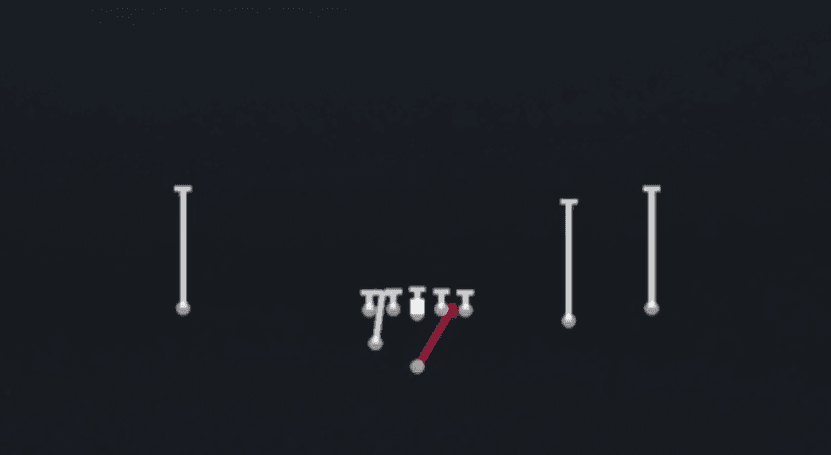


Find plays by concept, not by formation
Search every playbook by tag and personnel grouping, not just Balanced Run Offense.
Strengths
- Singleback depth (152 plays across 9 sets) lets you run Power, Play Action and quick passes from nearly identical alignments, so a defense cannot key personnel or formation to guess run or pass.
- Seven personnel groups, from 23 heavy to 10 with four wideouts, let you force substitution mismatches: go 22 or 23 to pull nickel defenders off the field, then hurry to 11 or 10 in Shotgun to catch base defense in coverage.
- Rare Full House (only 9 of 236 playbooks) and Wildcat (only 15 of 236) looks create unfamiliar run fits, and most opponents will not have a prepared blitz or user plan against a triple back backfield or direct snap.
- The fullback heavy family of I Form, Weak I and Strong I (90 plays combined) gives you lead blocking to either side, letting you pick the strength of the formation pre snap and flip run direction with a formation sub instead of a new playbook.
- Play Action, Block and Release and Swing concepts are layered on top of the run sets, so once a user defender starts crashing the box you can hot route a back or tight end into the vacated flat or seam from the same look.
Weaknesses
- Only 117 Shotgun plays and 3 Hail Mary plays leave the book thinner than true spread schemes on third and long, so a defense that gets you behind the chains can sit in deep zone and dare you to execute.
- The 10 personnel group is present but it is not the identity here, which limits empty and four wide spacing for players who want to spread the field and isolate a slot matchup.
- Concepts lean on Slant, Flat, Crosser, Deep Cross and Post Corner, with few pure vertical shot concepts listed, so disciplined Cover 3 or Cover 4 defenders can cap the top without fearing four verticals.
- Heavy looks like Full House, Goal Line Offense and Strong I carry small play counts (12, 9 and 18), so an opponent who sees them can load the box and expect run with limited pass counters available in those sets.
- Wildcat has only 3 plays in 1 set, so it works as a surprise call rather than a package, and repeated use becomes easy to key.
Usage Tips
Build your base audible package around Singleback: keep a Power Run, a Play Action shot and a Slant or Flat quick game in the same set so you can check between them on first and 10 based on box count.
On second and short or third and 1, sub into I Form or Weak I and call a lead run like FB Dive or a Power concept; if the defense stacks the box, audible to a Block and Release or Swing play action from the same formation.
On third and 6 or longer, move to Shotgun and lean on Deep Cross, Crosser and Post Corner combos, hot routing the back to a flat or swing against man blitzes.
Use Pistol on early downs when you want run action with more pass protection depth, pairing a downhill run with a play action Crosser to hit the middle after linebackers bite.
Save Full House and Wildcat for red zone and short yardage surprises, and use Goal Line Offense with 23 personnel inside the 3, mixing in a play action flat to punish crashing edge defenders.
Formations in this playbook
 Ace Double Wing232 RB · 3 TE · 0 WR8 in book
 Ace121 RB · 2 TE · 2 WR24 in book
 Ace Slot121 RB · 2 TE · 2 WR15 in book
 Wing Slot121 RB · 2 TE · 2 WR15 in book
 Doubles111 RB · 1 TE · 3 WR18 in book
 Doubles Flex111 RB · 1 TE · 3 WR21 in book
 Trips111 RB · 1 TE · 3 WR18 in book
 Y Off Trio111 RB · 1 TE · 3 WR12 in book
 Y Trips111 RB · 1 TE · 3 WR21 in book
Upgrade to Playbooks Rookie
- Filter every play by tag and concept
- Personnel groupings
- Premium play analysis