Playbooks
Scheme Playbook
Pistol Offense
SchemeOffenseOverview
The Pistol Offense playbook is about as single-minded as a Madden scheme book gets. Of its 371 plays, 359 (97%) come out of the Pistol formation across 28 sets, with the remaining snaps split between one Goal Line Offense set (9 plays) and two Hail Mary sets (3 plays). There is no Shotgun, Singleback or I Form. Every normal down is played with the quarterback at pistol depth and the back directly behind him, so the run and play action looks are built on the same foundation every snap.
What keeps that concentration from being predictable is personnel range. Those 28 Pistol sets span eight personnel groups, from 23 and 22 heavy looks and a rare 30 grouping (three backs, two receivers) down to 11 and 10 spread packages with three or four wideouts. The concept list backs this up: Play Action, Block and Release, Motion, and a quick game of Drag, Crosser, Flat, Slant, Hitch and Spot, topped off with Post shots and dedicated Cover 3 Beater calls. Plays like FB Dive and 494 F Flat show the book using its backs as both downhill runners and flat-route receivers.
Choose the Pistol Offense over a more balanced book if you want one formation family that you can learn completely, with defenses forced to guess personnel instead of formation. You get a downhill run game with a pro-style feel, play action off the same backfield alignment, and enough 10 and 11 personnel to spread out on third down without ever leaving the pistol.
Scheme Fit
The Pistol Offense playbook wants a physical, downhill running back, a fullback or second back who can catch in the flat, and at least one tight end who can block and then release, backed by an offensive line that wins at the point of attack. A quarterback with good short accuracy and play action throwing is enough, since the book leans on quick game and fakes more than scrambling. Pick it if you like a run-first, personnel-heavy game plan and want to master one formation deeply instead of juggling several.
Example Plays from this Playbook


Find plays by concept, not by formation
Search every playbook by tag and personnel grouping, not just Pistol Offense.
Strengths
- Nearly every call comes from the same Pistol alignment, so run, play action and quick game all share one pre-snap picture. That makes reading your tendencies much harder than in books that sort run and pass by formation.
- Eight personnel groups inside 28 Pistol sets let you keep one formation while forcing the CPU or a human opponent into substitution guesses. Running 23 or 30 personnel against a nickel sub and then jumping to 10 personnel against base defense creates mismatches with no change in formation.
- The rare 30 and 20 personnel sets put two or three backs on the field in a pistol look. FB Dive style runs and 494 F Flat style throws to the fullback punish linebackers who fill hard.
- The concept spread includes Drag, Crosser, Slant, Flat and Spot for quick game, plus a dedicated Cover 3 Beater tag and Post shots. That gives you answers to both man and zone without leaving the pistol, and it keeps hot routes as tweaks instead of full rebuilds.
- Block and Release and Motion concepts let tight ends and backs chip before leaking out, which buys time against nano blitz pressure while still putting a checkdown in the flat.
Weaknesses
- With 97% of plays out of the Pistol, there is no Shotgun or under center counterpart. Opponents who study the book know the QB depth and back alignment on every snap and can tune their run fits and play action reads around that one look.
- Goal Line Offense has only 9 plays in a single set. Short yardage inside the five gets thin fast, and a smart defender will sit on your few heavy calls, so you will often end up in heavy Pistol sets instead.
- Hail Mary offers just 3 plays across 2 sets. End of half desperation options are limited, so plan to use your clock earlier instead of relying on a deep jump ball package.
- The listed concepts lean toward quick game, play action and Cover 3 Beater calls, with no dedicated man beater tag in the data. Against heavy press man you will need hot routes, like slants and drags from the concept list, instead of built-in answers.
- Because the backfield never changes depth, play action fakes all look alike. Once a user-controlled defender stops biting on the run fake, the Post and Crosser shots lose much of their leverage.
Usage Tips
Build your base audible package around the Pistol 12 and 21 personnel sets on first and 10. They give you a real run threat plus Play Action Post and Crosser shots from the same alignment, which keeps defenses in base.
On third and 3 or shorter, go to the heavy Pistol 23, 22 or 30 personnel sets and call FB Dive style runs or 494 F Flat. Save the single Goal Line Offense set for inside the 3 so its 9 plays do not become predictable.
On third and 6 or longer, audible into the Pistol 10 or 11 personnel sets. Pair Drag, Slant and Spot concepts against man, and call the Cover 3 Beater plays when you see a single high safety with deep thirds.
Use Motion pre-snap in the Pistol 11 and 20 sets to diagnose coverage: if a defender follows across, it is man, so hot route a slant or drag. If defenders only bump, it is zone, so stay with the Cover 3 Beater or Hitch concepts.
Keep one of the two Hail Mary sets in your end-of-half plan, but do not waste timeouts to set it up. The book only has 3 Hail Mary plays, so the quick Hitch and Flat calls from Pistol 10 are often the better way to reach field goal range.
Formations in this playbook
 Full House303 RB · 0 TE · 2 WR12 in book
 Weak I Wing222 RB · 2 TE · 1 WR9 in book
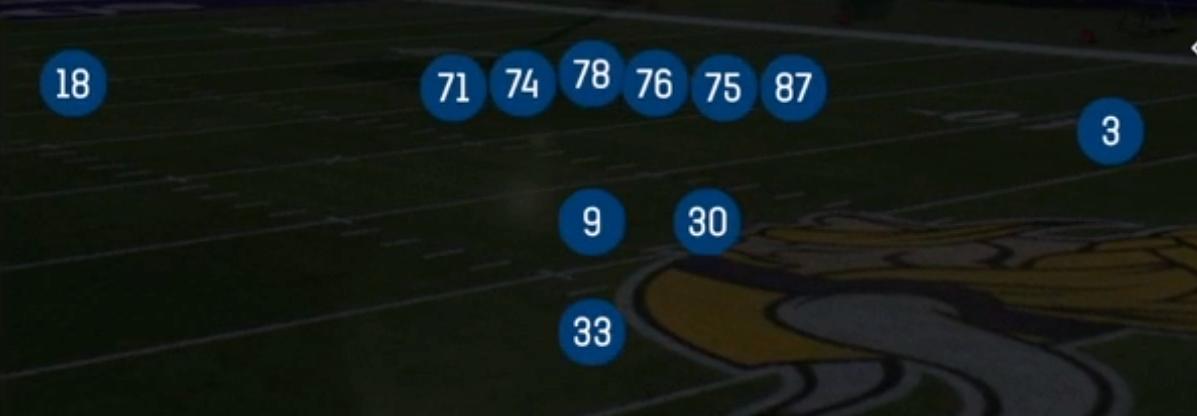 Strong212 RB · 1 TE · 2 WR15 in book
 Strong Slot212 RB · 1 TE · 2 WR12 in book
 Weak212 RB · 1 TE · 2 WR9 in book
 Weak Slot212 RB · 1 TE · 2 WR12 in book
 Strong Slot Open202 RB · 0 TE · 3 WR15 in book
 Weak Slot Open202 RB · 0 TE · 3 WR12 in book
 Ace121 RB · 2 TE · 2 WR12 in book
 Ace Slot121 RB · 2 TE · 2 WR17 in book
 U Off121 RB · 2 TE · 2 WR12 in book
 U Off Trips121 RB · 2 TE · 2 WR15 in book
 Wing121 RB · 2 TE · 2 WR18 in book
 Wing Slot121 RB · 2 TE · 2 WR15 in book
 Bunch111 RB · 1 TE · 3 WR12 in book
 Bunch TE111 RB · 1 TE · 3 WR12 in book
 Bunch X Nasty111 RB · 1 TE · 3 WR6 in book
 Doubles111 RB · 1 TE · 3 WR18 in book
 Doubles Flex Hip111 RB · 1 TE · 3 WR9 in book
 Doubles Y Off111 RB · 1 TE · 3 WR9 in book
 Open Flex111 RB · 1 TE · 3 WR9 in book
 Open Flex Close111 RB · 1 TE · 3 WR9 in book
 Tight Slots111 RB · 1 TE · 3 WR12 in book
 Trips111 RB · 1 TE · 3 WR15 in book
 Y Off Trips111 RB · 1 TE · 3 WR15 in book
 Y Trips111 RB · 1 TE · 3 WR15 in book
 Spread101 RB · 0 TE · 4 WR15 in book
 Trips Left Open101 RB · 0 TE · 4 WR18 in book
Upgrade to Playbooks Rookie
- Filter every play by tag and concept
- Personnel groupings
- Premium play analysis