Playbooks

Quick Reference
Breakdown
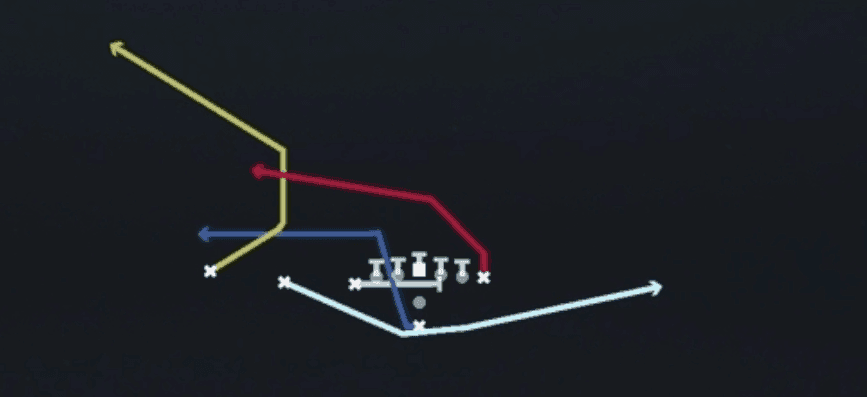
Inside Zone Split is a straightforward zone run play out of Pistol U Off Trips, using 12 personnel to keep two tight ends attached for extra double team power at the point of attack. The offensive line executes a standard inside zone blocking scheme, working double teams at the second level and climbing to linebackers based on the defensive front, while the HB reads the block flow from the RB alignment behind the QB. The two trips receivers and slot are not shown running routes here, since this is purely a run-blocking design, and the primary read progression is the HB reading the frontside double team first, then bending to the backside cutback lane if the frontside is clogged.
Defensive Reads
Pre-snap, identify whether the defense is in a base 4-3 or 3-4 front and check linebacker depth, since shallow linebackers crashing downhill get gashed by the cutback. Watch safety alignment for run support rotation, especially if a safety cheats into the box pre-snap indicating run blitz or run commit coverage. Post-snap, key the defensive line's gap integrity and any user-controlled defenders shooting gaps, since a disciplined 3-technique or nose that holds ground can blow up the frontside double team. This run beats light boxes and zone flow defenses that overcommit to one side, but it struggles against gap-sound defenses and heavy run blitz packages that get penetration before the double teams can climb. Look for backside linebackers flowing too fast, which opens the cutback lane as your best answer against aggressive flow defense.
Usage Tips
Run this on early downs like first and second and short to medium yardage situations where defenses often sit in base fronts. Check the box count pre-snap and if the defense has stacked the box with 7 or more defenders, consider audibling to a play-action or RPO instead. Use the cutback lane against defenses that overpursue with fast flowing linebackers, since inside zone naturally sets up backside cuts. Pair this play with RPO Zone Alert Flat or RPO Alert Flat from the same set to keep defenses honest on the perimeter without changing your formation, forcing linebackers to respect both the run and the quick flat throw. Mix in HB Slam or HB Dive from this set as a tempo changer so defenders cannot key on zone blocking angles every snap.
Other Plays in U Off Trips
 DBL PostPost, Double Posts, Pass Play +4
 HB CounterCounter, Run Play, Power Run
 HB DiveDive, Run Play
 HB SlamDive, Run Play
 HB Slip ScreenScreen Pass, Hb Screen, Pass Play +2
 HB StretchOutside Zone, Run Play, Zone Run
 HB Zone WkInside Zone, Run Play, Zone Run
 Jet Lead Read OptionRead Option, Motion, Run Play
 Jet PA BootPlay Action, Motion, Pass Play +5
 Jet Touch PassMotion, Pass Play
 Orbit HB Split ZoneMotion, Inside Zone, Run Play +1
 Orbit PA CrossPlay Action, Motion, Pass Play +5
 Orbit PA DBL CrossPlay Action, Motion, Pass Play +4
 Orbit Triple OptionTriple Option, Motion, Run Play
 PA BootPlay Action, Pass Play, Block and Release +3
 PA Boot OverPlay Action, Pass Play, Block and Release +3
 PA Corner DigPlay Action, Dig, Corner +2
 PA FL ClownPlay Action, Pass Play, Corner +3
 PA Slot OutPlay Action, Out, Pass Play +2
 PA Y CornerPlay Action, Corner, Pass Play +4
 Quick SlantsSlant, Pass Play, Flat
 Read OptionRead Option, Run Play
 RPO Alert FlatRPO, Flat, Pass Play +1
- RPO Zone Alert FlatRPO, Flat, Pass Play +1
 ShockMotion, Hitch, Stick +3
 StickStick, Stick Concept, Pass Play +3
 Strong PowerPower, Run Play, Power Run
- Switch FloodPost, Drag, Crosser +4
 TE CrossCrosser, Pass Play, Deep Cross +2