Playbooks

Quick Reference
Breakdown
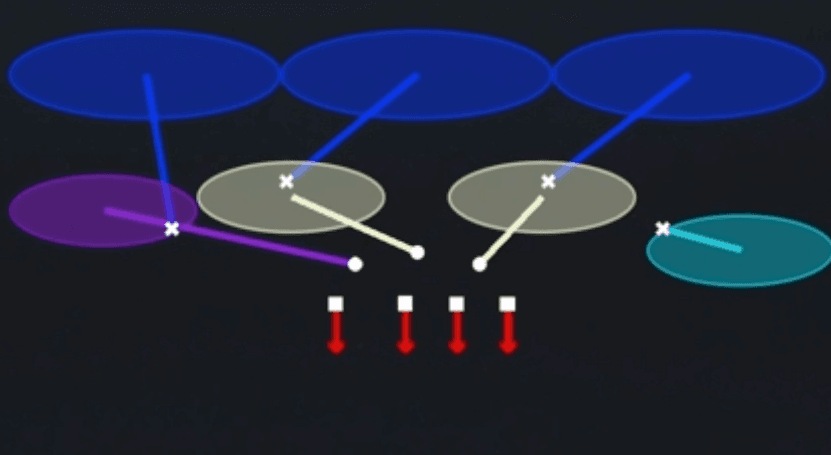
Cover 4 Quarters out of the 4-3 Over Base personnel is a four deep zone shell with the two corners and two safeties splitting the field into quarters while the underneath defenders sink into their zone drops. The diagram shows both corners bailing deep with the outside receivers while the two safeties rotate to the deep middle quarters, and the linebackers show flat and hook drops underneath to wall off crossers and shallow routes. This is a zone defense built to take away deep shots and vertical stretches from four wide receiver sets, forcing quarterbacks to check down into congested underneath zones. Against man beating route combos this shell can get stressed if the four verts stretch it horizontally, so the primary defensive read progression is deep quarters first, then react to any receiver who breaks off their vertical stem into the underneath zones.
Defensive Reads
Pre-snap, check safety depth and width since quarters coverage relies on both safeties being aligned deep enough to gain outside leverage on vertical routes from the number two receiver. Watch cornerback alignment, if they are playing off with outside leverage they are reading run first and pass second, which tips the quarters shell. Post-snap, key the number two receiver's release, if he breaks vertical the safety to that side should widen and play over the top, if he breaks in or out the safety can rob underneath. This coverage is vulnerable to man beater combos like slant flat or spot concepts that attack the underneath zones quickly before the deep defenders can react. It is also stressed by four verticals from 2x2 sets since the safeties have to make a leverage decision on the seam routes, so watch for user lurk defenders sitting in the seams to bait quarterbacks into throwing into a trap.
Usage Tips
Call this play on early downs or in situations where you expect the offense to test the deep middle since the two safeties account for four verts and any post or seam routes. Pre-snap, identify if the offense is running a 2x2 or 3x1 formation, and if it is 3x1 be ready to slide your strength to the trips side to avoid a natural vertical stretch conflict. Use your user-controlled defender to jump the most dangerous underneath route, typically a drag or dig, since the zone drops beneath it are the soft spot of this coverage. Pair this call with Cover 3 Sky or Cover 2 Hard Flat in your play-calling sequence so offenses cannot key your safety rotation from split alignment. Avoid calling this on third and short since the underneath zones can be exploited by quick game route combos that settle in the soft spots between the linebackers.
Other Plays in Over
 Cover 1 ContainCover 1, Contain, Man Coverage
 Cover 1 HoleCover 1, Cover 1 Hole, Man Coverage
 Cover 1 Hole PressCover 1, Cover 1 Hole, Press Man +1
 Cover 1 Robber PressCover 1, Cover 1 Robber, Press Man +1
 Cover 1 Sting WKCover 1, Line Stunt, Man Coverage
 Cover 2 Hard FlatCover 2, Zone Coverage
 Cover 2 ManCover 2 Man, Man To Man, Man Coverage
 Cover 3 Cloud PressCover 3, Cover 3 Cloud, Zone Coverage
 Cover 3 SkyCover 3, Cover 3 Sky, Zone Coverage
- Cover 4 PalmsCover 4, Cover 4 Palms, Zone Coverage
 Cover 6Cover 6, Zone Coverage
 Dbl Safety BlitzBlitz, Safety Blitz
 Free FireBlitz
- Free Fire 3Cover 3, Blitz, Zone Coverage
 Olb Fire ManMan To Man, Blitz, LB Blitz +1
 Press QuartersQuarters, Cover 4, Zone Coverage
 Sam Edge 3Cover 3, Zone Coverage
- Scene 44-3 DefenseRun Stop
 Tampa 2Cover 2, Tampa 2, Zone Coverage
 Thunder SmokeBlitz, Safety Blitz