Playbooks
Scheme Playbook
4-3 Defense
SchemeDefenseOverview
The 4-3 Defense playbook is a 226-play generic scheme book that carries a traditional four-man front into a modern, sub-package heavy structure. Despite the base-front name, the book leans hardest on Nickel, which accounts for 93 plays (41%) across 4 sets. Base 4-3 is a distant second at 48 plays (21%) across its own 4 sets. Add Dime (33 plays, 15%) and the single-set 4-2-5 (24 plays, 11%), and more than two thirds of the book is built to match three-receiver and spread personnel while keeping four down linemen as the pass rush engine.
The coverage menu is broad: Cover 1, Cover 2, Cover 3, Cover 4, Quarters, Cover 6, Cover 9 and Trap Coverage, plus LB Blitz, Safety Blitz and general Blitz pressure. That lets you disguise rotation from the same Nickel or 4-3 alignment, moving from rolled Cover 3 into a trap or split-field Cover 6 without changing personnel. Plays like 2 Invert Hard Flat, 3 Deep Blitz, 1 LB Dog and Casino Blitz show the range: invert and hard-flat zone looks on one end, and simulated or true pressure from the second level on the other.
Pick the 4-3 Defense over a thinner or more niche front if you want one book that covers nearly every personnel grouping your opponent can show. Eight personnel groups are represented, from Big Nickel 4-2-5 and Nickel 3-3-5 through 6-2-3 goal line and Big Quarter 3-1-7 prevent. It is larger than 80% of the game's defensive scheme playbooks. The result is a coverage-first, four-man-rush game plan with enough blitz and short-yardage depth to survive full games against varied offenses.
Scheme Fit
The 4-3 Defense playbook wants four disruptive down linemen who can win without extra rushers, a fast weakside linebacker who can carry seams, and at least three quality safeties plus a slot corner with high zone coverage and play recognition to power the Nickel and 4-2-5 packages. It suits players who like to user a safety or linebacker, disguise coverage from a single shell, and blitz selectively rather than every down. If your roster is built on edge speed and deep secondary depth rather than big run-stuffing linebackers, this book fits.
Example Plays from this Playbook


Find plays by concept, not by formation
Search every playbook by tag and personnel grouping, not just 4-3 Defense.
Strengths
- Nickel depth at 93 plays across 4 sets means you can match 11 personnel all game from one alignment family and still rotate Cover 3, Cover 4, Cover 6, Cover 9 and trap looks. Opponents struggle to read the shell pre-snap.
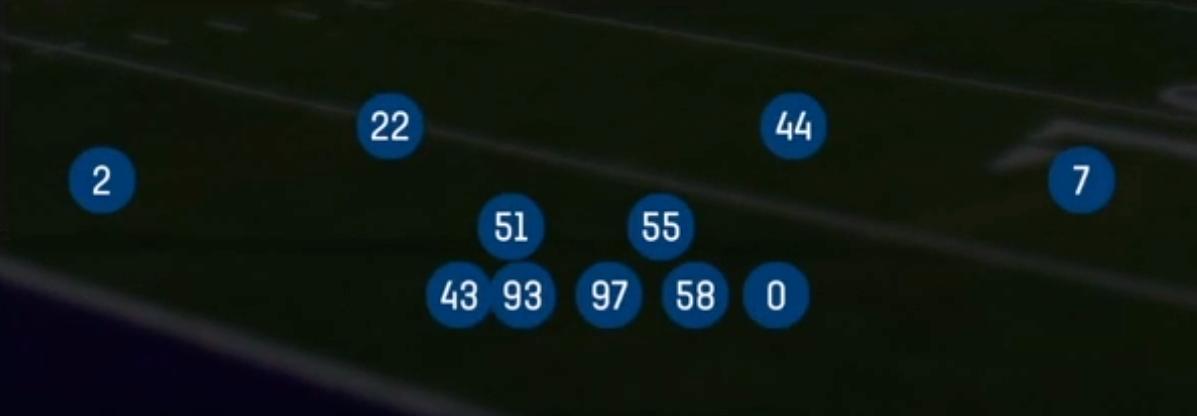
- The 4-2-5 set (24 plays, Big Nickel 4-2-5) gives you a third safety on the field against 12 personnel and spread-out tight ends. You keep run fit integrity without dropping back to base, which blunts formation subs designed to get a linebacker matched on a tight end.
- Nickel 3-3-5 personnel inside the book lets you show a three-man front with an extra stand-up rusher, then use LB Blitz and Safety Blitz calls to vary where the fourth and fifth rusher come from. That makes your protection-check reads harder to solve.
- Dime at 33 plays across 2 sets gives legitimate third-and-long answers with six defensive backs. You can play Cover 1 or Quarters with speed at every level instead of forcing linebackers into deep zone drops against empty and trips.
- Goal Line Defense has 3 sets and 13 plays, including 6-2-3 personnel, which is more short-yardage variety than many sub-heavy books. You can shift between heavy fronts inside the five without tipping the same look every snap.
Weaknesses
- Base 4-3 is only 21% of the book, so against teams that live in 21 and 22 personnel you have fewer true base run fits than a front-heavy playbook. Smart opponents will stay heavy to pull you out of your deep Nickel menu.
- The 4-4 formation is a single set with only 9 plays, so your eight-man box answers are thin. Downhill run offenses and QB power looks will see the same few 4-4 calls repeated once they force you into it.
- Prevent is one set with 6 plays in Big Quarter 3-1-7, leaving very little variety for end-of-half situations. Opponents running hurry-up Hail Mary or sideline shots can key on the limited drop patterns.
- The book leans on zone families and the only man coverage concept listed is Cover 1. Opponents who beat single-high with mesh, drive or pick concepts will see the same man structure, so you need user reps and hot route disguises rather than more man calls.
- With 41% of the book in Nickel, your nickel corner and two linebackers are on the field most snaps. Offenses can attack them with motion and bunch releases, and the book's tendency toward lighter personnel invites RPOs and inside zone against a six-man box.
Usage Tips
Build your base audible package inside Nickel: pair a Cover 3 look like 2 Invert Hard Flat with a pressure call like 3 Deep Blitz or Casino Blitz and a Cover 6 or Quarters check. That covers first-and-10 and second-and-medium without leaving the formation.
On first down against 12 or 21 personnel, check into the 4-2-5 Big Nickel set to keep three safeties. Use its rotation to spin late between hard-flat Cover 3 and Cover 4, and user the rover safety in the curl flat to kill quick outs and RPO slants.
On third-and-7 or longer, go to Dime and use Cover 1 with a spy or zone blitz. Against empty and trips, show a two-high shell and rotate to Cover 9 or trap coverage at the snap to bait throws into the flat.
Save base 4-3 and the 1 LB Dog pressure for second-and-short and third-and-3 or less. Stunt the defensive line and pinch the ends to force runs back inside to your linebackers.
Inside the 5-yard line, move to Goal Line Defense and alternate between its 3 sets, including 6-2-3. Keep the single 4-4 set as a change-up only on fourth-and-inches so opponents do not see it enough to set up a play-action counter.
Formations in this playbook


Upgrade to Playbooks Rookie
- Filter every play by tag and concept
- Personnel groupings
- Premium play analysis