Playbooks

Quick Reference
Breakdown
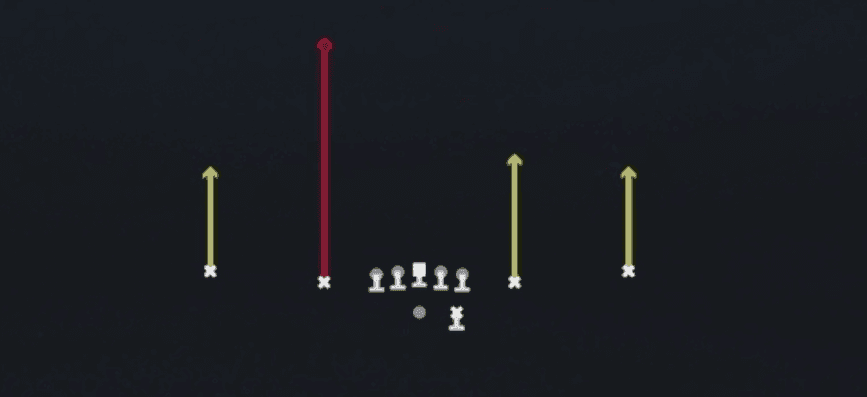
Inside Zone out of Shotgun Spread Slots Close with 10 personnel is a pure zone run play with no receiver routes drawn, four wide receivers releasing vertically upfield to occupy defensive backs while the offensive line executes a zone blocking scheme across the formation. The HB takes the handoff and reads the play side double team, pressing the line of scrimmage before cutting off the flow of the blockers. Primary read progression is backside to frontside: the ball carrier presses the initial hole, reads the play side double team block, and works to the cutback lane if the frontside gap is clogged.
Defensive Reads
Pre-snap, check linebacker depth and alignment: stacked or crashed linebackers signal a run blitz that can beat inside zone before the double team forms. Identify single high safety shells (Cover 1 or Cover 3) since these often leave light boxes vulnerable to inside zone if the linebackers do not fill gaps fast. Watch for user-controlled defensive linemen shooting gaps pre-snap, as a diagnosed nano blitz or A gap shoot can blow up the play before the double team engages. Post-snap, key the play side linebacker's flow: if he overruns the play side gap, cut the run back against the grain for a big gap. Cover 4 or Cover 6 shells with safeties sitting close to the line and quick linebacker fills tend to shut this run down, so avoid forcing it into a stacked box.
Usage Tips
Run this play when the defense shows light boxes with six or fewer defenders inside the tackles, since the four vertical releases pull safeties and corners away from run support.
Use pre-snap motion or a WR shift to check if you are facing man coverage, because if defenders follow your slots vertically it confirms man and opens up cutback lanes against a light box.
Hot route one of the outside receivers into a quick screen or leave them on their vertical release to hold the corner and prevent immediate safety rotation into the box.
Pair this with 45 Quick Base or RNS Y Stick from the same set so the defense has to respect both the quick passing game and the inside run, keeping linebackers honest on their run fits.
Best used on early downs (first and ten, second and short) when defenses are more likely to sit in base fronts instead of stacking the box for run support.
Other Plays in Spread Slots Close
 0 1 TrapTrap, Run Play, Power Run
 45 Quick BaseDive, Run Play
 90 Y ShallowShallow Cross, Pass Play, Drag +4
 90 Z ShallowShallow Cross, Pass Play, Drag +4
 HB DrawDraw, Run Play
 HB Middle ScreenScreen Pass, Hb Screen, Pass Play +5
 Read OptionRead Option, Run Play
 RNS 590 NebraskaPass Play, Flood, Go +7
 RNS 590 TexasTexas, Texas Concept, Pass Play +6
 RNS 590 Z ReplacePass Play, Seam, Flat +7
 RNS 60 Z ReadPass Play, Quick Pass, Go +7
 RNS 90 Replace Y StickStick, Stick Concept, Pass Play +3
 RNS HitchesPass Play, Block and Release, Option Route +1
 RNS Rip 60 Go SwapGo, Pass Play, Post +3
 RNS Rip 60 Z SlideSlide, Pass Play, Bubble Screen +3
 RNS Rip 61 ChoiceOption Route, Pass Play, Drag +2
 RNS StreakStreak, Pass Play, Option Route
 RNS Switch SmashSmash, Pass Play, Cover 2 Beater +4
 RNS Switch StreakStreak, Pass Play, Post +2
 RNS Y StickStick, Stick Concept, Pass Play +5
- TrapTrap, Run Play, Power Run