Playbooks

Quick Reference
In 46 playbooks
Breakdown
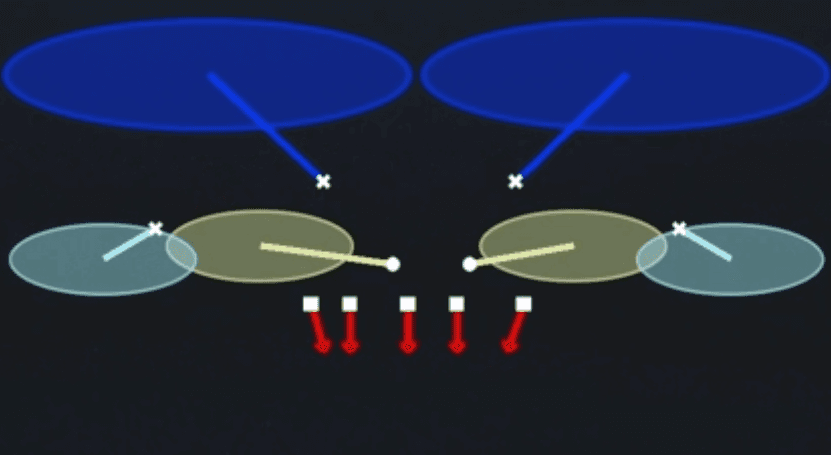
Sting Pinch is a defensive line stunt out of the 3-4 Over Base 5-2 personnel that pinches the interior rush lanes to collapse the pocket from the inside out. The diagram shows all five down linemen crashing downhill with the two interior rushers looping and crossing paths directly over the center to confuse blocking assignments, while the two off-ball linebackers stay in coverage responsibility underneath. This is a run stop and interior pressure package, not a coverage beater, designed to blow up gap runs and force quick, inaccurate throws by collapsing the pocket before the QB can step up.
Defensive Reads
Pre-snap, check the offensive line splits and running back alignment since a tight formation with the back in a downhill position signals inside run, which is exactly what this stunt is built to stop. Watch the center and guard hand placement at the snap, if they are already leaning to one side the pinch stunt can cross them up and create an unblocked rusher. Post-snap, key the fullback or lead blocker path, if he climbs to the second level immediately that tells you the play is designed for the exact gaps this stunt is attacking. This beats zone run schemes and gap runs that rely on double teams up front since the crossing linemen destroy blocking angles. This gets exposed by outside zone and stretch runs that get width quickly, along with quick game passing concepts like slants and stick that get the ball out before the pinch develops.
Usage Tips
Call this out of Over 3-4 on early downs when you expect inside zone or gap runs since the pinch action closes rush lanes and stacks blockers at the point of attack.
Use this on short yardage and third and short to bait interior run fits while still generating pressure if the offense checks to a pass.
Pair Sting Pinch with Cover 3 Hard Flat or Cover 3 Sky in the same set so your linebacker drops stay disguised and the offense cannot key the stunt from linebacker depth alone.
User the middle linebacker after the snap to read blocking down schemes and be ready to fill any cutback lane the pinch action opens up on the backside.
Avoid calling this against heavy shotgun spread sets that rely on quick game passing, since the stunt takes an extra half second to develop and can be picked up by a sliding protection.
Other Plays in Over
 Cover 1 HoleCover 1, Cover 1 Hole, Man Coverage
 Cover 2 InvertCover 2, Inverted Coverage, Zone Coverage
 Cover 2 Invert Hard FlatCover 2, Inverted Coverage, Zone Coverage
 Cover 3 Buzz MikeCover 3, Cover 3 Buzz, Zone Coverage
 Cover 3 Hard FlatCover 3, Zone Coverage
 Cover 3 MatchCover 3, Cover 3 Match, Zone Coverage
 Cover 3 SkyCover 3, Cover 3 Sky, Zone Coverage
 Cover 4 QuartersCover 4, Quarters, Zone Coverage
 Cover 6 PressCover 6, Zone Coverage
 Olb Fire 2Cover 2, Blitz, LB Blitz +1
 Saw Blitz 1Cover 1, Blitz, Man Coverage
 SS 2 TrapCover 2, Trap Coverage, Zone Coverage
 SS Blitz 1Cover 1, Blitz, Safety Blitz +1
 Trio Sky ZoneZone, Zone Coverage