Playbooks

Overview
Chargers Defense and NFL Live Chargers Defense are effectively the same playbook. They share all 368 plays and differ by zero sets, so every call, formation and audible package you build in one carries straight over to the other. Pick whichever cut your mode offers and your prep stays valid.
At 368 plays across 8 formations and 25 sets, Chargers Defense is larger than 63% of the game's 64 defensive team playbooks. Almost all of that depth sits in sub packages. Nickel carries 163 plays (44%) across 9 sets and Dime adds 87 plays (24%) across 4 sets, so more than two thirds of the book is five and six defensive back looks. The 3-4 is the only other meaningful chunk at 66 plays (18%) across 5 sets. The Nickel 2-4-5 set (18 plays) gives you a third sub package option with two down linemen and four linebackers, and Goal Line Defense, 46, 4-3 and Prevent together make up about 10% of the book.
This is a coverage-first playbook built to match spread offenses with extra defensive backs and then disguise from those shells. The concept list runs from Cover 0 and Cover 1 man pressure through Cover 2, Cover 3, Cover 3 Match, Cover 4, Quarters and Trap Coverage, with blitz and line stunt calls layered on top. That supports a game plan where you stay in Nickel or Dime on most downs, rotate the shell post-snap, and pick your spots to send pressure from the same personnel. The 3-4 is your answer when the offense goes heavy.
Scheme Fit
Chargers Defense wants a deep, athletic secondary: at least three quality corners with man coverage ratings, a hybrid safety who can play slot or box, and linebackers with enough speed to handle Nickel 2-4-5 and Dime assignments. Up front it favors edge rushers who fit an odd front in the 3-4 and can win one on one in sub packages, rather than a roster built around a classic 4-3 front. It suits a player who likes to stay in sub packages, disguise coverage and dial up pressure selectively, not someone who wants to line up heavy and trade blows with the run game.
Example Plays from this Playbook


Find plays by concept, not by formation
Search every playbook by tag and personnel grouping, not just Chargers Defense.
Strengths
- Nickel depth is the headline: 163 plays across 9 sets means you can stay in five defensive back personnel against 11 and 10 personnel and still carry man, zone, match, trap and pressure calls without subbing, so the offense reads the same pre-snap look every snap.
- The Nickel 2-4-5 set adds 18 plays with four linebackers on the field, which lets you keep a sub package structure against 12 personnel or RPO-heavy offenses instead of dropping to base and giving up speed on the perimeter.
- Dime at 87 plays across 4 sets, spread over multiple Dime 4-1-6 and Big Dime (1-4-6, 3-2-6, 4-1-6) groupings, gives you a real third down menu, so you can swap safeties for corners or add a hybrid linebacker body through formation subs based on what the offense runs out.
- The coverage menu covers Cover 0, Cover 1, Cover 3 Match, Quarters, Cover 4 and Trap Coverage, so you can set up a man beater read with Cover 1 Hole or Cover 1 Contain and then punish the same route combo with a trap or match call from an identical alignment.
- The 3-4 carries 66 plays across 5 sets, including Base 3-4 and Base 5-2 personnel, which gives you a legitimate odd front for pressure packages and edge pinch or stunt calls when you need to overload a side.
Weaknesses
- The 4-3 has only 6 plays in 1 set, so if your roster is built around four down linemen and a traditional MIKE you have almost nothing to call from an even base front and will be forced into the 3-4 or Nickel.
- The 46 carries just 9 plays in 1 set, so your heavy run stuffing identity is thin. Offenses that pound 21 or 22 personnel between the tackles will see the same handful of calls quickly.
- With 68% of the book in Nickel and Dime, a patient power run offense can stay heavy and test your light boxes. Your main counter is the 3-4, which means an opponent can key on personnel to know you are in odd front run defense.
- Goal Line Defense has only 13 plays across 3 sets and Prevent only 6 plays in 1 set, so short yardage and end of half situations offer limited variety and experienced opponents can script against them.
- Because the book is so heavily weighted toward sub packages, your pressure disguises mostly come from the same few shells, and an opponent who reads safety rotation well can catch Cover 0 and Cover 1 looks before the snap.
Usage Tips
Build your base audible package around Nickel: carry one Cover 1 man call such as Cover 1 Hole, one Cover 3 Match or Quarters call, one Trap Coverage call and one blitz, then use this Nickel menu on first and second down against 11 personnel without ever subbing.
On 3rd and 6 or longer, jump to Dime and choose between Dime 4-1-6 and the Big Dime groupings based on the offense's receiver count, pairing a Cover 0 or Cover 1 pressure with a Cover 4 or Quarters drop so the pre-snap picture stays the same.
When the offense shows 12 personnel or leans on RPOs, reach for the Nickel 2-4-5 set to keep an extra linebacker in the box while holding sub package speed, and user the flat defender to take away quick outs.
Against 21 or 22 personnel on 1st and 10 or 2nd and short, move to the 3-4 and use Base 5-2 personnel with a line stunt or edge pinch call to clog interior gaps, saving the 46 for one or two surprise snaps instead of a steady diet.
Inside the 5 and on 3rd or 4th and 1, use the 3 Goal Line Defense sets and mix man and pressure calls, then flip to the Prevent set only in true end of half situations since that single set gives you minimal disguise.
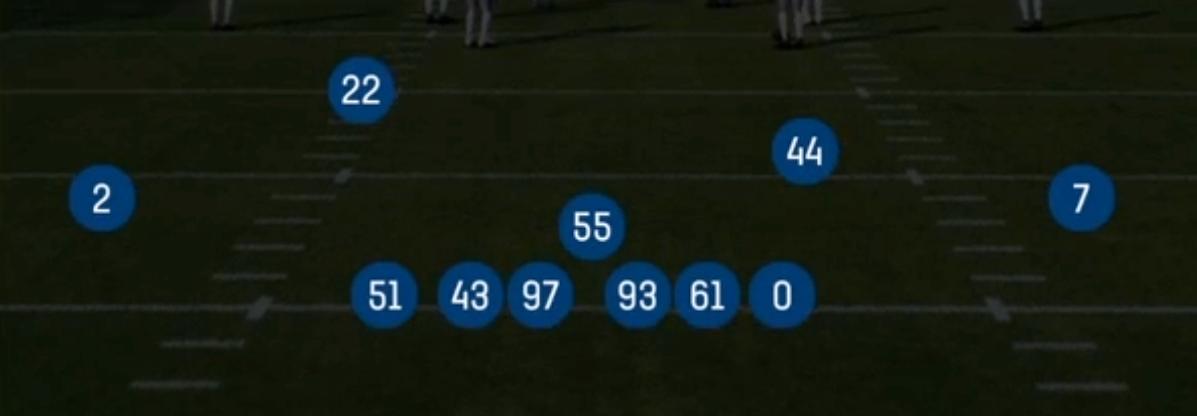
Formations in this playbook
Upgrade to Playbooks Rookie
- Filter every play by tag and concept
- Personnel groupings
- Premium play analysis