Team Hub

AFC West
Los Angeles Chargers
Team Snapshot
The Los Angeles Chargers enter 2026-2027 as a rising, Justin Herbert-led contender coming off back-to-back 11-6 seasons and playoff berths under head coach Jim Harbaugh, but still chasing the franchise's first Super Bowl title and trying to end two straight first-round playoff exits, with a modernized offense under new coordinator Mike McDaniel meant to better protect Herbert.
Franchise Difficulty
How hard this franchise is to run well: where the team stands, what the roster gives you, what the cap allows, and what you hold in the draft.
A franchise-ready quarterback in Justin Herbert, elite bookend tackles in Slater and Alt, $45.1M in cap room ranked 3rd in the league, and a young core with Superstar and Star dev traits make this roster forgiving to manage despite glaring holes at guard, linebacker, and defensive tackle.
Star Players
Scheme Fit
The schemes this team is set to run in-game, and how its roster grades in them.
- Multiple Zone RunoffensivePassable
- Base 3-4defensiveGood
Salary Cap
With $45.1M in cap room ranked 3rd in the league and a near-clean cap at rank 27 in dead money, the Chargers have the financial firepower to attack multiple needs in one offseason.
24 contracts expiring
Depth Chart
Madden Tools Analysis
Five starting spots have weak depth behind the starter.
Biggest gaps behind a starter
- REDGE
- DT
- MIKE
- QB
- FS
Draft Capital
Six picks this draft including five in the first five rounds, plus three first-rounders over the next three years, give the Chargers genuine resources to reload even while spending aggressively in free agency.
- Acquired: Round 7 from Jets, next draft
- Acquired: Round 7 from Rams, this draft
- Traded away: Round 7 to Lions, this draft
- Traded away: Round 6 to Saints, this draft
Team Ratings
The roster's top strength is its pair of elite bookend offensive tackles in Rashawn Slater (92 overall) and Joe Alt (86 overall), while the interior offensive line, featuring guards ranked near the bottom of the league, is its most glaring weakness.
Strengths
- RT
- SS
- C
- LT
- REDGE
Weak spots
- DT
- HB
- LEDGE
- LG
- MIKE
Offense
Defense
Special teams
Roster Needs
- DThigh
The interior defensive line is a critical weakness, ranking 28th in starter quality and 22nd in depth, with Teair Tart leading a thin group.
- HBhigh
Omarion Hampton is a promising 23-year-old starter, but the position ranks 28th at the starter level, signaling he needs support or development quickly.
- LEDGEhigh
Akheem Mesidor starts at left edge but the position ranks 24th in starter quality and a troubling 27th in depth, making it a top offseason priority.
- LGhigh
Trevor Penning starts at left guard but the position ranks 29th in starter quality, leaving a significant gap on what should be a strength offensive line.
- MIKEhigh
Denzel Perryman starts at middle linebacker but is entering the final stage of his career, and the position ranks 27th in starter quality and 25th in depth.
- RGhigh
Cole Strange holds the starting right guard spot but the position ranks 28th in starter quality, creating an interior line that is weak on both sides.
- TEmedium
Oronde Gadsden starts ahead of David Njoku at tight end, and while depth ranks 6th, the starter quality at 25th leaves room for a significant upgrade.
- CBlow
Donte Jackson leads the corner room with Tarheeb Still behind him, and though the group ranks 20th at the starter level, depth is a relative strength at 9th.
- WRlow
Ladd McConkey and Quentin Johnston give Herbert capable options, but the group ranks 21st in starter quality, leaving room to add a true difference-maker.
Cut Candidates
5-Year Outlook
The Chargers are built around Justin Herbert and one of the league's best offensive line foundations in Rashawn Slater and Joe Alt, giving the franchise a legitimate contention window. Ladd McConkey's Superstar development trajectory at receiver and Omarion Hampton's Star potential at running back give Herbert weapons that should grow alongside him. On defense, Derwin James Jr. remains the centerpiece of the secondary but is entering the late stage of his career, making it important to develop Genesis Smith behind him sooner rather than later. Khalil Mack continues to anchor the right edge, though he is among the oldest players at his position and cannot be counted on as a long-term fixture. The biggest obstacles to a Super Bowl run are the interior offensive line, the interior defensive line, and the middle linebacker spot, all of which rank near the bottom of the league. With $45.1M in current cap room ranked 3rd in the league and $77.2M projected next year, the Chargers have the financial runway to address multiple holes through free agency while continuing to develop their young core into a complete contender.
5-Year Plan
Year 1Patch the trenches, clear the clutter
- Release Bud Dupree, Trey Lance, DJ Uiagalelei, Kayode Awosika, and Hayden Rucci to recover over $7M in cap savings and free roster spots for upgrades.
- Use the $45.1M in cap room, ranked 3rd in the league, to sign free-agent starters at left guard, middle linebacker, and defensive tackle to address the team's three highest-severity needs.
- Lean on the six current draft picks, spread across rounds 1 through 7, to add developmental competition at LEDGE and RG, where depth ranks near the bottom of the league.
Year 2Grow the young core
- Feature Omarion Hampton as the clear lead back and allow his Star dev trait to develop behind a rebuilt interior offensive line.
- Expand Ladd McConkey's role as the Superstar receiver of the offense and push Quentin Johnston, also a Star dev trait, toward a true complementary threat opposite him.
- Tuli Tuipulotu, a 23-year-old Star dev trait at LEDGE, should be developed into the starter at his position to replace the departed Dupree and relieve pressure on Akheem Mesidor.
Year 3Lock in the contention window
- With $202.7M in committed salary two seasons out, evaluate contract extensions for Joe Alt and Tarheeb Still before they price up, locking in two Star-dev cornerstones long term.
- Develop Akheem Mesidor and Tuli Tuipulotu into a starting edge-rush tandem capable of replacing Khalil Mack's production as he nears the end of his playing days.
- Begin investing in a long-term replacement for Denzel Perryman at middle linebacker, where the position currently ranks near the bottom of the league in starter quality.
Year 4Build the complete roster
- With committed salary dropping to $138.3M three seasons out, leverage the financial flexibility to address any remaining roster holes through free agency or extension negotiations.
- Establish Genesis Smith as the heir apparent to Derwin James Jr. at strong safety, ensuring the defense does not experience a drop-off at its most important secondary position.
- With three first-round picks accumulated over the three-year window, prioritize any remaining starter-level gaps at DT or interior offensive line to build a roster capable of a deep playoff run.
Year 5Win now with Justin Herbert
- Herbert will be entering the prime years of his career as a Superstar quarterback, and the rebuilt roster around him should be targeting a Super Bowl, not a rebuild.
- Ensure the offensive line remains elite by protecting investments in Rashawn Slater and Joe Alt, the two pillars that give Herbert the time to operate any scheme.
- Transition defensive leadership to the developed young core of Tarheeb Still, Cam Hart, and Tuli Tuipulotu as the aging veterans from the current roster phase out of starting roles.
Young core
Full Roster
| Player | Pos | OVR | Age | Dev |
|---|---|---|---|---|
| Age 30 | SS | 93 | 30 |  |
| Age 27 | LT | 92 | 27 |  |
| Age 23 | RT | 86 | 23 |  |
| Age 35 | REDGE | 86 | 35 | |
| Age 28 | QB | 84 | 28 | |
| Age 24 | WR | 84 | 24 | |
| Age 26 | K | 82 | 26 |  |
| Age 30 | CB | 82 | 30 | |
| Age 23 | HB | 81 | 23 | |
| Age 26 | WILL | 81 | 26 | |
| Age 34 | SS | 81 | 34 | |
| Age 24 | CB | 81 | 24 | |
Franchise History
The Chargers were founded on August 14, 1959, and began play September 10, 1960, as a charter member of the American Football League, owned by hotel heir Barron Hilton. They played their inaugural 1960 season in Los Angeles at the Memorial Coliseum, going 10-4 under coach Sid Gillman and reaching the first AFL Championship Game (a 24-16 loss to the Houston Oilers). Poor attendance prompted a move to San Diego in 1961, where the team remained for 56 years. In San Diego, Gillman's high-scoring vertical passing game made the Chargers one of the AFL's glamour teams; they reached five of the first six AFL title games and won the franchise's only league championship on January 5, 1964, routing the Boston Patriots 51-10 behind stars like Lance Alworth, John Hadl, Ron Mix, Paul Lowe and Keith Lincoln. The Chargers joined the NFL in the 1970 AFL-NFL merger. The next golden era came with Don Coryell's 1978 arrival and the "Air Coryell" offense quarterbacked by Hall of Famer Dan Fouts, as San Diego led the NFL in passing for six straight years (1978-1983), won three straight AFC West titles (1979-1981) and reached two AFC Championship Games, producing the legendary "Epic in Miami" playoff win. The team's lone Super Bowl appearance came after the 1994 season under coach Bobby Ross and QB Stan Humphries, a 49-26 loss to the San Francisco 49ers in Super Bowl XXIX. The 2000s brought the LaDainian Tomlinson-Philip Rivers-Antonio Gates era, headlined by Tomlinson's record-setting 2006 MVP campaign. After a stadium dispute, owner Dean Spanos returned the franchise to Los Angeles for 2017, playing in Carson through 2019 before moving into SoFi Stadium in Inglewood in 2020. Across 67 seasons (1960-2026) the franchise holds an all-time regular-season record of 505-501-11, one league championship (1963 AFL), and eight players plus one coach in the Pro Football Hall of Fame.
Notable figures
 LaDainian Tomlinson · Running back (2001-2009)
Considered one of the greatest RBs ever; 2006 NFL MVP, set the single-season TD record (31); franchise's all-time leader in rushing yards (12,490) and rushing TDs (138); Hall of Fame 2017.
Photo: U.S. Navy, public domain (Wikimedia Commons)
 Philip Rivers · Quarterback (2004-2019)
Iron-man franchise QB; the Chargers' all-time leader in passing yards (59,271) and passing TDs (397); eight-time Pro Bowler.
Photo: Jeffrey Beall, CC BY 4.0 (Wikimedia Commons)
 Justin Herbert · Quarterback (2020-present)
2020 Offensive Rookie of the Year and current franchise cornerstone; the player the Harbaugh era is built around.
Photo: All-Pro Reels, CC BY-SA 2.0 (Wikimedia Commons)
 Junior Seau · Linebacker (1990-2002)
Hometown (Oceanside) icon and heart of the 1990s defense; a 12-time Pro Bowler and franchise tackles leader; Hall of Fame 2015 (posthumous).
Photo: JJ Hall, CC BY 2.0 (Wikimedia Commons)
 Dan Fouts · Quarterback (1973-1987)
Engine of "Air Coryell"; first player to throw for 4,000 yards in three straight seasons; second all-time in franchise passing yards (43,040); Hall of Fame 1993.
Photo: Marketcom, public domain (Wikimedia Commons)
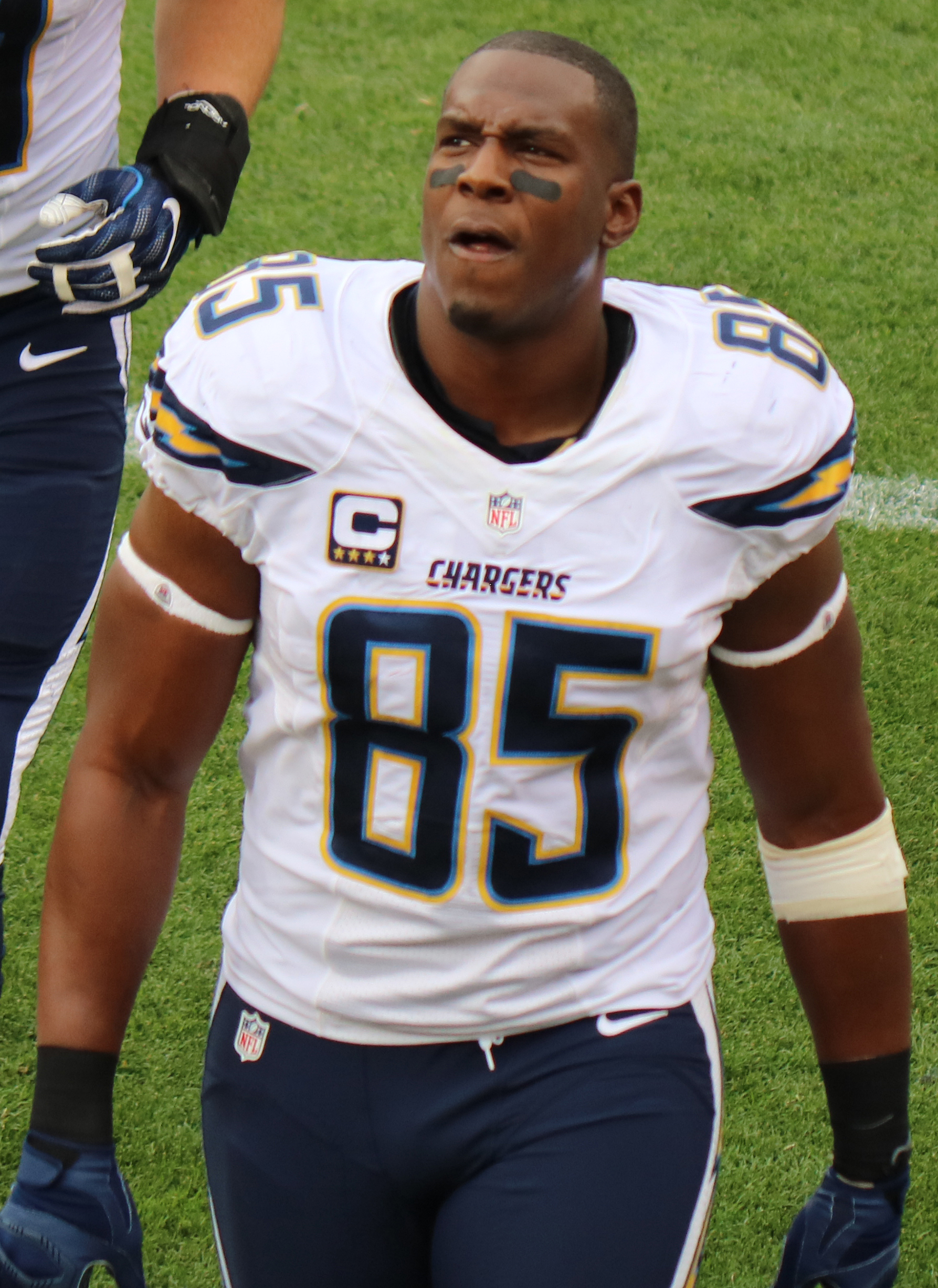 Antonio Gates · Tight end (2003-2018)
Undrafted former college basketball player who became the franchise's all-time leader in receiving yards (11,841) and receiving TDs (116); a revolutionary pass-catching tight end.
Photo: Jeffrey Beall, CC BY 4.0 (Wikimedia Commons)
 Lance Alworth · Wide receiver (1962-1970)
"Bambi"; the first AFL player elected to the Pro Football Hall of Fame (1978); deep threat of the 1963 championship team; 10,266 receiving yards.
Photo: public domain (Wikimedia Commons)
- Kellen Winslow · Tight end (1979-1987)
Revolutionary "joker" tight end of Air Coryell; central figure of the "Epic in Miami" (blocked a late field goal, then was carried off the field in exhaustion); Hall of Fame 1995.
 Sid Gillman · Head coach (1960-1969, 1971)
Founding coach and offensive innovator; winningest coach in franchise history (87-57-6 including playoffs); led the 1963 AFL title team; Hall of Fame 1983.
Photo: public domain (Wikimedia Commons)
Record book
- Passing yardsPhilip Rivers (59,271)
- Passing TDsPhilip Rivers (397)
- Rushing yardsLaDainian Tomlinson (12,490)
- Rushing TDsLaDainian Tomlinson (138)
- Receiving yardsAntonio Gates (11,841)
- Receiving TDsAntonio Gates (116)
- ReceptionsKeenan Allen (985)
- SacksLeslie O'Neal (105.5)
- InterceptionsGill Byrd (42)
- PointsJohn Carney (1,076)
Team Tips
Playing As
Win with defense and a physical run game paired with elite quarterback play from Justin Herbert. The 2024 defense finished 1st in the NFL in points allowed per game (17.7), was 5th in defensive EPA per play, and led the league in red-zone defense. Under new OC Mike McDaniel, install a YAC-oriented, outside-zone, timing-based passing scheme to get the ball out of Herbert's hands faster and lean on young playmakers like WR Ladd McConkey, WR Quentin Johnston and RB Omarion Hampton. Run efficiently, protect Herbert better, generate explosive plays, and let the defense keep games low-scoring.
Playing Against
The Chargers' persistent weakness is the offensive line, especially the interior. Herbert was sacked 54 times in the 2025 regular season (about 3.4 per game) behind an injury-ravaged line. Pressure up the middle to force Herbert off his spot and disrupt timing. The team overhauled its interior line in 2026 (adding center Tyler Biadasz and guard Cole Strange), but questions at guard remain, and the defense faces a transition after losing coordinator Jesse Minter to the Ravens.

Coaching · Jim Harbaugh
Enters his third season in 2026 (hired January 24, 2024). A proven winner at every level, a Super Bowl appearance with the 49ers and a national championship at Michigan, Harbaugh has led the Chargers to back-to-back 11-6 records and playoff berths in his first two seasons (a wild-card loss to Houston after 2024, and a 16-3 wild-card loss to New England on Jan. 11, 2026, after 2025). His philosophy centers on physical, run-heavy, defense-first football and culture-building; he is one of only two people in NFL history (with Norm Van Brocklin) to win 60+ games as both a starting quarterback and a head coach. Mike McDaniel replaced the fired Greg Roman as offensive coordinator, and Chris O'Leary replaced Jesse Minter as defensive coordinator.
Photo: Eric Upchurch, CC BY-SA 4.0 (Wikimedia Commons)
Coming soon
- Playbook Matches
- Key Plays & Audibles
Upgrade to Team Hub Rookie
- Salary cap breakdown
- Depth chart analysis
- Roster needs & scheme fit
- Cut candidates & 5-year outlook
- Full sortable roster