Playbooks

Overview
The NFL Live Packers Defense playbook is functionally the same book as Packers Defense. Both cuts share all 377 plays and differ by 0 sets, so your audibles, practice reps and pressure packages carry over between them. Pick whichever one your mode or menu surfaces; there is no hidden coverage or front that one has and the other lacks.
The book is built to play in sub packages. Nickel (139 plays, 37%, 7 sets) and Dime (87 plays, 23%, 4 sets) make up 60% of the book, so the default posture is five or six defensive backs matched against spread and 11 personnel. The personnel list backs that up: Big Nickel 4-2-5 and 5-1-5, Nickel 4-2-5 and 5-1-5, and four Dime looks ranging from Big Dime 1-4-6 to Dime 4-1-6. Behind that sits a real 3-4 layer (63 plays, 17%, 5 sets including Base 3-4 and Base 5-2) and a 3-3-5 package (45 plays, 12%, 3 sets) for odd-front pressure. It closes with a single-set Nickel 2-4-5 look, Goal Line Defense (13 plays across 3 sets), and thin Base 4-3 and Big Quarter 3-1-7 Prevent pages at 6 plays each.
At 377 plays it is larger than 73% of the game's 64 defensive team playbooks. Most of that depth sits in the DB-heavy formations. The concept list mixes Cover 1 and Cover 3 Match man-match with Cover 3, Cover 4 and Quarters zone, and adds Double Wr1 and Double Wr2 brackets plus corner and LB blitzes. That supports a game plan of disguising pressure and coverage out of Nickel and Dime, and taking away the opponent's best receiver with bracket calls. You shift into the 3-4 or 3-3-5 only when you need a heavier front or odd-front pressure.
Scheme Fit
The NFL Live Packers Defense playbook wants a deep secondary: at least three man-capable corners and a slot defender who can survive in Cover 1. It also needs rangy safeties for the Quarters and Cover 3 Match rotations and a pair of edge rushers who can win without help, since most snaps come from Nickel and Dime. It suits the competitive player who likes to user a safety or linebacker, disguise pressure from sub packages, and bracket the opponent's best receiver, rather than someone who wants to line up in a traditional 4-3 base and play downhill against the run.
Example Plays from this Playbook


Find plays by concept, not by formation
Search every playbook by tag and personnel grouping, not just NFL Live Packers Defense.
Strengths
- Nickel alone carries 139 plays across 7 sets, so you can stay in one sub package against 11 personnel and still rotate between Big Nickel 4-2-5, Big Nickel 5-1-5, Nickel 5-1-5 and Nickel 4-2-5 fronts without the offense reading your call from the formation.
- The Dime layer (87 plays, 4 sets) runs from Big Dime 1-4-6 to Dime 4-1-6, so on passing downs you can pick between a light-box coverage shell and a heavier Big Dime 3-2-6 without subbing out of your six-DB personnel.
- Double Wr1 and Double Wr2 bracket concepts sit alongside Cover 1, Cover 3 Match and Quarters, which lets you take away a single elite receiver or slot threat and still pick a man or zone shell.
- The 3-4 (63 plays) and 3-3-5 (45 plays) pages give this book a real odd-front pressure layer on top of its sub packages. You can show a Base 5-2 or 3-3-5 look, then use LB Blitz and Corner Blitz calls to overload the protection.
- At 377 plays and 25 sets, the book is deep enough to build separate audible packages for early downs, third down and the red zone without repeating the same coverage shell two snaps in a row.
Weaknesses
- Base 4-3 is only 6 plays in one set, so players who want a traditional four-down base front against 21 and 12 personnel have almost no menu and end up forced into the 3-4 or Big Nickel.
- Goal Line Defense has just 13 plays, and Big Quarter 3-1-7 Prevent has only 6. Opponents who spam heavy short-yardage sets or late-half Hail Marys will quickly see you repeat the same handful of calls.
- With 60% of the book in Nickel and Dime, an opponent who lines up in heavy personnel and runs downhill can pull you into light boxes. Staying in sub packages means giving up gap integrity against power run schemes.
- The listed concepts lean on Cover 1, Cover 3 and Quarters families with no Cover 2 or Cover 6 tagged. That makes it harder to squat on flat routes with a two-high, flat-sitting shell against quick game and smash-type concepts.
- The 2-4-5 is a single 18-play set. It works as a change-up, but calling it on consecutive snaps shows your hand because there is only one alignment to show.
Usage Tips
Build your core audible package around Nickel, specifically Big Nickel 4-2-5 and Nickel 5-1-5. On 1st and 10 against 11 personnel, keep Cover 1 Hole and Cover 3 Match calls ready so you can flip between man and match coverage out of the same look.
On 3rd and 6 or longer, jump to Dime 4-1-6 or Big Dime 3-2-6. Pair a Double Wr1 bracket on their top target with a user-controlled safety or linebacker in the middle hole.
When the offense comes out in 12 or 21 personnel on early downs, go to Base 3-4 or Base 5-2 in the 3-4 package instead of the thin Base 4-3. 60 Half Out gives you a heavier box without leaving the coverage shell short.
Use the 3-3-5 on 2nd and medium or 3rd and short to pass as a coverage look. Then call 3 Deep Blitz or an LB Blitz to bring five while the Cover 3 rotation still protects the deep thirds.
Inside the 5, lean on the 6-2-3 Goal Line pages with 1 Edge Pinch to squeeze the edges. Save the Big Quarter 3-1-7 Prevent only for true last-play situations, since you have just 6 calls there.
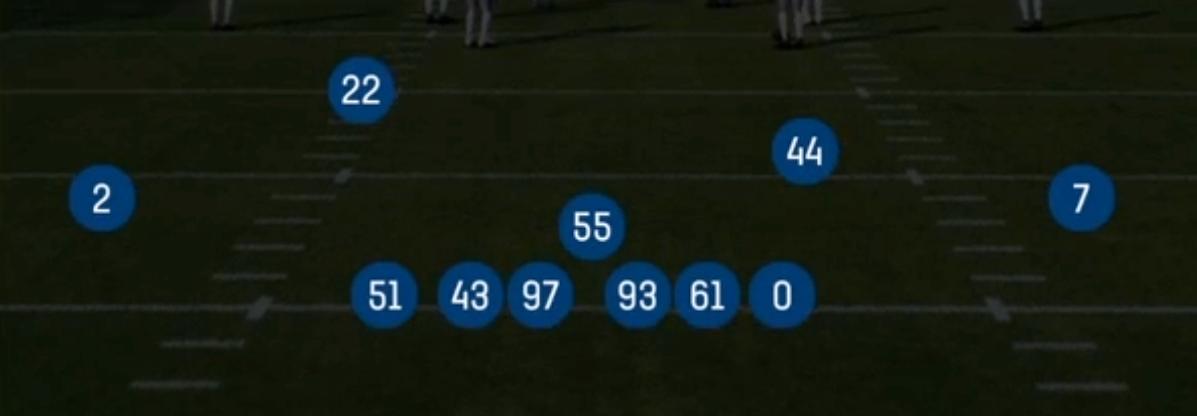
Formations in this playbook
Upgrade to Playbooks Rookie
- Filter every play by tag and concept
- Personnel groupings
- Premium play analysis