Playbooks

Overview
Packers Defense and NFL Live Packers Defense are functionally the same playbook. They share all 377 plays and differ by 0 sets, so every formation, set, and coverage call you learn here carries over directly to the sibling cut. Choose between them on preference alone, not on content. At 377 plays across 8 formations and 25 sets, the Packers Defense playbook is larger than 73% of the game's 64 defensive team playbooks, which gives you more disguise and audible depth than most team books.
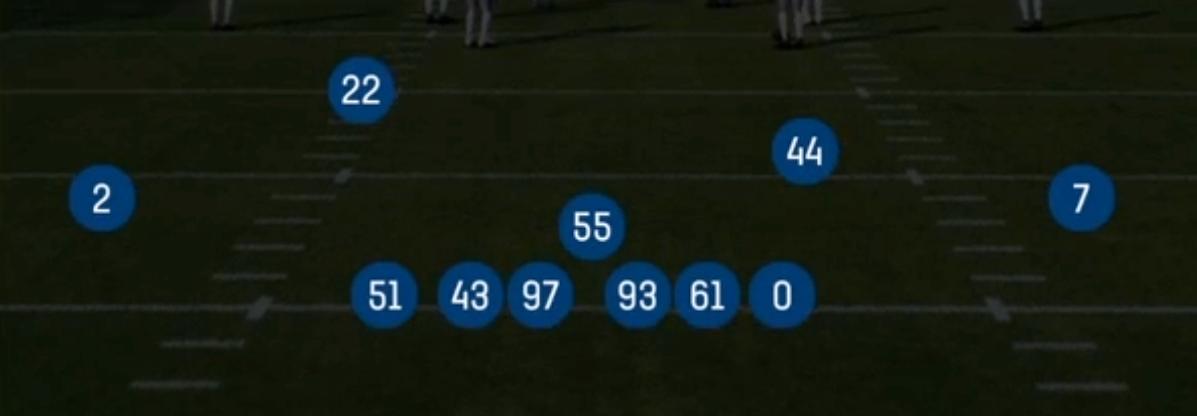
The identity is sub-package defense. Nickel carries 139 plays (37%) across 7 sets and Dime adds 87 plays (23%) across 4 sets, so 60% of the book puts five or more defensive backs on the field. The 3-4 is the base front at 63 plays (17%) across 5 sets. The 3-3-5 adds 45 plays (12%) across 3 sets and the 2-4-5 adds 18 plays in a single set, so the book has plenty of odd-front and light-box looks. Goal Line Defense (13 plays), 4-3 (6 plays), and Prevent (6 plays) are situational pieces rather than foundations.
The concept list covers Cover 1, Cover 3, Cover 3 Match, Cover 4 and Quarters, plus Double Wr1 and Double Wr2 bracket calls and a mix of LB Blitz and Corner Blitz pressure. That supports a game plan of living in Nickel and Dime against spread offenses and rotating between single-high man, match zone, and quarters from the same looks. Plays like Cover 1 Hole, 3 Deep Blitz, 3 Double Buzz and 1 Edge Pinch show the range. You can bracket an opponent's best receiver, bring five from disguised shells, or sit in Cover 3 Match without changing personnel.
Scheme Fit
The Packers Defense playbook wants a secondary-first roster: at least three cornerbacks who can hold up in man and press, a rangy free safety you can user in Cover 1 Hole and Cover 3 Match, and a slot defender versatile enough to blitz off the edge. Up front it rewards a disruptive interior lineman and two edge rushers who can win one-on-one out of odd fronts, because the book leans on five- and six-DB personnel rather than heavy boxes. Pick it if you face spread passing offenses, like to disguise coverage and user a safety, and are comfortable giving up some base run defense depth.
Example Plays from this Playbook


Find plays by concept, not by formation
Search every playbook by tag and personnel grouping, not just Packers Defense.
Strengths
- Deep sub-package menu: 226 combined Nickel and Dime plays across 11 sets let you match 11 and 10 personnel all game without repeating a set, and the Big Nickel 4-2-5, Big Nickel 5-1-5, Nickel 5-1-5 and Nickel 4-2-5 personnel groups let you adjust box weight while keeping the same coverage shell.
- Double Wr1 and Double Wr2 bracket calls live in the high-volume Nickel and Dime sets, so you can take away a single elite receiver on third down and still show the same pre-snap alignment you use for Cover 3 Match and Quarters.
- Odd-front pressure variety: the 3-4 (5 sets), 3-3-5 (3 sets) and 2-4-5 give you three distinct looks for LB Blitz and Corner Blitz calls, which makes it harder for opponents to set protection slides or hot route away from your nano blitz.
- Coverage disguise from one shell: Cover 1, Cover 3, Cover 3 Match, Cover 4 and Quarters are spread across the same formations, so a user-controlled safety can rotate late and the offense cannot read the call from alignment alone.
- Multiple Big Dime personnel groups (1-4-6, 3-2-6, 4-1-6) plus Big Quarter 3-1-7 give you true passing-down shells that still carry a linebacker or extra body against draws and screens.
Weaknesses
- Only 6 plays in the 4-3 and 63 in the 3-4 means under a quarter of the book is built for base personnel, so opponents who line up in heavy 12, 21 or 22 personnel force you into lighter fronts or a thin menu of base calls.
- Goal Line Defense has just 13 plays across 3 sets, so a short-yardage offense that keeps pounding inside the five will see you repeat calls quickly, and a good player will pick up on your tendencies.
- The 2-4-5 is a single set with 18 plays, so it is easy to scout. If you lean on it, opponents can pre-set hot routes or audibles for that alignment.
- Prevent carries only 6 plays, which limits end-of-half and end-of-game options and pushes you back into Dime for most two-minute situations.
- The concept tags focus on single-high, match and quarters looks with no Cover 2 listed, so offenses that attack the seams and flats against three-deep structures (flood and smash combos) can press on the same coverage rules repeatedly.
Usage Tips
Build your base audible package in Nickel: keep a Cover 3 Match call, a Quarters call, and a Cover 1 Hole with a user in the hole on first and second down against 11 personnel, and use the 7 Nickel sets to swap alignment without changing coverage family.
On 3rd and 5 or longer, go to Dime and call Double Wr1 or Double Wr2 to bracket the offense's top target, then use Big Dime 4-1-6 or Big Dime 3-2-6 personnel if the offense has shown draws or screens on passing downs.
When you need pressure on 2nd and long or 3rd and medium, go to the 3-3-5 or 3-4 sets for LB Blitz and Corner Blitz calls like 1 Edge Pinch, and show the same look with 3 Deep Blitz or 3 Double Buzz to keep protections guessing.
Against heavy personnel on early downs, sub into the 3-4 or the Base 5-2 front rather than staying in Nickel, and save the 6-play 4-3 set for obvious run downs so the offense does not see it often enough to scout.
Inside the 5, rotate across all 3 Goal Line Defense sets and mix in Big Nickel 5-1-5 so a short-yardage offense cannot key on a single alignment. Save Prevent's 6 plays for true Hail Mary situations and use Dime in the rest of your two-minute defense.
Formations in this playbook
Upgrade to Playbooks Rookie
- Filter every play by tag and concept
- Personnel groupings
- Premium play analysis