Playbooks
Full House
OffenseExample Plays from Full House

Overview
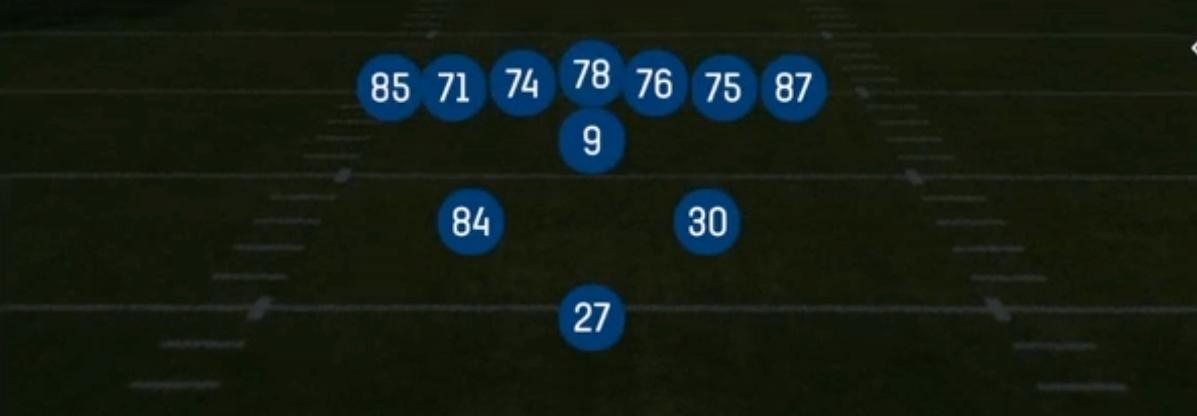
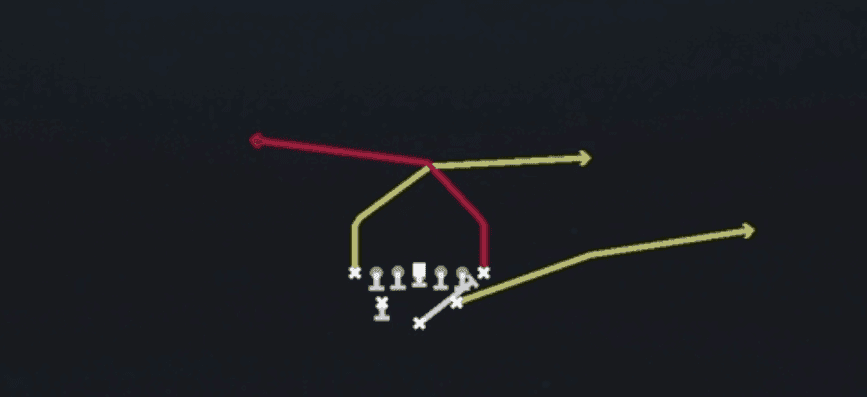
Full House puts the quarterback under center with three backs in the backfield, typically two offset or split backs flanking the QB in a T alignment and a tailback stacked deep behind him. In Full House Tight, 32 personnel removes every wideout: two tight ends sit in tight to the formation and the surface is compressed, so all 11 defenders have to account for downhill gaps. Full House Normal and Normal Wide use 21 personnel to add receivers outside. The Normal Wide set pushes those receivers toward the numbers to stretch the defense horizontally and pull defenders out of the box.
The core philosophy is numbers-based power football. With multiple lead blockers available on either side of the ball, you create a numerical advantage at the point of attack that the defense can only match by walking safeties into the box. Every backfield player can be a lead blocker, a ball carrier, or a leak route in the flat, so the pre-snap picture hides the play's true direction. This makes Full House lethal for iso, power, dive, and toss concepts, and it forces defenses to commit heavy personnel like Goal Line or 4-4 packages.
Once the defense sells out to the run, Full House turns into a play-action weapon. Safeties crashing downhill leave seams and corner routes open, and backs leaking into the flat get matched up on slow linebackers or isolated against a single deep defender. The Normal Wide set can isolate a WR one on one outside when the defense brings an extra man into the box. That matchup rewards a quick fade or stop route audible.
At a Glance
Full House is built for power run and smashmouth ground-and-pound schemes that rely on gap blocking, lead blockers, and play-action shots off heavy run looks. It fits play-callers who want to win the line of scrimmage and control the clock, using rosters with a strong run-blocking offensive line, a physical fullback, a bruising halfback, and a reliable tight end. Spread, air raid, and RPO-heavy players will find it limited as a base set, though it works as a short-yardage and red zone package in any system.
Strengths
- Overwhelming numbers at the point of attack, with up to two lead blockers creating extra gaps that single-high looks and base 4-3 fronts struggle to fill
- Elite play-action value, since the heavy run look pulls safeties and hook defenders downhill and opens deep over, corner, and seam routes behind them
- Backfield flexibility disguises intent: backs can lead block, take handoffs, or leak into the flats, making key-reading off play art difficult for user defenders
- The Normal Wide set forces defenses to respect the boundary, letting you isolate a WR on a fade or slant when the defense crowds the box
- Matches up well against goal line and short-yardage defenses, where the extra blockers win the leverage battle on dives and QB sneaks
Weaknesses
- Limited passing distribution: with only zero to two receivers out wide, Cover 0 and heavy man blitzes can blanket every eligible target and force hurried throws
- Predictable run tendency in Full House Tight lets opponents stack the box with Goal Line or 5-2 looks and slant the line to blow up gap schemes
- Play-action timing is slow from under center, so edge nano blitzes and overload pressure off the boundary can get home before deep routes develop
- User-controlled linebackers or a user safety lurking in the flat can jump leak routes and backfield checkdowns, which are the formation's primary quick reads
- Few motion or spread options mean struggles against Cover 4 and quarters shells that keep safeties deep and rally to the ball without guessing
Usage Tips
Deploy Full House on 3rd and short, 4th and 1, and inside the 10, where the extra blockers flip leverage in your favor; save Normal Wide for 1st and 10 to keep the defense honest
Pair every core run with its play-action mirror, running the same play art look so defenders cannot key the difference until the ball is faked
Against Cover 0 or heavy man pressure, hot route a back to a block or set protection with slide adjustments, then audible to a quick slant or fade to the isolated boundary receiver
When the defense crowds the box with safeties at linebacker depth, flip to a play-action rollout toward the TE side and hit the deep corner or crosser behind the vacated zone
Use run commit and blocking adjustments pre-snap by pulling the lead back toward the strength of the defense's shade, and chain dives and tosses in the same drive to exhaust box defenders