Playbooks

Overview
Rams Defense and NFL Live Rams Defense are the same playbook in practice. The NFL Live cut shares all 337 of this book's plays and differs by zero sets, so every audible package, formation sub and install plan you build here carries over without changes. Choose between them on preference or availability, not content. At 337 plays across 9 formations and 22 sets, Rams Defense sits right around the middle of the 64 defensive team playbooks, larger than 48% of them. That size gives you depth without clutter in the play call screen.
This is a sub package book first. Nickel carries 123 plays (36%) across 6 sets and Dime adds 72 plays (21%) across 3 sets, so 57% of the playbook puts five or more defensive backs on the field. The 3-4 is the only true base front with real depth: 63 plays (19%) across 5 sets, including Base 3-4 and Base 5-2 personnel. The 4-3 is almost a token inclusion at 6 plays in a single set. The personnel list runs from Big Nickel 5-1-5 and Nickel 2-4-5 up to Big Dime 4-1-6 and Big Quarter 3-1-7, so you can match offensive personnel without leaving the book's odd and light front identity.
The game plan it supports is coverage flexibility over brute force. The concept list pairs Cover 1, Cover 3, Cover 3 Match, Cover 4 and Quarters with Double Wr1 and Double Wr2 brackets, then layers Blitz, Corner Blitz and LB Blitz pressure on top. Change-up fronts like the 3-3-5 (21 plays) and 2-4-5 (18 plays) muddy protection reads. The ideal user lives in Nickel against spread sets, drops into Dime or Quarter on passing downs, and uses the 3-4 when the offense goes heavy.
Scheme Fit
Rams Defense wants a secondary deep enough to play five or six defensive backs most of the game: a slot corner who can match in man, safeties with range for Quarters and Cover 4, and at least one corner you trust on Corner Blitz. Up front it rewards a disruptive interior lineman and edge players who fit odd fronts, plus a rangy linebacker who can spy or cover in space when Nickel and Dime thin the box. Pick it if you like to match personnel, disguise coverage and play mostly in sub packages, not if you want to line up in a 4-3 and stop the run with bodies.
Example Plays from this Playbook

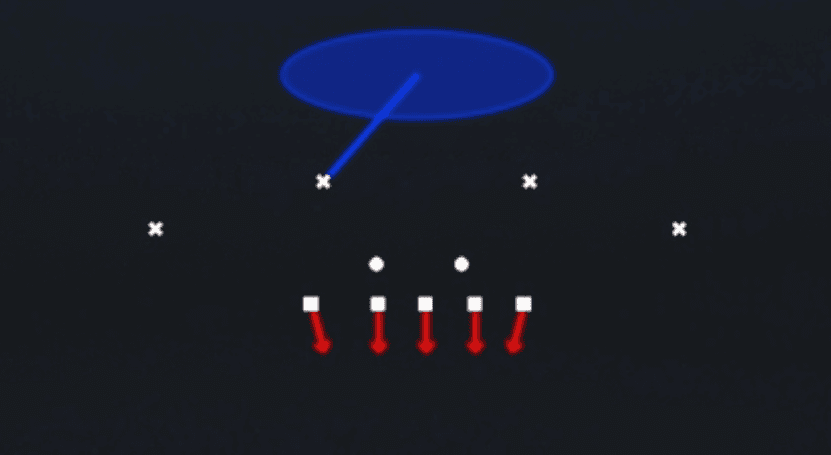


Find plays by concept, not by formation
Search every playbook by tag and personnel grouping, not just Rams Defense.
Strengths
- Nickel depth of 123 plays over 6 sets lets you stay in one personnel grouping against 11 personnel while still rotating between Cover 1, Cover 3 Match, Quarters and blitz looks, so opponents cannot read your call from the substitution screen.
- With 57% of the book in Nickel or Dime, you can match spread and empty offenses snap after snap without subbing out of coverage, which kills the formation-sub mismatches that punish books built around base fronts.
- Double Wr1 and Double Wr2 concepts give you built-in brackets on an opponent's top target, so you do not have to rely on manual shading or user cloud adjustments against one-read passers.
- The 3-3-5 (21 plays) and 2-4-5 (18 plays) are uncommon change-up fronts that disguise rush angles and create confusion for players who slide protection or hot route a back into a block.
- Five 3-4 sets and Base 5-2 personnel give an odd-front answer to heavy personnel, so you can load the edges against 12 and 21 personnel runs without switching to the thin 4-3.
Weaknesses
- The 4-3 is only 6 plays in 1 set, so players who want an even-front base defense have almost nothing to work with and must win run downs out of the 3-4 or Big Nickel.
- With a majority of plays in five and six defensive back looks, a patient opponent running inside zone and power from heavy personnel can test your light boxes if you are slow to sub into the 3-4 or Goal Line Defense.
- The listed concepts include no Cover 2 family, so you lack a traditional two-deep, flat-squatting shell against smash and flood combos and must answer them through Cover 4, Quarters or match coverage.
- Goal Line Defense has just 13 plays spread across 3 sets and Prevent only 6, so short yardage and end-of-half situations offer limited variety that an opponent can learn over a long franchise season.
- Quarter is a single set of 15 plays, so your deepest dime-plus package is easy to scout once an opponent sees it on third and long a few times.
Usage Tips
Build your base audible package in Nickel for first and second down against 11 personnel, keeping one Cover 3 Match call, one Quarters call, one Cover 1 call and one blitz ready so you can adjust after you see the formation.
On third and 7 or longer, sub into Dime and lean on Double Wr1 or Double Wr2 brackets against the opponent's top receiver, then bring a Corner Blitz or LB Blitz when you expect a quick throw to a single read.
When the offense shows 12 or 21 personnel on early downs or third and short, go to the 3-4 sets or Base 5-2 personnel to set the edge rather than trusting a light Nickel box against the run.
Save the 3-3-5 and 2-4-5 for third and medium, since the unusual front alignments give you the most value when the offense must pass and is trying to read your pressure pre snap.
Inside your own 3 yard line switch to Goal Line Defense, and in two minute or end-of-half situations use Quarter and Prevent sparingly, since both are shallow and repeating the same look invites the offense to sit down in the soft spots.
Formations in this playbook
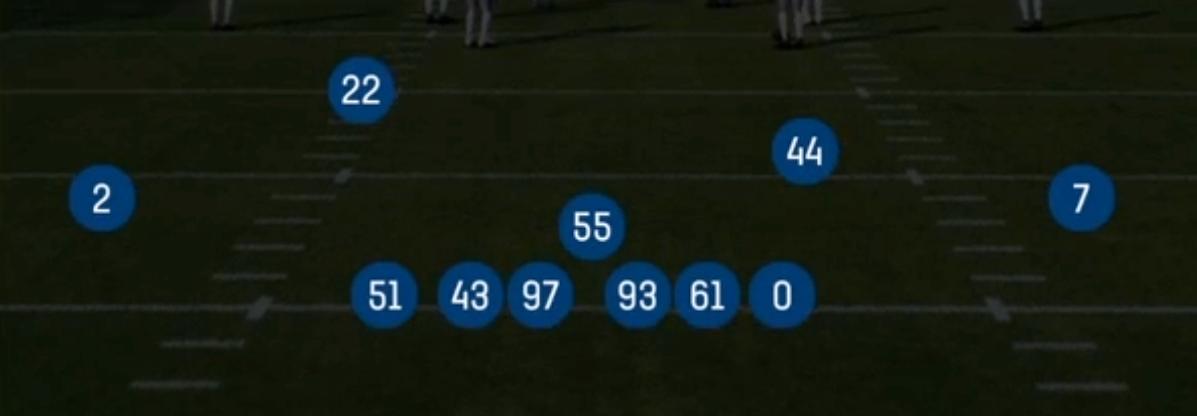
Upgrade to Playbooks Rookie
- Filter every play by tag and concept
- Personnel groupings
- Premium play analysis