Team Hub

NFC West
Los Angeles Rams
Team Snapshot
As they enter the 2026-2027 season, the Los Angeles Rams are a Super Bowl favorite built to win now: they return reigning NFL MVP Matthew Stafford and the league's No. 1 scoring offense from 2025 and paired it with reigning Defensive Player of the Year Myles Garrett and a rebuilt secondary, all under franchise-winningest coach Sean McVay.
Franchise Difficulty
How hard this franchise is to run well: where the team stands, what the roster gives you, what the cap allows, and what you hold in the draft.
A 99-overall quarterback under center, a roster stacked with elite talent on both sides of the ball, nearly clean dead money, and a clear path to $91.2M in cap space next season make this one of the most manageable franchises in the game, even with thin right tackle depth and limited current draft capital.
Star Players
Scheme Fit
The schemes this team is set to run in-game, and how its roster grades in them.
- West Coast Zone RunoffensiveGood
- Base 3-4defensivePassable
Salary Cap
The Rams are tight right now at $15.2M (rank 26), but nearly clean dead money and a projected $91.2M in room next season mean this is a short-term squeeze, not a long-term crisis.
28 contracts expiring
Depth Chart
Madden Tools Analysis
Four starting spots have weak depth behind the starter.
Biggest gaps behind a starter
- HB
- C
- REDGE
- FS
Draft Capital
With just 4 picks in the upcoming draft, including no first-rounder this year after forfeiting it to the Browns, the Rams are drafting from a shallow pool, though they hold 2 first-rounders across the next three years and a three-year total of 17 picks.
- Acquired: Round 7 from Browns, next draft
- Traded away: Round 3 to Browns, the third draft
- Traded away: Round 2 to Browns, next draft
- Traded away: Round 1 to Browns, this draft
- Traded away: Round 7 to Chargers, this draft
- Traded away: Round 3 to Chiefs, this draft
Team Ratings
The roster's top strength is an elite defensive front headlined by a 99-overall Myles Garrett and a 95-overall Aaron Donald, while the weakest spot is right tackle, where the starter ranks 24th league-wide and depth is razor thin.
Strengths
- CB
- DT
- QB
- REDGE
- RG
Weak spots
- RT
- TE
Offense
Defense
Special teams
Roster Needs
- RTmedium
Warren McClendon Jr. is the starter at right tackle but ranks 24th among starters league-wide, and the depth behind him is thin enough to rank just 6th of 27 at the position.
- TEmedium
Tyler Higbee starts at tight end but ranks 26th among starters at the position, and the overall depth at 11th of 32 league-wide signals a clear upgrade opportunity.
Cut Candidates
5-Year Outlook
The Rams are a win-now operation built around two all-time talents in Matthew Stafford and Aaron Donald, both of whom are in the twilight of their careers, making the next one to two seasons the clearest championship window. Puka Nacua at 25 and Trent McDuffie at 25 ensure the franchise has genuine long-term pillars once that window closes, and Kyren Williams at 26 gives the offense a reliable backfield anchor going forward. The offensive line has a real weakness at right tackle, and the tight end room is thin behind an aging Tyler Higbee, so addressing those spots early is critical to protecting Stafford and keeping the offense at full tilt. The defensive front is elite so long as Myles Garrett and Aaron Donald are healthy and engaged, and the linebacker and secondary depth is solid enough to support them. With committed cap obligations dropping sharply from $224.5M next season to $167.6M the season after, the front office gains real flexibility to reload around the young core once the Stafford-Donald era concludes.
5-Year Plan
Year 1Maximize the window
- Release Alex Bachman, Keir Thomas II, and Stetson Bennett IV to clear cap clutter and open roster spots, then target a legitimate starting-caliber tight end to replace the 73-overall Colby Parkinson.
- Address right tackle directly, as Warren McClendon Jr. ranks 24th league-wide, by pursuing an upgrade through free agency using the available $15.2M in cap room.
- Push for a Super Bowl run with Stafford and Donald still at peak output, leveraging the elite defensive front and the Nacua-Adams receiver duo.
Year 2Shore up the trenches
- With $91.2M in projected cap room next offseason, invest heavily at right tackle and tight end to plug the two medium-severity roster needs identified this year.
- Begin developing Ty Simpson, the 71-overall Star-trait backup quarterback, as the eventual Stafford successor while Stafford remains the clear starter.
- Extend or re-sign key contributors from the defensive front rotation, particularly Kobie Turner and Byron Young, to lock in the pass rush infrastructure beyond Garrett.
Year 3Build around the young core
- With committed obligations dropping to $167.6M, use the financial flexibility to lock in long-term extensions for Puka Nacua, Trent McDuffie, and Kyren Williams as the new franchise pillars.
- Establish a succession plan at quarterback and defensive tackle, as both Stafford and Aaron Donald will be deep into the back half of their careers by this point.
- Use the four picks from the upcoming draft and any accumulated capital from the three-year total of 17 picks to add developmental talent at the positions vacated by aging starters.
Year 4Transition to the next era
- With committed obligations falling to $87.3M, aggressively retool the roster around McDuffie, Nacua, Williams, and Kamren Kinchens as the defensive secondary anchor.
- Commit to a clear answer at quarterback, whether through Ty Simpson's development or a free-agency acquisition, to avoid a gap at the most important position on the field.
- Elevate Josaiah Stewart and Braden Fiske into larger defensive roles as the front seven transitions away from its twilight-era centerpieces.
Year 5Contend with the new core
- With the cap fully restructured and long-term commitments slimmed down from their peak, use the financial flexibility to add premium free agents around the established young core.
- Ensure McDuffie, Nacua, and Williams are all on strong long-term deals and supported by depth built through the draft capital accumulated over the rebuild seasons.
- Target a championship run behind a fully matured core, replicating the win-now mentality of the Stafford era with a younger, longer-term foundation.
Full Roster
| Player | Pos | OVR | Age | Dev |
|---|---|---|---|---|
| Age 30 | REDGE | 99 | 30 |  |
| Age 38 | QB | 99 | 38 | |
| Age 25 | WR | 98 | 25 | |
| Age 25 | CB | 96 | 25 |  |
| Age 35 | DT | 95 | 35 | |
| Age 33 | WR | 91 | 33 | |
| Age 29 | RG | 90 | 29 |  |
| Age 26 | HB | 90 | 26 | |
| Age 27 | MIKE | 86 | 27 | |
| Age 28 | LT | 85 | 28 | |
| Age 27 | DT | 85 | 27 | |
| Age 28 | LEDGE | 85 | 28 | |
Franchise History
The franchise was founded on April 11, 1936, in Cleveland, Ohio, by attorney Homer Marshman (the "Rams" name chosen after the Fordham University Rams). The club spent its first season in the second American Football League, then joined the NFL in 1937. After lean early years, and suspending operations in 1943 due to World War II player shortages, the Cleveland Rams won their first NFL Championship in 1945, beating the Washington Redskins 15-14 in roughly −8°F cold, with rookie quarterback Bob Waterfield named league MVP. Owner Dan Reeves moved the team to Los Angeles in 1946, making the Rams the first major pro sports franchise on the West Coast. In Los Angeles the Rams won the 1951 NFL Championship behind Waterfield, Norm Van Brocklin, and receivers Tom Fears and Elroy "Crazylegs" Hirsch. The 1960s were defined by the "Fearsome Foursome" defensive line, Deacon Jones, Merlin Olsen, Rosey Grier, and Lamar Lundy. The 1970s brought seven straight division titles (1973-1979) and the franchise's first Super Bowl appearance (a 31-19 loss to Pittsburgh in Super Bowl XIV). Eric Dickerson set the still-standing single-season rushing record of 2,105 yards in 1984. After moving to Anaheim (1980) and then St. Louis in 1995, the Rams reached their apex with "The Greatest Show on Turf": Kurt Warner, Marshall Faulk, Isaac Bruce, and Torry Holt won Super Bowl XXXIV over the Tennessee Titans (23-16) following the 1999 season, then lost Super Bowl XXXVI to New England (20-17) after the 2001 season. The franchise returned to Los Angeles in 2016. Under Sean McVay (hired 2017) the Rams reached Super Bowl LIII (a 13-3 loss to New England), then won Super Bowl LVI in February 2022 at SoFi Stadium, beating the Cincinnati Bengals 23-20, making the Rams the only NFL franchise to win championships representing three different cities: Cleveland (1945), Los Angeles (1951 and the 2021 season), and St. Louis (1999 season).
Notable figures
 Merlin Olsen · Defensive tackle (1962-1976)
Hall of Famer, 14 Pro Bowls, anchor of the Fearsome Foursome and the franchise's all-time Approximate Value leader.
Photo: Robert Lachman / Los Angeles Times, CC BY 4.0 (Wikimedia Commons)
 Deacon Jones · Defensive end (1961-1971)
Hall of Famer who popularized the term "sack"; a Fearsome Foursome cornerstone credited unofficially with 159.5 Rams sacks.
Photo: Topps (1963), public domain (Wikimedia Commons)
 Jack Youngblood · Defensive end (1971-1984)
Hall of Famer who played all of Super Bowl XIV on a fractured left fibula; played a team-record 201 consecutive games and unofficially recorded 151.5 career sacks.
Photo: public domain (Wikimedia Commons)
 Eric Dickerson · Running back (1983-1987)
Hall of Famer who holds the NFL single-season rushing record (2,105 yards, 1984); No. 29 retired.
Photo: Los Angeles Rams (1985 Police card), public domain (Wikimedia Commons)
 Kurt Warner · Quarterback (1998-2003)
Hall of Famer, undrafted, two-time NFL MVP and Super Bowl XXXIV MVP; face of the Greatest Show on Turf.
Photo: John Trainor, CC BY 2.0 (Wikimedia Commons)
 Marshall Faulk · Running back (1999-2006)
Hall of Famer; NFL MVP (2000) and three-time Offensive Player of the Year; franchise rushing-TD leader (58).
Photo: Gage Skidmore, CC BY-SA 3.0 (Wikimedia Commons)
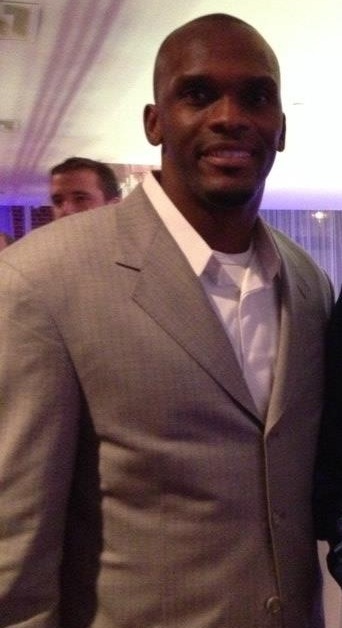 Isaac Bruce · Wide receiver (1994-2007)
Hall of Famer who holds the franchise records for receptions (942), receiving yards (14,109), and touchdown catches (84); caught the Super Bowl XXXIV game-winner.
Photo: MavsFan28, CC BY-SA 3.0 (Wikimedia Commons)
 Torry Holt · Wide receiver (1999-2008)
Seven-time Pro Bowl receiver, second in franchise receiving yards (12,660) and receptions (869); 2000s All-Decade Team.
Photo: GMO66, CC BY 2.0 (Wikimedia Commons)
 Orlando Pace · Left tackle (1997-2008)
Hall of Famer, No. 1 overall pick (1997), protector of the Greatest Show on Turf.
Photo: Monica's Dad, CC BY 2.0 (Wikimedia Commons)
 Aaron Donald · Defensive tackle (2014-2023)
Three-time Defensive Player of the Year, the franchise's official all-time sack leader (111.0) and a Super Bowl LVI champion.
Photo: All-Pro Reels, CC BY-SA 2.0 (Wikimedia Commons)
 Bob Waterfield · Quarterback (1945-1952)
Hall of Famer; 1945 NFL MVP and the first Ram elected to the Hall of Fame (1965).
Photo: public domain (Wikimedia Commons)
Record book
- Passing yardsJim Everett (23,758)
- Passing TDsRoman Gabriel (154)
- Rushing yardsSteven Jackson (10,138)
- Receiving yardsIsaac Bruce (14,109)
- ReceptionsIsaac Bruce (942)
- SacksAaron Donald (111.0 (official; Deacon Jones 159.5 and Jack Youngblood 151.5 have higher unofficial pre-1982 totals))
- InterceptionsEddie Meador (46)
- PointsJeff Wilkins (1,223)
Team Tips
Playing As
Under McVay, run an efficient offense that marries the run game and play-action to put defenders in conflict. Lean on heavy "13 personnel" (one back, three tight ends) to generate explosive plays while keeping defenses in base fronts. Use the ground game with Kyren Williams and Blake Corum to set up Stafford's league-best play-action passing to Puka Nacua and Davante Adams, and rely on an elite pass rush up front with Myles Garrett added.
Playing Against
Attack through the secondary, coverage has been the roster's biggest weakness (Seattle's Jaxon Smith-Njigba torched the defensive backfield in the NFC Championship Game). Use a mobile, quick-strike passing attack with light, spread personnel to force the Rams out of their heavier packages, as Seattle's nickel-heavy, zone-based scheme did.

Coaching · Sean McVay
Head coach since January 2017, entering his 10th season in 2026. Hired at age 30 as the youngest modern-era NFL head coach, McVay is an offensive innovator who won Super Bowl LVI (February 2022), is the youngest coach ever to win a Super Bowl, and is the winningest coach in franchise history. He and GM Les Snead signed multi-year extensions in the 2026 offseason, and his staff was reshaped with Kliff Kingsbury as assistant head coach, Nate Scheelhaase as offensive coordinator, and Bubba Ventrone as special teams coordinator.
Photo: 621st Contingency Response Wing (U.S. Air Force), CC BY 2.0 (Wikimedia Commons)
Coming soon
- Playbook Matches
- Key Plays & Audibles
Upgrade to Team Hub Rookie
- Salary cap breakdown
- Depth chart analysis
- Roster needs & scheme fit
- Cut candidates & 5-year outlook
- Full sortable roster