Playbooks

Overview
Jets Defense and NFL Live Jets Defense are effectively the same playbook. They share all 337 of this cut's plays and differ by zero sets, so everything here applies equally to both. Pick whichever cut your mode offers and your audible package will carry over without changes.
At 337 plays across 8 formations and 24 sets, Jets Defense sits right at the middle of the 64 defensive team playbooks in size, but its weight is anything but balanced. Nickel carries 132 plays (39%) across 9 sets, Dime adds 81 plays (24%), and Dollar chips in 12 more. That gives you roughly two thirds of the book in sub packages, with personnel ranging from Nickel 4-2-5 and Big Nickel 4-2-5 through Dime 3-2-6, three Big Dime looks (1-4-6, 4-1-6, 2-3-6) and Big Quarter 3-1-7. The base fronts are split between 3-4 (57 plays, 4 sets) and 4-3 (27 plays, 2 sets), with a thin 4-4 (9 plays, 1 set) for heavy run downs.
This is a coverage-first book built to match spread offenses with extra defensive backs and disguise from one personnel group. The concept list runs deep on man (Cover 1, Cover 1 Hole, Cover 1 Robber Press) and match zone (Cover 3 Match, Quarters, Cover 6), with LB Blitz and pressure calls like 3 Deep Blitz layered on top. It supports a game plan where you live in Nickel and Dime on early downs, rotate the safety picture pre-snap, and only drop into 3-4 or 4-3 when the offense forces you into base personnel.
Scheme Fit
Jets Defense wants a secondary deep enough to play five and six defensive backs on most snaps: at least three press-capable corners with high man coverage and speed, plus a versatile safety who can drop into the box in Big Dime or play robber in Cover 1. Up front it rewards a disruptive four-man rush and a rangy, coverage-capable linebacker who can hold up alone in Nickel, so it fits players who like to user a robber or hook defender, disguise from sub packages, and trust their corners in press man rather than stacking the box.
Example Plays from this Playbook


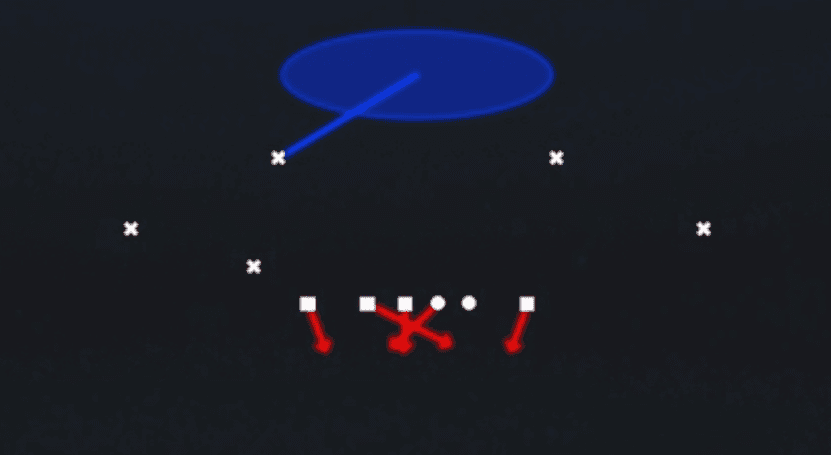


Find plays by concept, not by formation
Search every playbook by tag and personnel grouping, not just Jets Defense.
Strengths
- Nickel is 39% of the book spread across 9 sets, so you can stay in one sub package against 11 personnel all game and still show different fronts, pressure paths and shells without substituting and tipping your call.
- The combined 225 sub-package plays across Nickel, Dime and Dollar let you match 10 and 11 personnel with extra corners and still check between Cover 1 Hole, Cover 3 Match and Quarters from the same alignment, which base-heavy books cannot do.
- Three Big Dime personnel groups (1-4-6, 4-1-6, 2-3-6) inside an 81-play Dime package let you keep six DBs on the field while choosing between a heavier box or a lighter pass-rush look, ideal for sticking with passing downs without getting gashed by draws.
- Having both 3-4 (57 plays) and 4-3 (27 plays) as base options means you can answer 12 and 21 personnel with either an odd or even front, so an opponent cannot build their run game around one set of gap assignments.
- The man coverage depth (Cover 1, Cover 1 Hole, Cover 1 Robber Press, Cover 1 Contain) gives you a user robber and a contain rusher variant for mobile quarterbacks, letting you play aggressive press man without surrendering scrambles.
Weaknesses
- The 4-4 is only 9 plays in a single set, so against true power run teams you have very few eight-man-box calls and will often be forced back into 3-4 or 4-3 where the offense can read your front.
- With 4-3 limited to 27 plays across 2 sets, a 4-3 roster has a narrow menu of base calls, and a savvy opponent who motions into heavy personnel can predict your coverage from limited looks.
- Nearly two thirds of the book is sub package, which means your front seven is lighter on most snaps; offenses that sub into 12 or 13 personnel and run inside zone will stress your Nickel linebackers and force costly formation subs.
- Prevent is just 6 plays in one set and Goal Line Defense is 13 plays, so end-of-half deep defense and short-yardage stops have limited variety, making those situations easier for opponents to scout.
- The Dollar package offers only 12 plays in one set, so heavy dime-plus looks on 3rd and very long become repetitive if you lean on them every drive.
Usage Tips
Build your core audible package around Nickel 4-2-5: keep a Cover 1 Robber Press, a Cover 3 Match, a Quarters call and an LB Blitz in the same set so you can check on 1st and 10 and 2nd and medium without substituting.
On 3rd and 6 or longer, move to Dime and pick the Big Dime group that fits the matchup (4-1-6 to keep four rushers, 2-3-6 to show pressure and drop), then pair Cover 1 Hole with a 3 Deep Blitz as your two primary checks.
When the offense subs into 12 or 21 personnel on early downs, respond with the 3-4 (57 plays, 4 sets) rather than the thinner 4-3, and use pre-snap shifts to flip the strength of your front.
Save Dollar for 3rd and 12 plus and two-minute drills, but mix it with Dime so the single Dollar set does not become predictable.
On 3rd and 1 or 4th and short, go to the 4-4 or Goal Line Defense sets, and use Cover 1 Contain type calls against quarterback sneaks and boot action so a mobile passer cannot escape the edge.
Formations in this playbook


Upgrade to Playbooks Rookie
- Filter every play by tag and concept
- Personnel groupings
- Premium play analysis