Team Hub

AFC North
Pittsburgh Steelers
Team Snapshot
The Pittsburgh Steelers enter 2026-2027 as a proud, defense-first franchise in its first true leadership transition in two decades, Mike McCarthy has replaced the retired Mike Tomlin, looking to convert perennial competitiveness into a first playoff win since the 2016 season while sorting out the quarterback position.
Franchise Difficulty
How hard this franchise is to run well: where the team stands, what the roster gives you, what the cap allows, and what you hold in the draft.
A quarterback room built around a player entering the twilight of his career, two glaring offensive line holes ranked at the bottom of the league, limited cap flexibility going into next season at $1.6M, and an aging core at several defensive cornerstones combine to make this roster genuinely demanding to manage well.
Star Players
Scheme Fit
The schemes this team is set to run in-game, and how its roster grades in them.
- West Coast Power RunoffensivePassable
- Base 3-4defensiveGood
Salary Cap
Pittsburgh has $19.3M in room today but faces a near-empty $1.6M next season, so every dollar spent this year carries real consequences.
19 contracts expiring
Depth Chart
Madden Tools Analysis
Four starting spots have weak depth behind the starter.
Biggest gaps behind a starter
- LT
- C
- RT
- MIKE
Draft Capital
Seven picks this cycle with five landing in the first five rounds, plus 21 total picks over three years and three first-rounders in that window, gives Pittsburgh genuine rebuild firepower if the front office uses it wisely.
- Acquired: Round 5 from Cowboys, this draft
- Acquired: Round 7 from Dolphins, this draft
- Traded away: Round 6 to Cowboys, this draft
- Traded away: Round 5 to Dolphins, this draft
Team Ratings
The roster's top strength is an elite defensive front built around T.J. Watt and Cam Heyward, while the right guard spot, ranked 31st in the league at the starter level, is the clearest weakness on the team.
Strengths
- C
- DT
- FS
- LEDGE
- REDGE
Weak spots
- LT
- RG
- MIKE
- QB
- RT
Offense
Defense
Special teams
Roster Needs
- LThigh
Troy Fautanu (75 overall) is the starter but ranks 27th among starting left tackles, making this the most urgent upgrade on the roster.
- RGhigh
Gennings Dunker (72 overall) starts at right guard and ranks 31st at the position, making this the single weakest spot on the offensive line.
- MIKElow
Patrick Queen (79 overall) starts but depth is thin, and the unit ranks 25th in depth across the league.
- QBlow
Aaron Rodgers (78 overall) leads the room but his situation at this stage of his career creates real uncertainty, with Drew Allar (69 overall) as the only developmental option behind him.
- RTlow
Max Iheanachor (75 overall) holds the starting job, but the depth chart behind him ranks 18th overall and offers limited security.
- TElow
Pat Freiermuth (79 overall) starts and the unit's depth actually ranks 4th in the league, but the starter still ranks 20th, leaving room to upgrade the top of the position.
- WILLlow
Payton Wilson (75 overall) starts and depth ranks 3rd in the league, so this is a low-priority need that resolves itself if Wilson develops.
Cut Candidates
5-Year Outlook
Pittsburgh hands you a defense that can still carry games, headlined by T.J. Watt, Cam Heyward, and Jalen Ramsey, but the offense is a work in progress built on shaky foundations at left tackle and right guard. Aaron Rodgers is the starter but is well into the late stage of his career, and Drew Allar at 69 overall is not yet ready to step in without risk. DK Metcalf and Michael Pittman give Rodgers legitimate weapons, and Jaylen Warren and Rico Dowdle form a capable backfield, but none of that matters if the line keeps leaking pressure. Cam Heyward and Jalen Ramsey are both in the late stages of their careers, which means the defensive ceiling that exists today will begin to compress without intentional succession planning. The cap picture is workable this season at $19.3M in room but narrows sharply to $1.6M next year, demanding disciplined contract management. With seven picks this cycle, five of them in the first five rounds, there are real resources to address the trenches and begin building toward a post-transition window, but the window to compete with this current core is short.
5-Year Plan
Year 1Patch the trenches, clear the cap
- Evaluate the Aaron Rodgers situation early and consider releasing him to unlock $22.0M in cap room, then use the available $19.3M and any additional space to target upgrades at left tackle and right guard through free agency.
- Release Mason Rudolph, Ryan McCollum, Robert Tonyan, and Dylan Cook to shed redundant depth contracts and accumulate cap space for offensive line investment.
- Use the team's five picks in rounds one through five to add competitive depth or a starting-caliber guard or tackle, prioritizing the two line needs ranked at the bottom of the league.
Year 2Build around the young core
- Allow Zach Frazier (25, Star) and Gennings Dunker (23, Star) to grow into anchoring the interior of the line, leaning on their development trajectory to reduce the need for outside spending inside.
- Give Derrick Harmon (23, Star) and Nick Herbig (24, Superstar) expanded roles as Cam Heyward's usage is managed more carefully given where he is in his career.
- Evaluate Drew Allar as the potential long-term answer at quarterback and decide whether to invest in his development or target the position through available picks or free agency.
Year 3Develop successors at aging positions
- Begin a genuine succession plan at the defensive tackle position as Cam Heyward's role at the front of the depth chart becomes less certain, leaning on Derrick Harmon and Keeanu Benton to absorb snaps.
- Identify a long-term free safety to develop behind Jalen Ramsey, whose career timeline demands a plan be in place, with Jaquan Brisker (27, Star) as an internal candidate to cross-train.
- Lock in cost-controlled extensions for Alex Highsmith and Patrick Queen before the committed cap load of $252.2M in year three squeezes available room.
Year 4Reload around the pass rush identity
- Center the defensive identity on the Watt-Highsmith edge pairing and an ascending Derrick Harmon inside, with Jack Sawyer (24, Star) pushing for a larger role as the group's developmental piece.
- With committed cap dropping to $123.7M by year four, use the emerging flexibility to extend or acquire a genuine franchise quarterback if Allar has not established himself.
- Prioritize re-signing Germie Bernard (22, Star) and Daylen Everette (22, Star) as cost-controlled contributors entering their peak development windows.
Year 5Contend with a rebuilt roster
- Target a playoff run with a rebuilt offensive line, a settled quarterback situation, and a defensive front that has organically transitioned from its veteran core to Harmon, Herbig, and Sawyer.
- Use the three first-round picks in the three-year draft capital window and 21 total picks over that span to ensure the roster has enough blue-chip talent to compete without relying on aging contracts.
- Assess the secondary's long-term needs as Rayshawn Jenkins and the veteran corner group age out, using the financial flexibility created by years of cap discipline to address any remaining holes.
Full Roster
| Player | Pos | OVR | Age | Dev |
|---|---|---|---|---|
| Age 31 | LEDGE | 96 | 31 |  |
| Age 37 | DT | 95 | 37 | |
| Age 31 | FS | 90 | 31 | |
| Age 29 | REDGE | 87 | 29 |  |
| Age 35 | K | 86 | 35 |  |
| Age 29 | CB | 86 | 29 |  |
| Age 25 | C | 86 | 25 | |
| Age 28 | WR | 85 | 28 | |
| Age 27 | HB | 84 | 27 | |
| Age 28 | HB | 82 | 28 | |
| Age 28 | WR | 81 | 28 | |
| Age 27 | SS | 80 | 27 | |
Franchise History
The Steelers were founded on July 8, 1933, by Art Rooney, who paid a $2,500 NFL franchise fee and named the team the Pittsburgh Pirates after the city's baseball club. For nearly four decades the franchise was among the NFL's most futile, posting just one playoff appearance (a 1947 loss to Philadelphia) through 1971. The name changed to "Steelers" in 1940 to honor the region's steel industry; the team briefly merged with Philadelphia (the 1943 "Steagles") and the Chicago Cardinals (1944's winless "Card-Pitt") during World War II player shortages. The turning point came when Chuck Noll was hired in 1969. Through a remarkable run of drafts, Noll assembled a dynasty: the "Immaculate Reception", Franco Harris's miraculous catch in a December 23, 1972 playoff win over Oakland, gave the franchise its first-ever postseason victory and launched a golden era. Behind the "Steel Curtain" defense, the Steelers won four Super Bowls in six years (IX, X, XIII, XIV), becoming the first team to win four titles and the only one to win back-to-back Super Bowls twice. After a fallow 1980s, Bill Cowher (hired 1992) returned the team to contention, reaching Super Bowl XXX after the 1995 season. The Steelers won their fifth title in Super Bowl XL (February 2006) as a No. 6 seed, the first sixth seed to win a Super Bowl. Mike Tomlin took over in 2007 and won Super Bowl XLIII (February 2009), the franchise's sixth championship, making Pittsburgh the first team to six Super Bowl wins. Tomlin never had a losing season in 19 years but did not win a playoff game after the 2016 season; he stepped down in January 2026, and Pittsburgh native Mike McCarthy was hired as the franchise's 17th head coach.
Notable figures
 Art Rooney · Founder/Owner
"The Chief" founded the team in 1933 and ran it until his 1988 death; a Pro Football Hall of Famer whose family still owns the franchise.
Photo: Tony Fischer, CC BY 2.0 (Wikimedia Commons)
 Chuck Noll · Head Coach (1969-1991)
Built the 1970s dynasty and won four Super Bowls, the most by any coach; turned the NFL's "lovable losers" into champions.
Photo: Cleveland Browns, public domain (Wikimedia Commons)
 Terry Bradshaw · Quarterback (1970-1983)
Four-time Super Bowl champion and two-time Super Bowl MVP; the triggerman of the dynasty offense and a Hall of Famer.
Photo: U.S. Navy (Damon J. Morit), public domain (Wikimedia Commons)
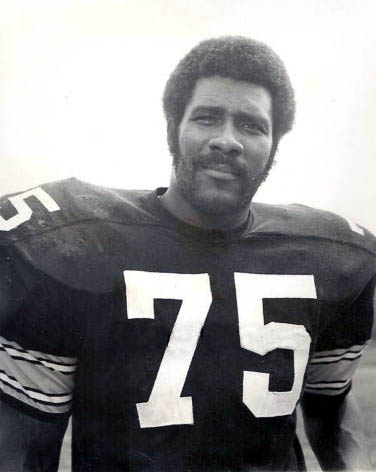 "Mean" Joe Greene · Defensive Tackle (1969-1981)
The cornerstone of the Steel Curtain, two-time NFL Defensive Player of the Year, and Noll's first building block; jersey No. 75 retired.
Photo: The Steelers / NFL, public domain (Wikimedia Commons)
 Franco Harris · Running Back (1972-1983)
Franchise all-time rushing leader, author of the Immaculate Reception, Super Bowl IX MVP, and Hall of Famer.
Photo: Governor Tom Wolf (Commonwealth Media Services), CC BY 2.0 (Wikimedia Commons)
 Mel Blount · Cornerback (1970-1983)
Franchise all-time interceptions leader (57); his physical bump-and-run play prompted the NFL's "Mel Blount Rule." Hall of Famer.
Photo: Cramerwiki, CC0 (Wikimedia Commons)
 Hines Ward · Wide Receiver (1998-2011)
Franchise all-time leader in receptions, receiving yards and receiving touchdowns; Super Bowl XL MVP.
Photo: John Seb Barber, CC BY 2.0 (Wikimedia Commons)
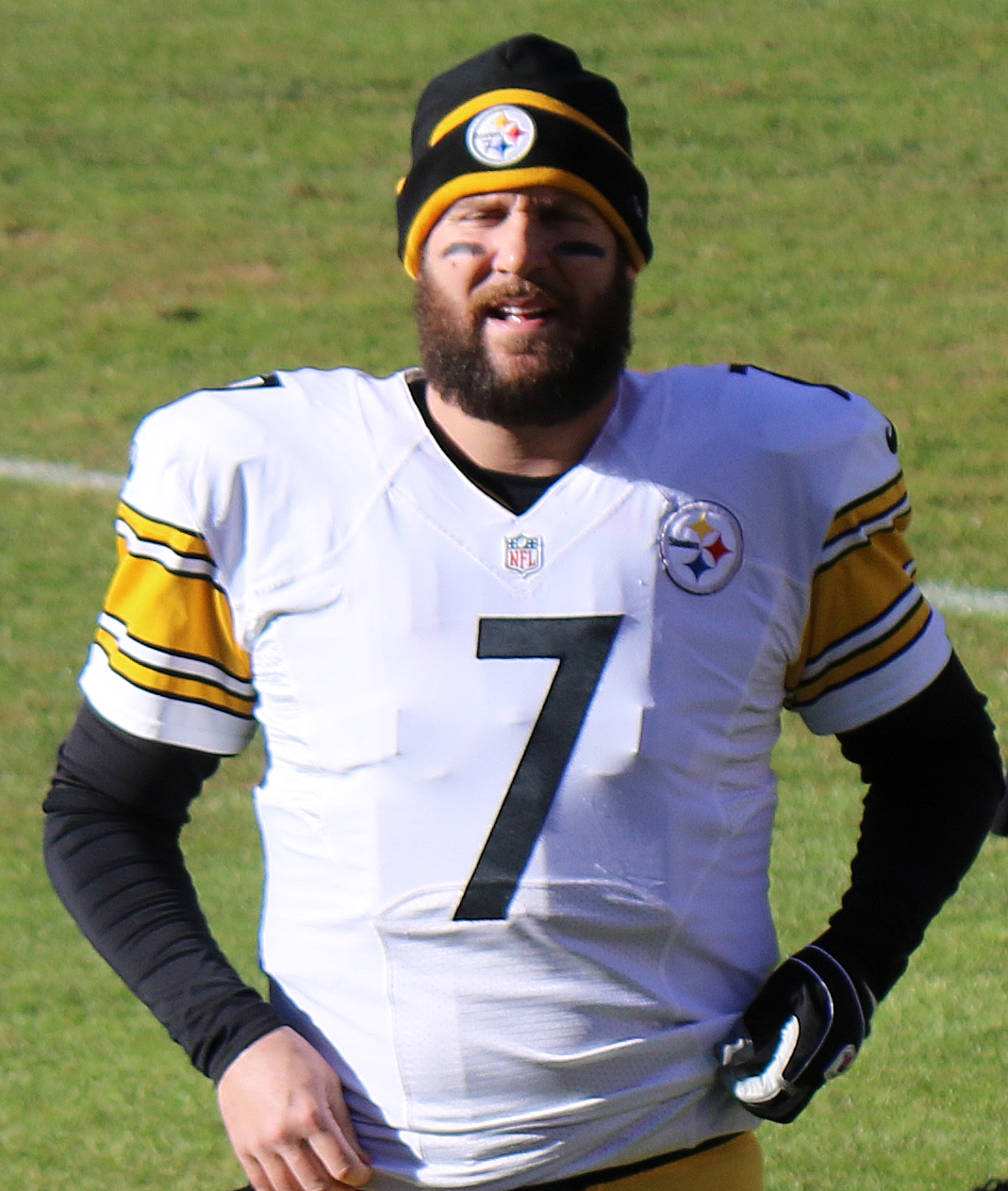 Ben Roethlisberger · Quarterback (2004-2021)
Franchise all-time leader in passing yards and touchdowns; two-time Super Bowl champion (XL, XLIII).
Photo: Jeffrey Beall, CC BY 3.0 (Wikimedia Commons)
 Troy Polamalu · Strong Safety (2003-2014)
Eight-time Pro Bowler, 2010 Defensive Player of the Year, two-time Super Bowl champion, Hall of Famer.
Photo: Paula Lively, CC BY 2.0 (Wikimedia Commons)
 T.J. Watt · Outside Linebacker (2017-present)
Franchise all-time sack leader, 2021 NFL Defensive Player of the Year, and the face of the modern Steelers defense.
Photo: Erik Drost, CC BY 2.0 (Wikimedia Commons)
Record book
- Passing yardsBen Roethlisberger (64,088 (2004-2021))
- Passing TDsBen Roethlisberger (418 (2004-2021))
- Rushing yardsFranco Harris (11,950)
- Receiving yardsHines Ward (12,083)
- ReceptionsHines Ward (1,000)
- SacksT.J. Watt (Franchise record (passed James Harrison's 80.5 in 2023))
- InterceptionsMel Blount (57)
- PointsGary Anderson (1,343 (1982-1994))
Team Tips
Playing As
Lean into "Steeler football": defense-first, physical, run-stopping play built on the legacy of the Steel Curtain and Dick LeBeau's 3-4 zone-blitz scheme, with new coordinator Patrick Graham continuing the template, shut down the run in the trenches, win early downs, and force opponents to become one-dimensional. On offense, prioritize balance, clock control and physical running, while leaning on McCarthy's offensive background and DK Metcalf as the top target.
Playing Against
Attack the run-defense interior with a power running game, Buffalo rushed for 249 yards against Pittsburgh in Week 13 of 2025 (the most ever allowed at Acrisure Stadium) and Baltimore overwhelmed them in the 2025 Wild Card loss. On offense, exploit the Steelers' lack of an established, dynamic quarterback and a reliable No. 2 receiver behind DK Metcalf by loading the box and pressuring the pocket.

Coaching · Mike McCarthy
Head coach introduced January 27, 2026, entering his first season in 2026-2027. A Pittsburgh native (raised in Greenfield) and Super Bowl XLV-winning former Green Bay Packers (2006-18) and Dallas Cowboys (2020-24) head coach, McCarthy carries a 174-112-2 (.608) overall record. He is the franchise's 17th head coach all-time and only the fourth hired since 1969, with an offensive orientation that marks a departure from the defensive-minded coaches who preceded him.
Photo: Thomas J. Grant, CC BY 3.0 (Wikimedia Commons)
Coming soon
- Playbook Matches
- Key Plays & Audibles
Upgrade to Team Hub Rookie
- Salary cap breakdown
- Depth chart analysis
- Roster needs & scheme fit
- Cut candidates & 5-year outlook
- Full sortable roster