Team Hub

AFC South
Indianapolis Colts
Team Snapshot
The Indianapolis Colts enter 2026-2027 as a franchise under pressure: after squandering an 8-2 start to finish 8-9 and miss the playoffs for a fifth straight season, they retained head coach Shane Steichen and GM Chris Ballard for a make-or-break campaign built around a healthy Daniel Jones, workhorse RB Jonathan Taylor, and a retooled defense.
Franchise Difficulty
How hard this franchise is to run well: where the team stands, what the roster gives you, what the cap allows, and what you hold in the draft.
The franchise hands you a legitimate rushing star and a standout cornerback duo, but a bottom-tier quarterback, glaring holes at linebacker, right tackle, and strong safety, an aging defensive interior, and $15.0M in dead cap money collectively make this a roster that demands active management rather than passive enjoyment.
Star Players
Scheme Fit
The schemes this team is set to run in-game, and how its roster grades in them.
- West Coast Power RunoffensiveGood
- Tampa 2defensiveGood
Salary Cap
With $36.3M in room now ranked seventh in the league and commitments falling steeply after next season, Indianapolis has real financial leverage to attack its holes in free agency today.
23 contracts expiring
Depth Chart
Madden Tools Analysis
Seven starting spots have weak depth behind the starter.
Draft Capital
Six picks this cycle with none in the first round after forfeiting it to the Jets, spread across rounds two through seven, give the Colts a workable but unspectacular haul that demands hitting on mid-round selections to fill the roster's many gaps.
- Traded away: Round 1 to Jets, this draft
Team Ratings
The roster's clearest strength is its run game and cornerback tandem, while linebacker is the most glaring systemic weakness with both the MIKE and WILL starters ranking in the bottom two at their respective positions league-wide.
Strengths
- C
- CB
- DT
- HB
- LG
Weak spots
- MIKE
- REDGE
- RT
- SS
- WILL
Offense
Defense
Special teams
Roster Needs
- MIKEhigh
Akeem Davis-Gaither (74 overall) starts at MIKE, giving the Colts the 31st-ranked starter at the position, making this the single most urgent upgrade on the roster.
- REDGEhigh
JT Tuimoloau (74 overall) is the starter off the right edge, ranking 28th among starting REDGE players and requiring a significant talent infusion.
- RThigh
Jalen Travis (70 overall) holds the RT spot but ranks dead last among starters at the position, and the entire depth chart there is thin and unproven.
- SShigh
A.J. Haulcy (74 overall) starts at SS but the unit ranks 31st in starter quality and 30th in depth, leaving the position dangerously exposed.
- WILLhigh
Bryce Boettcher (70 overall) starts at WILL with the 30th-ranked starter grade, and the linebacker corps as a whole is a systemic weakness that needs addressing.
- QBmedium
Daniel Jones (76 overall) leads a QB room that ranks 25th in starter quality, meaning the position is a modest but real drag on the offense without a clear heir apparent.
- WRlow
Alec Pierce (84 overall) leads the receiver room competently, but the group ranks 21st overall and could use a weapon capable of stressing defenses at the top of the route tree.
Cut Candidates
5-Year Outlook
Indianapolis is built around an elite run game anchored by Jonathan Taylor and protected by one of the better interior lines in the league, with Quenton Nelson and Tanor Bortolini forming a strong left-side foundation. Sauce Gardner and Charvarius Ward Sr give the secondary genuine star power at corner, and Tyler Warren at tight end is a young Superstar talent who should develop into a featured weapon. The challenge is everywhere else: Daniel Jones is a serviceable but unspectacular starter, the linebackers rank near the bottom of the league, the right tackle situation is the worst among starters in the entire league, and strong safety is nearly as barren. DeForest Buckner and Grover Stewart anchor the defensive line, but both are in the later stages of their careers and cannot be counted on as long-term cornerstones. Charvarius Ward Sr is in a similar position, making succession at his corner spot a real medium-term concern. With $36.3M in cap room ranked seventh in the league and a solid class of six upcoming picks spread across rounds two through seven, the front office has the resources to fill holes in free agency and gradually build through the draft, but the path from competitive to contender requires hitting on multiple needs simultaneously.
5-Year Plan
Year 1Patch the worst holes, free the cap
- Release Luke Tenuta, Laquon Treadwell, D.J. Montgomery, and Jonathan Owens to free more than $4.5M in combined cap space and clear roster spots at positions of need.
- Use the available $36.3M in cap room, ranked seventh in the league, to sign a legitimate starting-caliber MIKE linebacker and a right tackle capable of protecting Daniel Jones and opening lanes for Jonathan Taylor.
- Target the strong safety market to find a reliable starter ahead of Hunter Wohler, addressing the league's second-worst starter at that position.
Year 2Develop the young core, demand more from the quarterback
- Give Tyler Warren a featured role in the passing game to accelerate his Superstar development trajectory and build a genuine two-way threat at tight end.
- Evaluate whether Daniel Jones can operate effectively in a vertical power scheme or whether the cap flexibility growing toward $42.3M projected next year creates a realistic window to upgrade the position.
- Continue developing CJ Allen at MIKE and JT Tuimoloau at REDGE, both young Star or better prospects who need consistent starting reps to reach their ceilings.
Year 3Build the linebacker corps, plan succession at the trenches
- With Quenton Nelson moving deeper into his 30s, identify and develop a long-term left guard successor so the interior line remains elite beyond his window.
- Invest draft capital, six picks this cycle spread across rounds two through seven, in linebacker and edge depth to address the two positions where the Colts rank worst in starter quality.
- Establish Sauce Gardner as the defensive centerpiece while beginning to plan for life after Charvarius Ward Sr, whose career is in its final competitive window.
Year 4Contend around Taylor and Gardner
- With committed cap obligations dropping sharply to $112.9M by the third season out, pursue a franchise-caliber upgrade at quarterback if Jones has not proven himself a legitimate starter.
- Ensure Jonathan Taylor, still in his athletic prime, is surrounded by a rebuilt offensive line and a competent receiving corps that keeps defenses from loading the box.
- Lean on the three-year draft total of 20 picks to have generated at least two or three above-average starters at the positions that were weakest at the start of the rebuild.
Year 5Sustain the contention window
- With DeForest Buckner's long-term contribution uncertain at this point, ensure the defensive line has a next-generation anchor developed or acquired to maintain interior pressure.
- Use the two first-round picks accumulated over the three-year draft horizon as potential trade chips to move up for a difference-making player or to acquire proven veterans on short-term deals.
- Build the roster so it no longer depends on any single aging star, allowing the franchise to compete consistently rather than riding a shrinking window.
Young core
Full Roster
| Player | Pos | OVR | Age | Dev |
|---|---|---|---|---|
| Age 27 | HB | 96 | 27 |  |
| Age 30 | LG | 95 | 30 |  |
| Age 32 | DT | 92 | 32 | |
| Age 25 | CB | 89 | 25 | |
| Age 30 | CB | 88 | 30 | |
| Age 24 | C | 86 | 24 |  |
| Age 28 | LT | 86 | 28 | |
| Age 28 | FS | 84 | 28 | |
| Age 26 | WR | 84 | 26 | |
| Age 24 | TE | 84 | 24 | |
| Age 31 | P | 83 | 31 | |
| Age 32 | DT | 83 | 32 | |
Franchise History
The Colts were founded in 1953 in Baltimore, when a group led by Carroll Rosenbloom was awarded the assets of the defunct Dallas Texans. Under coach Weeb Ewbank and quarterback Johnny Unitas (signed 1956), the Colts rose fast, beating the New York Giants 23-17 on December 28, 1958, in the first sudden-death overtime championship, "The Greatest Game Ever Played." They repeated as NFL champions in 1959 and won another NFL title in 1968. After joining the AFC in the merger, they won Super Bowl V after the 1970 season, defeating Dallas 16-13 on Jim O'Brien's late field goal. After the 1972 season the franchise was sold to Robert Irsay, and in March 1984 Irsay relocated the team to Indianapolis in the infamous "Mayflower Midnight" move. The Peyton Manning era began with the No. 1 overall pick in 1998 and became the greatest stretch in franchise history: 11 playoff appearances, an NFL-record seven straight 12-win seasons (2003-09), and, under coach Tony Dungy, a Super Bowl XLI win after the 2006 season, 29-17 over the Chicago Bears. Manning missed 2011 with neck surgery, and the team drafted Andrew Luck first overall in 2012. Luck led a division-title revival before injuries forced his shocking 2019 retirement. The recent era has been defined by quarterback instability and a playoff drought dating to 2020.
Notable figures
 Johnny Unitas · Quarterback (1956-1972)
"The Golden Arm"; three-time MVP, led the 1958, 1959 and 1968 title teams and Super Bowl V; widely regarded as the prototype of the modern QB.
Photo: Malcolm W. Emmons, public domain (Wikimedia Commons)
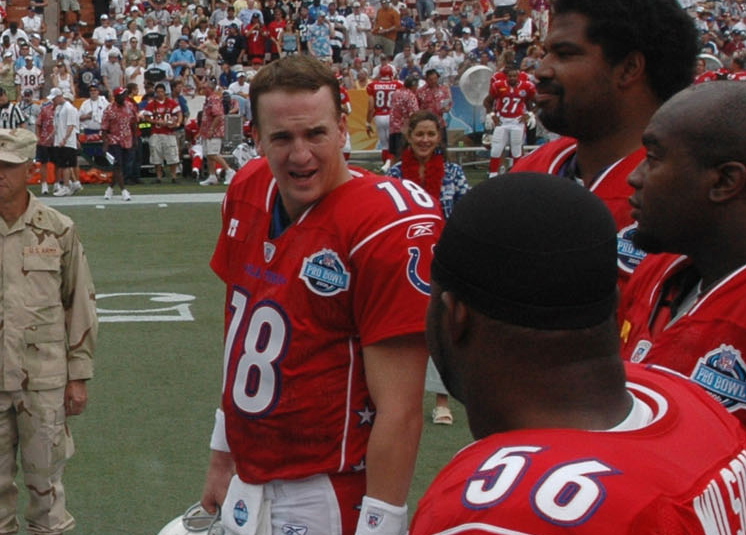 Peyton Manning · Quarterback (1998-2010)
Five-time NFL MVP (four with Indy), Super Bowl XLI champion, franchise leader in passing yards (54,828) and passing TDs (399).
Photo: U.S. Navy (Chief Photographer's Mate Don Bray), public domain (Wikimedia Commons)
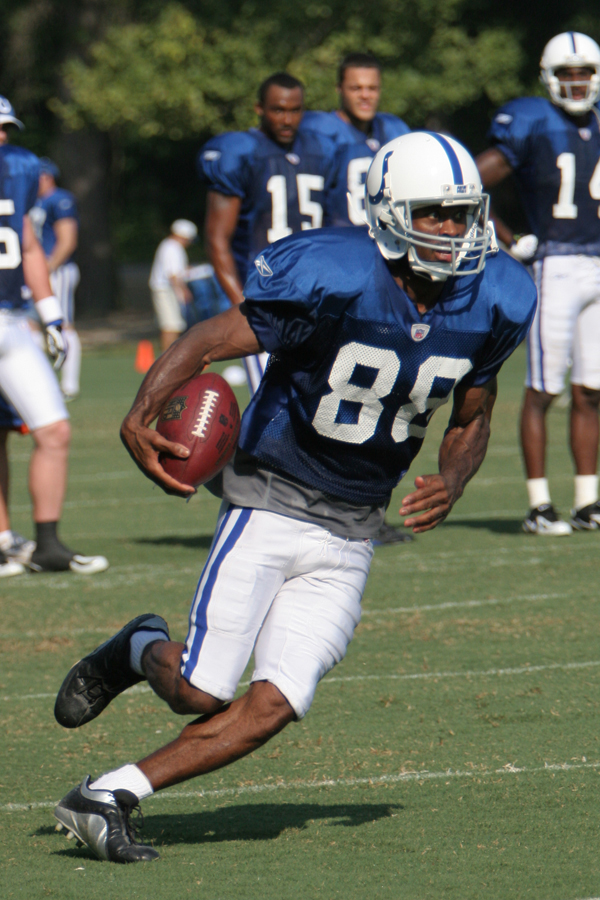 Marvin Harrison · Wide receiver (1996-2008)
Hall of Famer; franchise leader in receptions (1,102), receiving yards (14,580) and receiving TDs (128); Manning's top target.
Photo: Djmunden, CC BY-SA 3.0 (Wikimedia Commons)
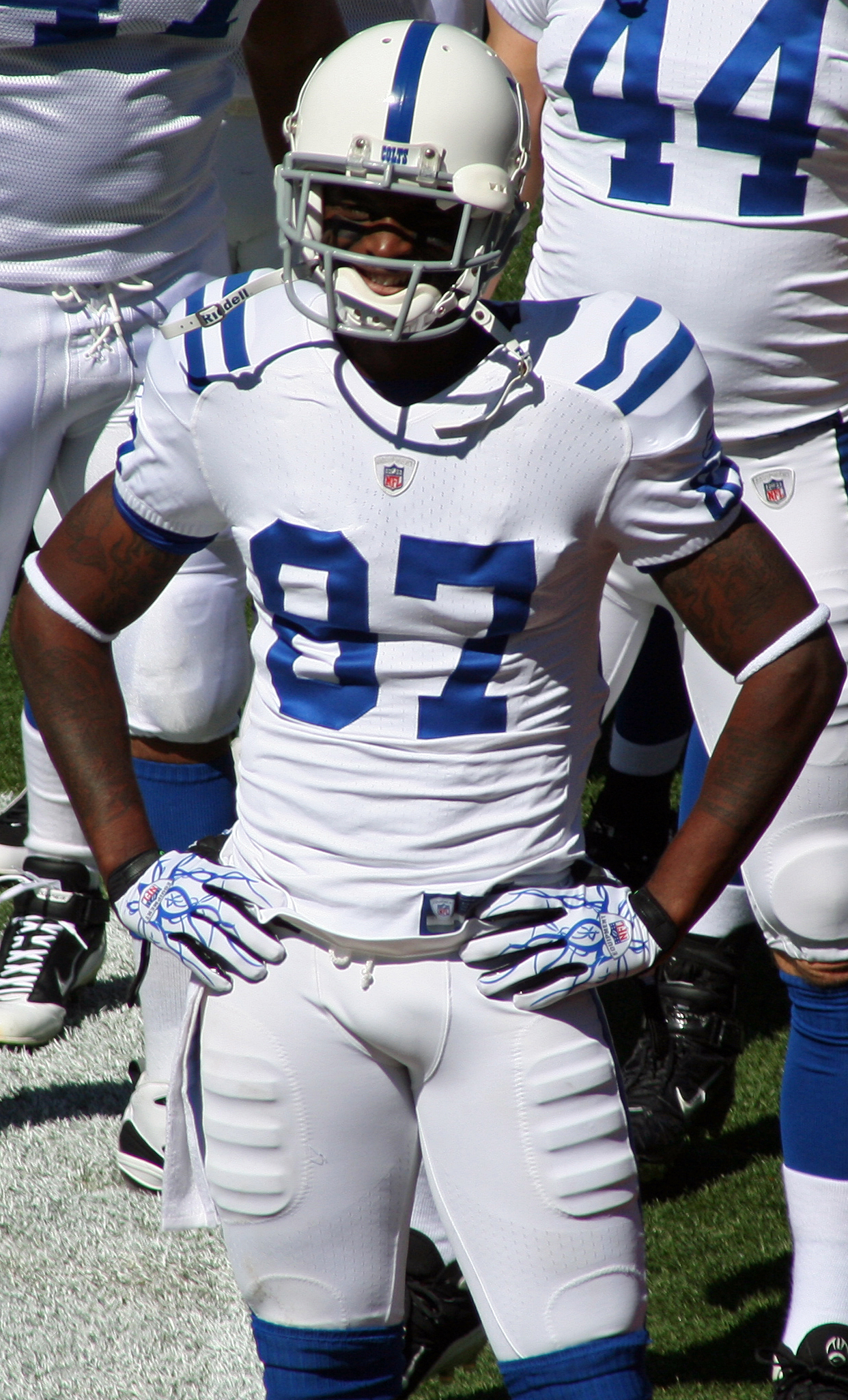 Reggie Wayne · Wide receiver (2001-2014)
Six-time Pro Bowler, Super Bowl XLI champion, No. 2 in franchise receiving yards (14,345) and franchise leader in games played (211); now the Colts' WR coach.
Photo: Jeffrey Beall, CC BY-SA 3.0 (Wikimedia Commons)
 Edgerrin James · Running back (1999-2005)
Hall of Famer; franchise's all-time leading rusher (9,226 yards); 1999 Offensive Rookie of the Year, two-time rushing champ.
Photo: John Martinez Pavliga, CC BY 2.0 (Wikimedia Commons)
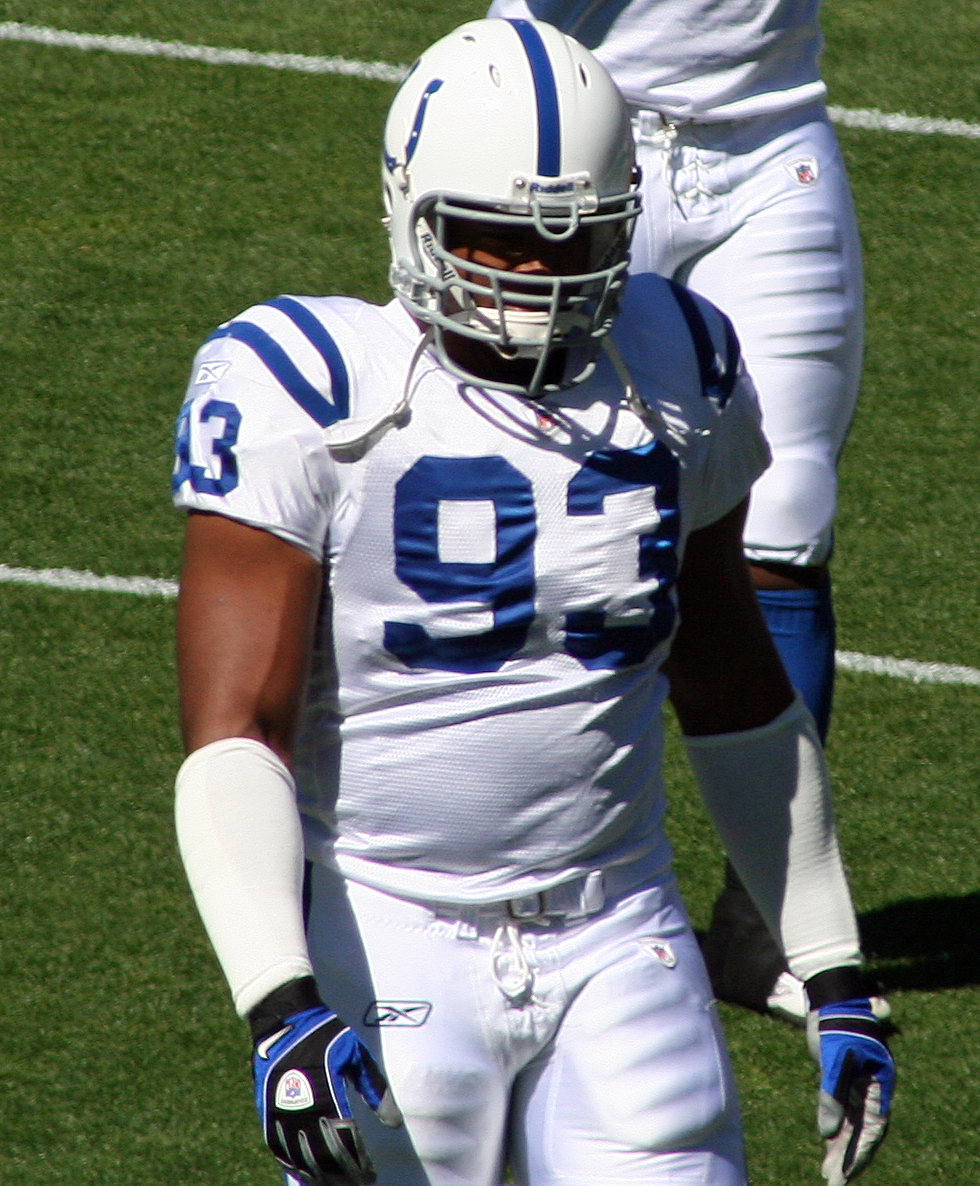
 Tony Dungy · Head coach (2002-2008)
Winningest coach in franchise history; led the Super Bowl XLI title; first Black head coach to win a Super Bowl; Hall of Famer.
Photo: U.S. Navy (PM Airman William J. Davis), public domain (Wikimedia Commons)
 Dwight Freeney · Defensive end (2002-2012)
Seven-time Pro Bowler famed for his spin move; 125.5 career sacks; Super Bowl XLI champion.
Photo: Jeffrey Beall, CC BY-SA 3.0 (Wikimedia Commons)
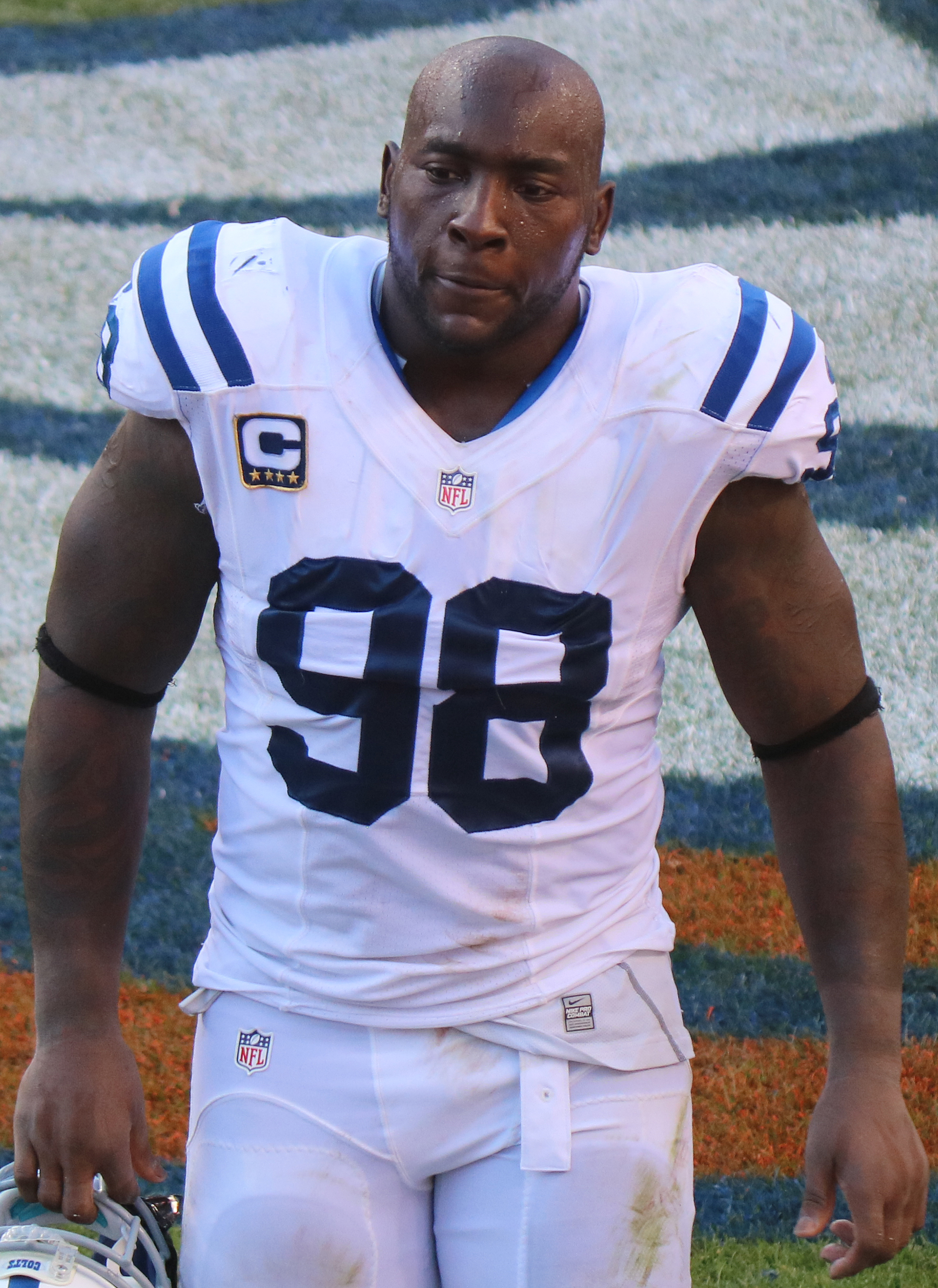 Robert Mathis · Defensive end/linebacker (2003-2016)
Franchise's all-time sack leader (123) and forced-fumble leader (54); five-time Pro Bowler; Super Bowl XLI champion.
Photo: Jeffrey Beall, CC BY 4.0 (Wikimedia Commons)
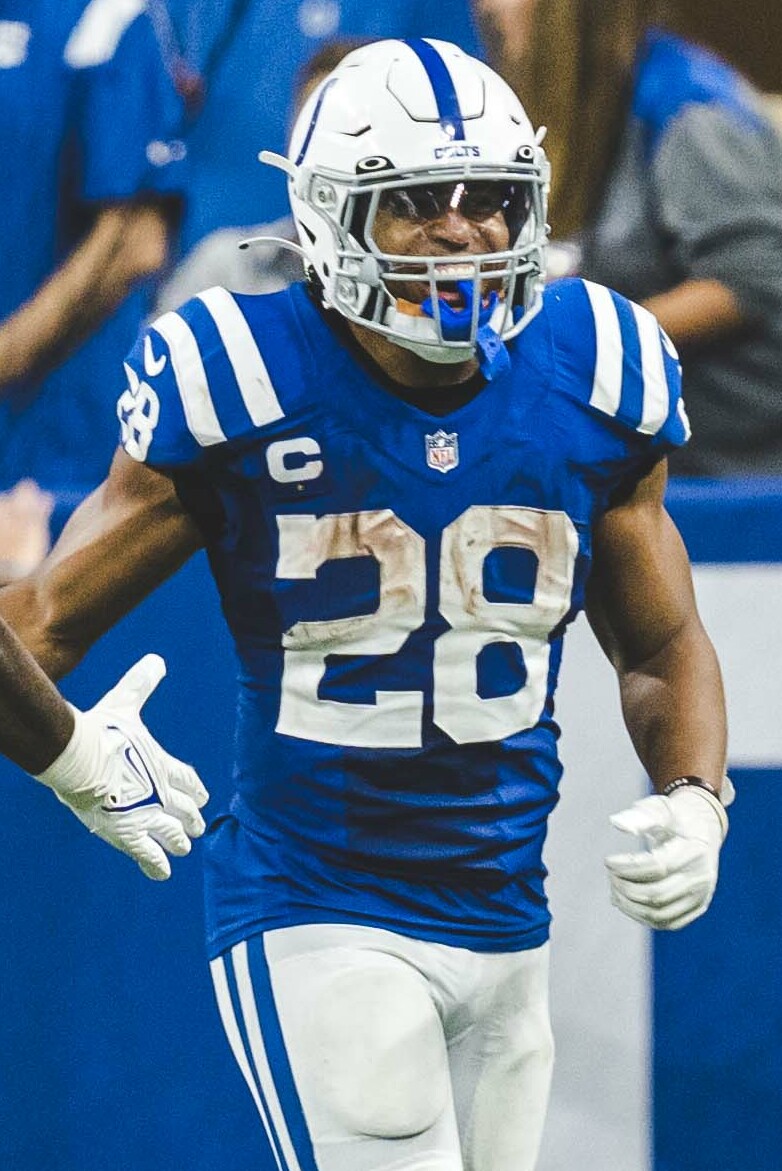 Jonathan Taylor · Running back (2020-present)
Franchise's all-time rushing-TD leader (69) and single-season rushing record holder (1,811 in 2021); the current offensive engine.
Photo: All-Pro Reels, CC BY-SA 2.0 (Wikimedia Commons)
Record book
- Passing yardsPeyton Manning (54,828)
- Passing TDsPeyton Manning (399)
- Rushing yardsEdgerrin James (9,226)
- Receiving yardsMarvin Harrison (14,580)
- ReceptionsMarvin Harrison (1,102)
- SacksRobert Mathis (123 (2003-2016))
- InterceptionsBobby Boyd (57 (1960-1968))
- PointsAdam Vinatieri (1,515 (2006-2019))
Team Tips
Playing As
Win on the ground and control tempo. Steichen's offense revolves around Jonathan Taylor, who led the league in total touchdowns (20), rushing touchdowns (18) and carries (323) in 2025, running behind a strong offensive line. Complement the run with play-action and Daniel Jones's efficiency (third-best yards per attempt at 8.1, fourth-best completion percentage at 68%, sixth-best passer rating at 100.2 in 2025). Use deep threat Alec Pierce, who led the NFL in yards per catch (21.3), to stretch the field.
Playing Against
Load the box, make Jones win from the pocket, and pressure him, his late-season injury and the offense's collapse (they lost every game after the Week 11 bye) exposed problems closing games. The defense finished No. 21 in scoring (24.2 ppg allowed) and is young and unproven, with potentially as many as five first- or second-year starters, so test rookie starters and target a secondary dependent on the health of Sauce Gardner and Charvarius Ward.

Coaching · Shane Steichen
Head coach entering his fourth season (2026-2027), confirmed returning by owner/CEO Carlie Irsay-Gordon and GM Chris Ballard. An offensive-minded play-caller who developed Justin Herbert and Jalen Hurts before Indianapolis, he enters 25-26 with no playoff appearances, on multiple analysts' "hot seat" lists, and tasked with fixing the late-season and late-game collapses.
Photo: All-Pro Reels, CC BY-SA 2.0 (Wikimedia Commons)
Coming soon
- Playbook Matches
- Key Plays & Audibles
Upgrade to Team Hub Rookie
- Salary cap breakdown
- Depth chart analysis
- Roster needs & scheme fit
- Cut candidates & 5-year outlook
- Full sortable roster