Team Hub
AFC East
Buffalo Bills
Team Snapshot
As the Buffalo Bills enter the 2026-2027 season, they are a Super Bowl-hungry contender in transition, armed with reigning-era MVP Josh Allen and a fresh start under first-year head coach Joe Brady, moving into a new $2.1 billion Highmark Stadium, but still chasing the franchise's first championship after decades of playoff-era near-misses.
Franchise Difficulty
How hard this franchise is to run well: where the team stands, what the roster gives you, what the cap allows, and what you hold in the draft.
A 99 overall X-Factor quarterback at the helm paired with two Superstar skill players, a competitive depth chart on both sides, and legitimate star power across the roster keeps this franchise approachable despite near-bottom cap room, $47.0M in dead money, and a projected overage heading into next season.
Star Players
Scheme Fit
The schemes this team is set to run in-game, and how its roster grades in them.
- West Coast Zone RunoffensiveGood
- Tampa 2defensiveGood
Build the playbook for this roster.
Playbook Genius ranks the schemes that fit the Buffalo Bills and builds a playbook and call sheet around them.
Salary Cap
With only $9.3M in room ranking 30th in the league, $47.0M in dead money, and a projected $42.5M hole next season ranking last leaguewide, the Bills are in one of the tightest cap situations in football.
11 contracts expiring
Depth Chart
Madden Tools Analysis
Four starting spots have weak depth behind the starter.
Biggest gaps behind a starter
- RG
- RT
- QB
- CB
Draft Capital
Buffalo holds eight picks in the current draft across six rounds, including a first-rounder, and has accumulated 22 picks across the three-year window with three first-rounders, giving the rebuild real runway even in a tight cap environment.
- Acquired: Round 6 from Colts, this draft
- Acquired: Round 7 from Raiders, this draft
- Acquired: Round 5 from Titans, this draft
- Traded away: Round 2 to Titans, this draft
- Traded away: Round 7 to Colts, this draft
Team Ratings
The roster's top strength is its skill-position and pass-rush star power headlined by a 99 overall quarterback, while the weakest spot is the right guard position, which ranks among the worst starting grades in the league.
Strengths
- LEDGE
- QB
- C
- HB
- RT
Weak spots
- RG
- CB
- DT
- REDGE
- WILL
Offense
Defense
Special teams
Roster Needs
- RGhigh
O'Cyrus Torrence starts at right guard but ranks 26th among starting guards and 21st in depth, making this the most urgent upgrade on the roster.
- CBmedium
Christian Benford leads a cornerback group that ranks 25th at the starter level and 26th in overall depth, leaving the secondary thin behind him.
- DTlow
Ed Oliver starts at a 21st-ranked DT spot, but deep depth that ranks 7th leaguewide softens the urgency here considerably.
- REDGElow
Bradley Chubb starts at REDGE and ranks 20th at the position, but T.J. Parker and Javon Solomon give the depth chart a rank of 5th leaguewide.
- WILLlow
Dorian Williams starts at WILL and ranks 22nd at the position, though the overall depth ranks 10th and limits the severity of this need.
- WRlow
DJ Moore leads a receiver room that ranks 22nd at the starter level, but depth ranking 7th leaguewide means this is a rotational concern more than a crisis.
Cut Candidates
5-Year Outlook
Buffalo enters this stretch as a legitimately dangerous team built around Josh Allen, whose 99 overall makes every season a contention window. James Cook III and Greg Rousseau give the offense and defense star power in the backfield and on the edge, and Terrel Bernard, Cole Bishop, and Davison Igbinosun represent a young, developing defensive core. The offensive line is the clearest structural weakness, with right guard ranking near the bottom of the league and Dion Dawkins, Austin Corbett, and Ty Johnson all entering later stages of their careers, meaning the trenches need both short-term upgrades and longer-term succession. The cap situation demands attention immediately, with only $9.3M in room this season, $47.0M in dead money, and a projected gap of $42.5M in the hole next season, so roster construction will require creative maneuvering. DJ Moore gives the receiving corps a solid starter but is trending toward the back half of his career, and the cornerback group needs reinforcement to match the team's offensive ceiling. If the cap can be restructured and the right guard position addressed, this roster has the talent to compete deep into January.
5-Year Plan
Year 1Clear the books, patch the guard
- Release Joshua Palmer and Michael Hoecht to recover $12.1M combined and bring the team closer to workable cap space given the current $9.3M in room.
- Prioritize upgrading the starting right guard spot, which ranks 26th leaguewide with O'Cyrus Torrence starting and Ar'maj Reed-Adams as the only backup.
- Use the team's eight picks spread across rounds 1, 3, 4, 5, 5, 6, 6, and 7 to add depth at cornerback and interior line without overcommitting cap dollars.
Year 2Develop the young core, brace for the cap crunch
- Invest development resources in Star-trait players Cole Bishop, Davison Igbinosun, Maxwell Hairston, and T.J. Parker, who each have the ceiling to become starters or key contributors.
- Begin addressing the projected $42.5M cap overage heading into next season by restructuring or releasing aging contributors on the offensive line, including Austin Corbett.
- Lean on Deone Walker and T.J. Parker as ascending pieces on the defensive front to reduce reliance on aging starters.
Year 3Reshape the trenches for the next phase
- Establish succession at left tackle as Dion Dawkins moves further into the late stage of his career, with Jude Bowry as the in-house developmental candidate to evaluate.
- Build the cornerback group around Christian Benford, Davison Igbinosun, and Maxwell Hairston as the team's long-term starting trio, reducing dependence on Dee Alford.
- With three first-round picks across the three-year window and 22 total picks, use accumulated capital to land a high-upside interior lineman or cornerback to address the two biggest positional gaps.
Year 4Contend with a reshaped roster
- With Bradley Chubb's contributions potentially winding down, establish T.J. Parker as the full-time starter opposite Greg Rousseau to maintain elite edge pressure.
- Target a Super Bowl window while Josh Allen is at the peak of his powers, surrounding him with the most complete supporting cast the cap allows after two seasons of restructuring.
- Ensure DJ Moore has been succeeded or supplemented at the top of the receiver depth chart by a younger option developed through the draft capital accumulated in prior seasons.
Year 5Sustain the window, secure the next generation
- Lock in extensions for Greg Rousseau, James Cook III, Dalton Kincaid, and Khalil Shakir as the core of the next competitive cycle alongside Josh Allen.
- Confirm that the offensive line has been rebuilt with younger starters at guard and tackle, completing the transition away from the aging contributors who anchored the early years.
- Evaluate whether the team is positioned for another multi-year run or requires a targeted reload at specific positions using remaining draft capital from the three-year stockpile.
Full Roster
| Player | Pos | OVR | Age | Dev |
|---|---|---|---|---|
| Age 30 | QB | 99 | 30 |  |
| Age 26 | LEDGE | 93 | 26 |  |
| Age 26 | HB | 92 | 26 | |
| Age 32 | LT | 89 | 32 | |
| Age 27 | MIKE | 85 | 27 |  |
| Age 28 | RT | 85 | 28 |  |
| Age 29 | WR | 84 | 29 | |
| Age 28 | SS | 83 | 28 | |
| Age 26 | TE | 83 | 26 | |
| Age 26 | WR | 83 | 26 | |
| Age 28 | DT | 82 | 28 | |
| Age 28 | C | 81 | 28 | |
Franchise History
The Buffalo Bills were founded in 1959 as a charter member of the American Football League (AFL), beginning play in 1960, owned by Ralph Wilson and named after an earlier All-America Football Conference franchise that honored frontiersman Buffalo Bill. The team's early glory came under quarterback Jack Kemp and head coach Lou Saban, who won back-to-back AFL Championships in 1964 and 1965. When the AFL merged with the NFL in 1970, the Bills joined the NFL, and the 1970s were defined by running back O.J. Simpson, who in 1973 became the first player to rush for over 2,000 yards in a season. The franchise's defining era arrived under head coach Marv Levy from 1986 to 1997. Powered by a Hall-of-Fame core, quarterback Jim Kelly, running back Thurman Thomas, wide receiver Andre Reed, and defensive end Bruce Smith, the Bills won four consecutive AFC Championships and reached four straight Super Bowls (XXV-XXVIII) from the 1990 through 1993 seasons, a feat unmatched in NFL history. They lost all four, most agonizingly Super Bowl XXV on Scott Norwood's "Wide Right" field goal. This era also produced "The Comeback," the January 3, 1993 wild-card game in which backup QB Frank Reich rallied Buffalo from a 35-3 deficit to a 41-38 overtime win over the Houston Oilers, the largest comeback in NFL postseason history. After Kelly retired, the Bills endured a 17-year playoff drought (2000-2016), the longest in major North American pro sports at the time. The drought ended in 2017, the first year under head coach Sean McDermott. The 2018 drafting of quarterback Josh Allen transformed the franchise into a perennial contender, with five straight AFC East titles (2020-2024) and Allen's 2024 NFL MVP award. Yet repeated playoff heartbreak, including a string of losses to Patrick Mahomes' Chiefs and the 2025 overtime Divisional defeat at Denver, led to McDermott's firing after the 2025 season and the promotion of Joe Brady to head coach.
Notable figures
 Jim Kelly · Quarterback (1986-1996)
Hall-of-Fame field general of the K-Gun no-huddle offense who led the Bills to four straight Super Bowls; franchise leader in career passing yards (35,467).
Photo: U.S. Air Force (Staff Sgt. Corenthia Fennell), public domain (Wikimedia Commons)
 Thurman Thomas · Running back (1988-1999)
Hall-of-Fame dual-threat back and 1991 NFL MVP; the franchise's all-time leading rusher (11,938 yards).
Photo: Jeff Kern, CC BY 2.0 (Wikimedia Commons)
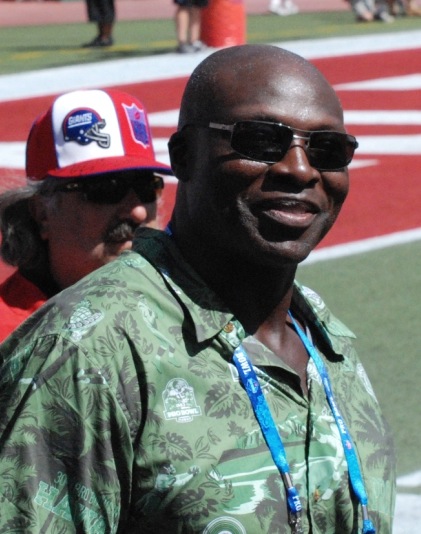 Bruce Smith · Defensive end (1985-1999)
Hall-of-Famer and the NFL's all-time sack leader (200 career; 171 with Buffalo); No. 1 overall pick in 1985.
Photo: Michele Moore, CC BY 2.0 (Wikimedia Commons)
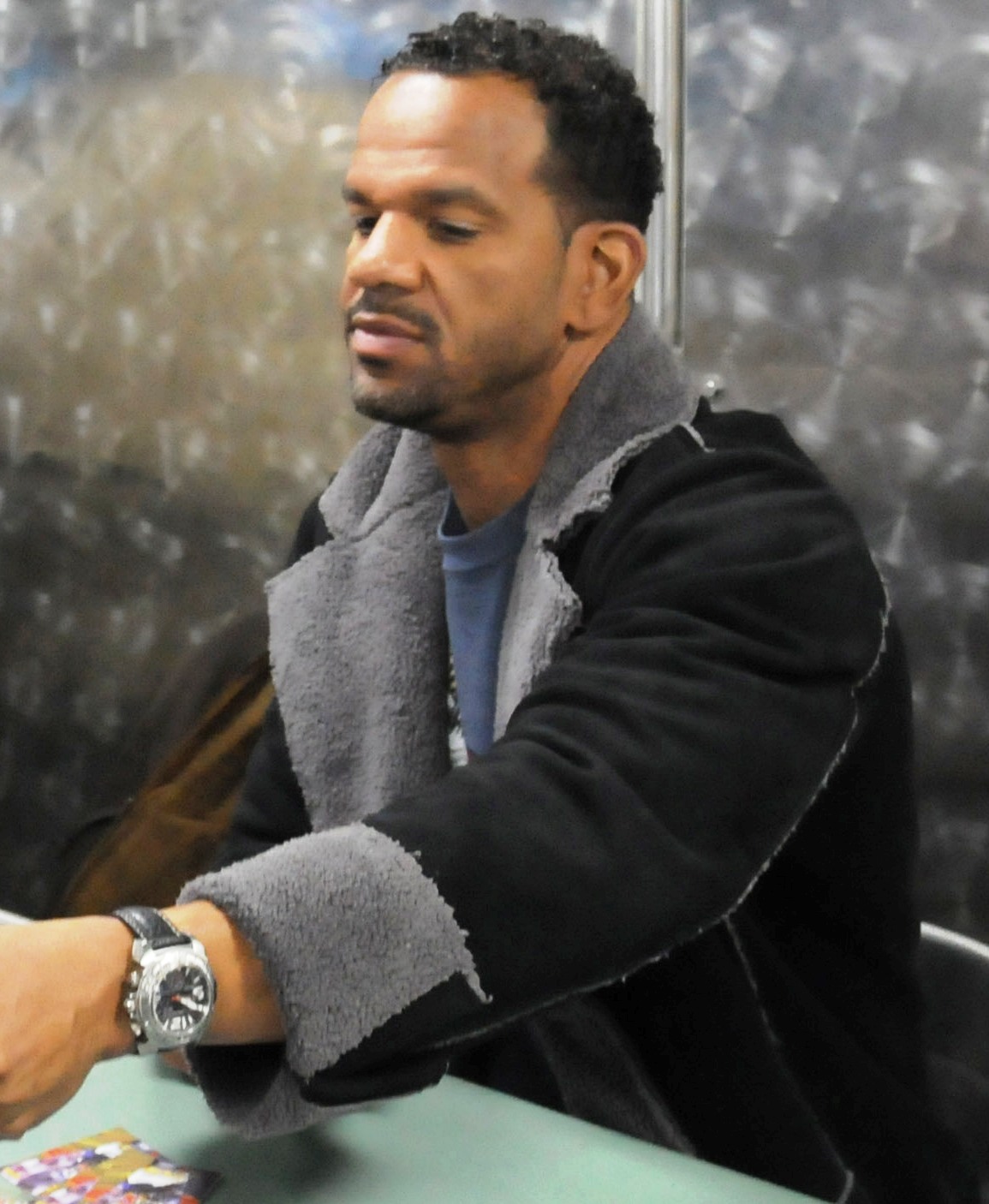 Andre Reed · Wide receiver (1985-1999)
Hall-of-Fame receiver and the franchise's all-time leader in receptions (941) and receiving yards (13,095).
Photo: U.S. Navy (Petty Officer 3rd Class Gary Prill), public domain (Wikimedia Commons)
 O.J. Simpson · Running back (1969-1977)
Electrifying "The Juice," first NFL player to rush for 2,000 yards in a season (1973); the Bills' all-time No. 2 rusher (10,183 yards).
Photo: U.S. Department of Defense (Gerald Johnson), public domain (Wikimedia Commons)
 Marv Levy · Head coach (1986-1997)
Hall-of-Fame coach who led Buffalo to four consecutive Super Bowls; most career playoff wins of any coach without an NFL title.
Photo: The Rockpile, CC BY-SA 4.0 (Wikimedia Commons)
 Josh Allen · Quarterback (2018-present)
2024 NFL MVP and the face of the franchise; now the franchise's all-time leader in total touchdowns (surpassing Kelly's 244) and rushing touchdowns (passing Thomas's 65).
Photo: All-Pro Reels, CC BY-SA 2.0 (Wikimedia Commons)
 Steve Christie · Placekicker (1992-2000)
The franchise's all-time leading scorer (1,011 points) and kicker of "The Comeback" game-winner.
Photo: Tennessee Titans, CC BY 3.0 (Wikimedia Commons)
- Ralph Wilson · Founder/Owner (1959-2014)
Founding owner who kept the franchise in Buffalo for over five decades; Pro Football Hall of Fame contributor.
Record book
- Passing yardsJim Kelly (35,467)
- Passing TDsJim Kelly (237)
- Rushing yardsThurman Thomas (11,938)
- Receiving yardsAndre Reed (13,095)
- ReceptionsAndre Reed (941)
- SacksBruce Smith (171 (NFL-record 200 career))
- InterceptionsButch Byrd (40)
- PointsSteve Christie (1,011)
- Total touchdownsJosh Allen (Surpassed Jim Kelly's 244)
- Rushing touchdownsJosh Allen (Passed Thurman Thomas's 65)
Team Tips
Playing As
Build around Josh Allen, a uniquely powerful dual-threat quarterback with elite arm strength who can run for first downs and touchdowns. Under Joe Brady's balanced, run-heavy "Everybody Eats" offense, lean on running back James Cook (NFL rushing leader in 2025 with 1,621 yards and 12 TDs) and spread the ball among many receivers, the 2025 offense led the NFL in rushing yards per game (159.6) and time of possession. The addition of receiver DJ Moore reunites him with Brady to give Allen a true No. 1 target.
Playing Against
Use two-high safety coverage (Vic Fangio-style) to take away deep shots and force Allen into patient, underneath throws, betting Buffalo's receivers can't consistently win one-on-one. Attack the Bills on the ground, they were badly vulnerable against the run in 2025, surrendering roughly 136 rushing yards per game (around 28th in the league) while transitioning to a new 3-4 base under coordinator Bobby Babich. Probe a secondary with inconsistent safety play, and exploit soft zones with efficient passers and play-action.
Coaching · Joe Brady
Head coach hired January 27, 2026 on a five-year deal, promoted after Sean McDermott was fired on January 19, 2026. The Bills' offensive coordinator in 2024-2025 (interim OC from late 2023), Brady is a former LSU passing-game coordinator who won the 2019 Broyles Award and later served as Carolina Panthers OC. He is known for his balanced, adaptable "Everybody Eats" offensive philosophy that helped power Josh Allen's MVP season; his 2024 Bills offense set a record with 13 different players scoring receiving touchdowns.
Coming soon
- Playbook Matches
- Key Plays & Audibles
Upgrade to Team Hub Rookie
- Salary cap breakdown
- Depth chart analysis
- Roster needs & scheme fit
- Cut candidates & 5-year outlook
- Full sortable roster