Playbooks
Playbook
Superstar QB Improvisor
OtherOverview
The Superstar QB Improvisor playbook is a compact, Shotgun-first offensive book built around a quarterback who extends plays and creates outside the pocket. At 180 plays across 7 formations and 17 sets, it is the smallest of the game's 9 Superstar playbooks. That small size matters: you learn the whole call sheet quickly, but you lose depth in every formation outside Shotgun. Shotgun carries 102 plays (57%) across 8 sets, so nearly half of the book's sets live in one formation. The concept list (Drag, Crosser, Flat, Hitch, Slant, Spot, Post, Cover 3 Beater) points to quick-game and horizontal stretch passing that gives an improvising QB clean scramble lanes and late throwing windows.
The non-Shotgun portion is spread thin but covers a wide range of personnel. Singleback (27 plays, 2 sets) and Pistol (21 plays, 2 sets) give you 11 and 12 personnel looks with Play Action and Block and Release tags. I Form, Strong I and Goal Line Offense each carry 9 plays, which puts 21 and 23 personnel packages in reach for short yardage and the red zone. Calls like FB Dive and Counter Weak keep a downhill run threat on the sheet, and Goal Post and the 3-play Hail Mary package cover scoring and end-of-half situations.
Choose the Superstar QB Improvisor if you want a spread passing offense where the quarterback is the primary weapon. You also keep enough heavy formations to punish light boxes without scrolling through a bloated book. You give up the formation variety and run-game depth of larger books. In return you get a focused Shotgun menu that is easy to master and fast to audible out of.
Scheme Fit
The Superstar QB Improvisor wants a mobile quarterback with strong throw-on-the-run accuracy, quick receivers who separate on drags, slants and crossers, and a receiving back or tight end who can release late on Block and Release concepts. You also need at least one fullback and a big-bodied tight end to make the 21 and 23 personnel packages in I Form, Strong I and Goal Line Offense viable. Pick it if you play a spread, quarterback-driven style and prefer mastering a compact Shotgun menu over managing a large balanced playbook.
Example Plays from this Playbook

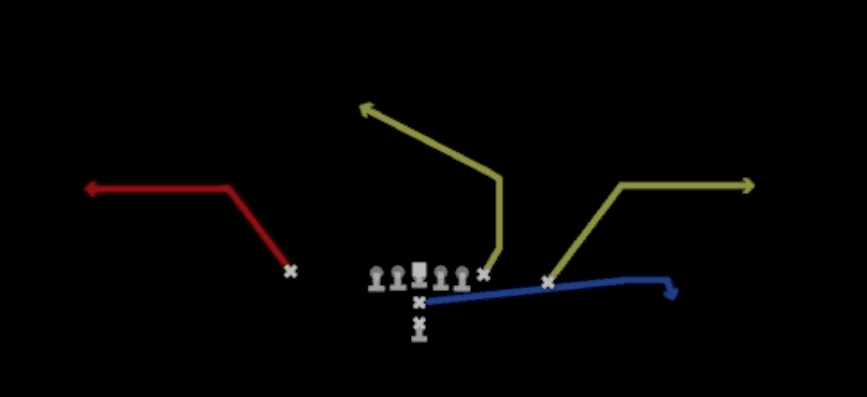


Find plays by concept, not by formation
Search every playbook by tag and personnel grouping, not just Superstar QB Improvisor.
Strengths
- Shotgun owns 102 plays across 8 sets, so you can stay in shotgun spacing all game and still show enough set variety to disguise your intent. That gives an improvising QB constant pocket depth and scramble width that under-center heavy books cannot match.
- The concept mix (Drag, Crosser, Flat, Hitch, Slant, Spot) is built for quick-game and horizontal stretch. Calls like Cross Drag and DBL Outs put receivers on the move underneath, which gives a scrambling QB late checkdowns when he breaks contain.
- The Cover 3 Beater tag and Post and Spot concepts attack the most common zone shell directly. Paired with a hot-routed seam or streak, they punish a flat-footed deep third.
- Four personnel groups (11, 12, 21, 23) across only 180 plays let you force defensive subs between spread and heavy looks. Motion tags in several sets help you read man versus zone pre-snap before you commit.
- At the smallest size among Superstar playbooks, every set is quick to learn. Building a tight audible package takes minimal menu time, and you can realistically master every play in the book.
Weaknesses
- With 57% of the plays in Shotgun, opponents can sit in nickel or dime personnel for most of the game and build their user-controlled defender plan around spread passing concepts.
- I Form, Strong I and Goal Line Offense carry only 9 plays each, so your downhill run game is a thin menu. Once a defense sees FB Dive or Counter Weak a couple of times, you have few alternate heavy calls to break tendencies.
- Singleback (2 sets) and Pistol (2 sets) are the only under-center or balanced middle ground. Your Play Action and Block and Release looks outside Shotgun get repetitive fast, and savvy opponents will key the formation to spot play action.
- As the smallest Superstar book at 180 plays, it offers less route-combo redundancy than larger books. Against a defense that adjusts well, you will lean on hot routes and QB scrambles rather than calling a fresh concept.
- The concept list is heavy on underneath and intermediate routes (Drag, Crosser, Flat, Hitch, Slant). A defense that plays aggressive underneath zone, spies or contains the QB can cut into the improvisation this book depends on.
Usage Tips
Build your base audible package around Shotgun. Carry Cross Drag for man coverage and a Cover 3 Beater concept for single-high zone, and use them on 1st and 10 and 2nd and medium where the underneath windows are widest.
On 3rd and short to medium, go to the Slant, Hitch and Flat concepts in Shotgun. If the throw is not there, roll out toward the flat side so your quarterback keeps a throw-or-run option against an overplayed middle.
Use Singleback and Pistol on early downs to show 11 and 12 personnel with Play Action. Sell the run with a motion tag first, then attack the Post or Spot behind linebackers who bite on the fake.
Save I Form and Strong I for 3rd and 1, 4th and short and four-minute drives. Call FB Dive and Counter Weak to punish light boxes, then switch to Goal Line Offense and Goal Post inside the 5.
Keep Angle Y Sail and Bench ready for 2nd and long, where flood and sideline-level concepts create space. Save the Hail Mary package strictly for final-play situations beyond 45 yards.
Formations in this playbook


Upgrade to Playbooks Rookie
- Filter every play by tag and concept
- Personnel groupings
- Premium play analysis