Team Hub
NFC South
Tampa Bay Buccaneers
Team Snapshot
The Buccaneers enter 2026-2027 at a genuine crossroads: five straight playoff berths and four straight NFC South titles ended with a late-season collapse and an 8-9 finish in 2025, and the offseason stripped away two franchise pillars, receiver Mike Evans (left for San Francisco) and linebacker Lavonte David (retired). Todd Bowles survived a hot seat, overhauled his staff around new offensive coordinator Zac Robinson, and is betting that a healthier Baker Mayfield, a deep young receiver room, and a more physical defense can drag the franchise back into contention in a soft division.
Franchise Difficulty
How hard this franchise is to run well: where the team stands, what the roster gives you, what the cap allows, and what you hold in the draft.
The Buccaneers hand you a functional but imperfect roster built around Baker Mayfield and a strong offensive line, with glaring holes at middle linebacker and tight end, a cap situation that turns negative next year at negative $2.9M (rank 26 of 32), 24 expiring contracts adding roster turnover pressure, and aging contributors at several key spots.
Star Players
Scheme Fit
The schemes this team is set to run in-game, and how its roster grades in them.
- West Coast Zone RunoffensivePassable
- Base 3-4defensiveGood
Build the playbook for this roster.
Playbook Genius ranks the schemes that fit the Tampa Bay Buccaneers and builds a playbook and call sheet around them.
Salary Cap
Tampa Bay has $27.9M (rank 17 of 32) in room now, but with 24 expiring contracts and a projected negative $2.9M (rank 26 of 32) next year, the financial runway is shorter than it looks.
24 contracts expiring
Depth Chart
Madden Tools Analysis
Four starting spots have weak depth behind the starter.
Biggest gaps behind a starter
- TE
- LT
- RG
- QB
Draft Capital
Seven picks this season, all spread across every round, plus three first-rounders in the three-year window gives Tampa Bay real ammunition to address its roster holes in a single aggressive offseason.
Team Ratings
The roster's top strength is its offensive line, headlined by two 90-plus overall tackles in Wirfs and Goedeke, while its weakest spot is tight end, where the depth ranks 31st leaguewide behind a starter ranked 28th.
Strengths
- DT
- FS
- LT
- RT
- WILL
Weak spots
- MIKE
- TE
- WR
- CB
- LEDGE
Offense
Defense
Special teams
Roster Needs
- MIKEhigh
The starting MIKE is Josiah Trotter, ranked 28th among starters leaguewide, making middle linebacker the most urgent upgrade on the roster.
- TEhigh
Cade Otton starts at tight end but ranks 28th among starters and the depth behind him is historically thin at 31st leaguewide, making TE a two-deep problem.
- WRmedium
Chris Godwin Jr. leads a receiver room ranked 26th among starters, and while Emeka Egbuka provides a long-term answer, an additional weapon is needed now.
- CBlow
Zyon McCollum starts opposite a young cornerback group that ranks 22nd leaguewide, leaving the position a secondary concern that still warrants depth investment.
- LEDGElow
Rueben Bain Jr. is the starter but the position ranks 22nd leaguewide, and the depth behind him is thin enough that adding a veteran edge presence makes sense.
- LGlow
Ben Bredeson starts at left guard at 74 overall, ranking the position 21st leaguewide and flagging it as a quiet interior line weakness worth addressing.
Cut Candidates
5-Year Outlook
Tampa Bay enters this franchise window as a team caught between competing and rebuilding. Baker Mayfield provides a capable, Superstar-trait quarterback to keep the offense functional, and Tristan Wirfs and Luke Goedeke give him elite protection on both edges. Bucky Irving is a 24-year-old Superstar who can be the offensive centerpiece for years, and Emeka Egbuka at 23 with a Star dev trait gives the passing game a genuine long-term weapon at receiver. Antoine Winfield Jr. anchors a strong secondary, and Vita Vea, despite entering the later stage of his career, remains the most dominant interior defender on the roster. The concerns are real, though: the team carries no reliable tight end, the middle linebacker position is one of the weakest in the league, and the cap turns negative next season at negative $2.9M (rank 26 of 32) with 24 expiring contracts adding urgency to every offseason decision. Chris Godwin Jr. and Al-Quadin Muhammad are contributors whose best years are behind them, and the dead cap sitting at $11.8M (rank 24 of 32) limits immediate flexibility. With seven picks this season, all falling in the first round through the full seven-round spread, there is real ammunition to address the holes, but the franchise will require disciplined roster management to push past moderate contention into a genuine championship window.
5-Year Plan
Year 1Clear the deck, fill the holes
- Release the highest-value cut candidates, starting with Anthony Nelson ($4.0M freed) and Sean Tucker ($3.5M freed), to generate immediate cap relief before the roster turns negative next year.
- Use the seven available picks to target middle linebacker and tight end, the two positions ranked worst among starters and depth charts leaguewide, as the primary draft focus.
- Evaluate Josiah Trotter and SirVocea Dennis at MIKE and WILL to determine which, if either, can grow into a long-term answer at linebacker before committing to a bigger investment.
Year 2Build around the young core
- Enter Bucky Irving's prime development window as the feature back and build the offensive scheme around his Superstar traits alongside Baker Mayfield.
- Accelerate Emeka Egbuka's growth at receiver, where the roster ranks 26th among starters, by pairing him with a veteran complement to take pressure off his development.
- Address the cap crunch, projected at negative $2.9M next year (rank 26 of 32), by restructuring or renegotiating deals among the 24 expiring contracts to restore working room.
Year 3Find succession at aging positions
- Begin transitioning away from reliance on Chris Godwin Jr. at the top of the WR depth chart, as he moves deeper into the later stage of his career, by elevating Emeka Egbuka to the lead role.
- Establish a long-term answer at MIKE, either through the development of Josiah Trotter or a targeted free-agent investment, as the position remains a league-worst liability without intervention.
- Use the three first-round picks in the three-year capital window to prioritize the interior of both lines and the linebacker corps where youth and development traits are weakest.
Year 4Push into the contention window
- Surround Baker Mayfield with a complete supporting cast at tight end, wide receiver, and linebacker now that cap commitments drop sharply to $196.1M in the plus-two season.
- Lean on Rueben Bain Jr. and Yaya Diaby as ascending EDGE contributors to carry the pass rush forward as Vita Vea's role is carefully managed given where he is in his career.
- Secure Tristan Wirfs and Antoine Winfield Jr. as the cornerstones of a contending team and build the depth chart around their Superstar and X-Factor traits.
Year 5Compete for a championship
- With committed spending falling to $144.7M by the plus-three season, use the financial flexibility to retain key contributors from the young core and add proven veterans at remaining positional holes.
- Ensure the linebacker corps, safety depth, and tight end position, all weaknesses entering this franchise, have been rebuilt through the draft capital accumulated over the prior four seasons.
- Evaluate whether Baker Mayfield or an emerging option at quarterback best fits the franchise's timeline, and make a decisive commitment to the signal-caller who can lead a championship run.
Young core
Full Roster
| Player | Pos | OVR | Age | Dev |
|---|---|---|---|---|
| Age 31 | DT | 94 | 31 |  |
| Age 27 | LT | 94 | 27 |  |
| Age 28 | FS | 93 | 28 | |
| Age 24 | HB | 85 | 24 | |
| Age 27 | RT | 84 | 27 |  |
| Age 30 | WR | 82 | 30 |  |
| Age 23 | WR | 81 | 23 | |
| Age 31 | QB | 81 | 31 | |
| Age 27 | CB | 81 | 27 | |
| Age 30 | K | 81 | 30 | |
| Age 31 | WILL | 80 | 31 | |
| Age 21 | LEDGE | 79 | 21 | |
Franchise History
The Buccaneers were born as an NFL expansion team in 1976, awarded to Tampa, Florida under original owner Hugh Culverhouse and dropped into the AFC West for a single season before moving to the NFC Central in 1977. The beginning was historically brutal: Tampa Bay lost all 14 games in 1976 and the first 12 of 1977, 26 straight defeats, still the longest season-spanning losing streak to open a franchise in NFL history, while wearing the orange "creamsicle" uniforms and the winking-pirate "Bucco Bruce" logo that became cult icons. Coached by John McKay and led by first-ever draft pick Lee Roy Selmon and young quarterback Doug Williams, the Bucs reached the 1979 NFC Championship Game in just their fourth season. From 1983 through 1996 Tampa Bay endured 14 consecutive non-winning seasons, cycling through coaches and high draft picks. Everything changed when Tony Dungy arrived in 1996 and installed the "Tampa 2" defense, building around Derrick Brooks, Warren Sapp, John Lynch, and Ronde Barber. Jon Gruden, acquired in a blockbuster 2002 trade, put them over the top, and that defense throttled the Oakland Raiders 48-21 in Super Bowl XXXVII for the franchise's first championship (2002 season). The team rebranded to its pewter-and-red identity in 1997 and opened Raymond James Stadium that same year. A second title came a generation later: the 2020 signing of Tom Brady, paired with head coach Bruce Arians, produced an immediate championship in Super Bowl LV, 31-9 over the Kansas City Chiefs, the first team ever to play and win a Super Bowl in its own home stadium. The Brady era gave way to the Baker Mayfield years under Todd Bowles, who guided the Bucs to four consecutive NFC South titles (2021-2024) before the streak snapped in 2025.
Notable figures
- Lee Roy Selmon · Defensive end (1976-1984)
The franchise's first-ever draft pick (No. 1 overall, 1976), first Hall of Famer, and cornerstone of its first great defense; the all-time franchise sack leader (78.5) and 1979 NFL Defensive Player of the Year.
 Warren Sapp · Defensive tackle (1995-2003)
Brash, dominant interior rusher and first-ballot Hall of Famer; 1999 Defensive Player of the Year and the engine of the Super Bowl XXXVII defense (77.0 sacks as a Buc).
Photo: Gage Skidmore, CC BY-SA 3.0 (Wikimedia Commons)
 Derrick Brooks · Linebacker (1995-2008)
The franchise's most decorated player: 11 Pro Bowls, 2002 Defensive Player of the Year, Hall of Famer; the soul of the Tampa 2 defense.
Photo: Spiderman789, CC BY-SA 4.0 (Wikimedia Commons)
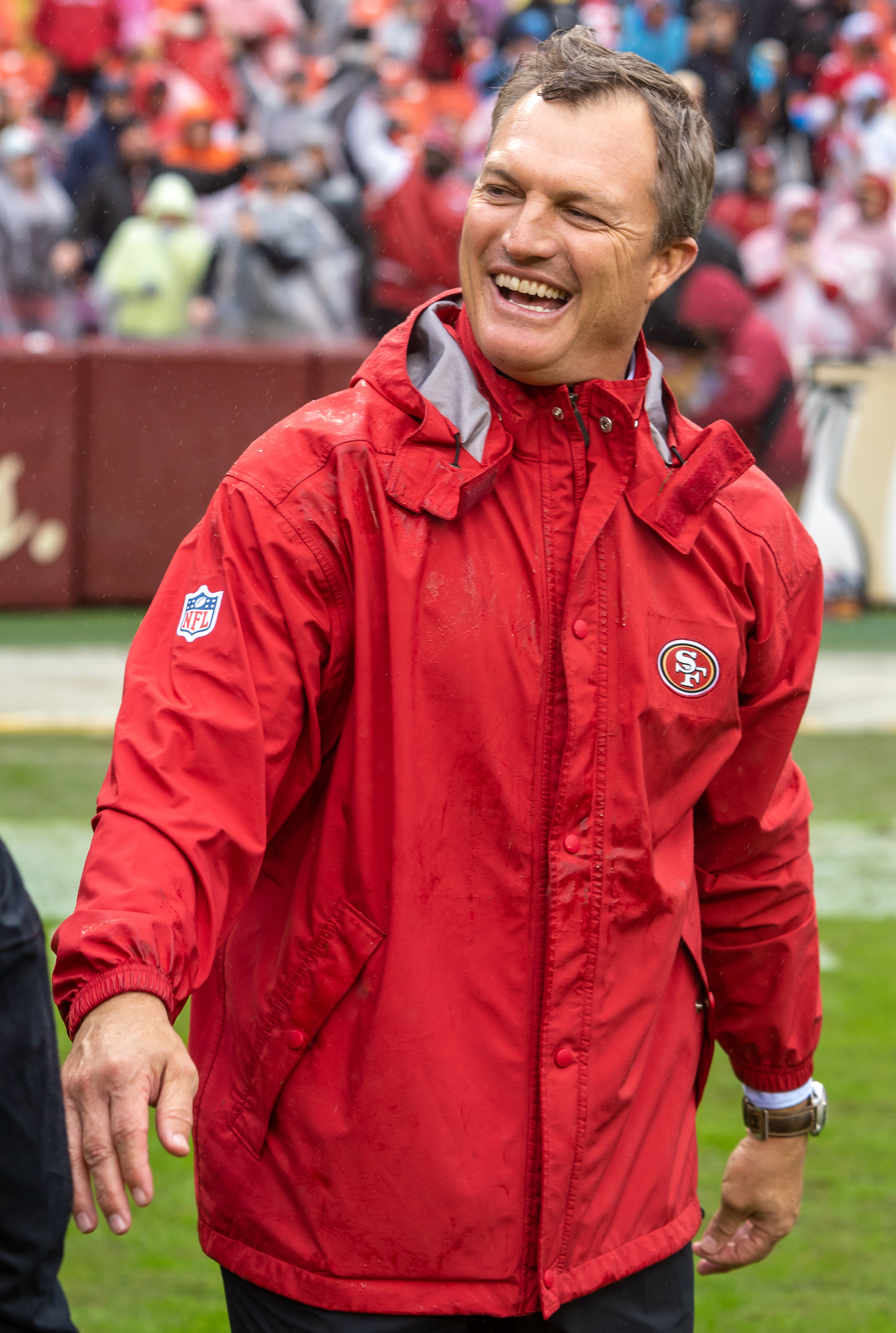 John Lynch · Safety (1993-2003)
Hard-hitting Hall of Fame safety who set the tone in the secondary of the Super Bowl XXXVII defense; five Pro Bowls in Tampa Bay (now an NFL front-office executive).
Photo: All-Pro Reels, CC BY-SA 2.0 (Wikimedia Commons)
 Ronde Barber · Cornerback (1997-2012)
The longest-tenured player in franchise history and its all-time interceptions leader (47); a Hall of Famer whose pick-six in the 2002 NFC Championship Game is franchise lore.
Photo: Jeffrey Beall, CC BY-SA 3.0 (Wikimedia Commons)
 Mike Evans · Wide receiver (2014-2025)
Rewrote the receiving record book: franchise leader in receptions (866), receiving yards (13,052), and receiving touchdowns (108), and holder of the NFL record for consecutive 1,000-yard seasons to open a career (11). Departed for San Francisco in 2026 free agency.
Photo: FloridaMan21, CC BY-SA 4.0 (Wikimedia Commons)
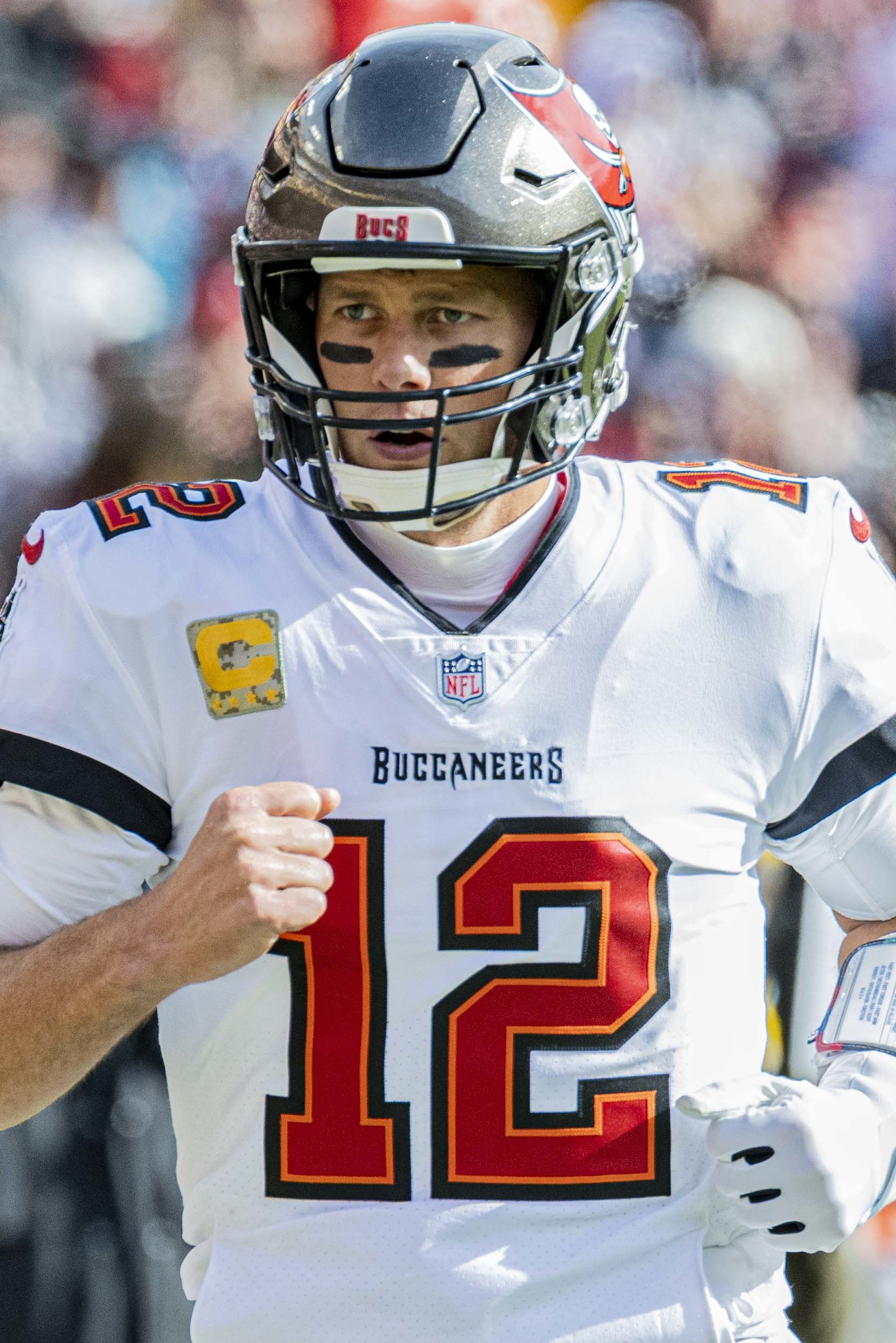 Tom Brady · Quarterback (2020-2022)
Signed in 2020 and delivered a title in his first season; Super Bowl LV MVP and holder of several single-season franchise passing marks set during his three Tampa Bay years.
Photo: All-Pro Reels, CC BY-SA 2.0 (Wikimedia Commons)
 Doug Williams · Quarterback (1978-1982)
The franchise's first franchise quarterback, who led the young Bucs to the 1979 NFC Championship Game; a Ring of Honor member and a pioneering figure in league history.
Photo: Washington Redskins, public domain (Wikimedia Commons)
 Mike Alstott · Fullback (1996-2006)
"The A-Train," a six-time Pro Bowl fullback, beloved fan favorite, and the first Buccaneer to score in a Super Bowl; the franchise's second-leading rusher.
Photo: U.S. Air Force (Staff Sgt. Ned T. Johnston), public domain (Wikimedia Commons)
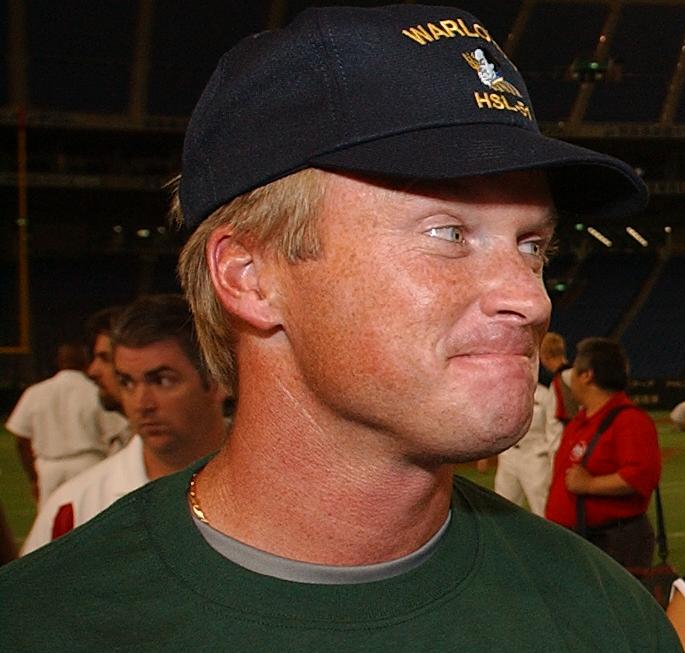 Jon Gruden · Head coach (2002-2008)
The franchise's winningest coach (60-57) and the man who delivered Super Bowl XXXVII in his first season in Tampa.
Photo: U.S. Navy (PM3 John E. Woods), public domain (Wikimedia Commons)
Record book
- Passing yards (career)Jameis Winston (2015-2019) (19,737)
- Passing TDs (career)Jameis Winston (121)
- Rushing yards (career)James Wilder (1981-1989) (5,957)
- Receiving yards (career)Mike Evans (2014-2025) (13,052)
- Receptions (career)Mike Evans (866)
- Sacks (career)Lee Roy Selmon (78.5 (Warren Sapp's 77.0 leads the official era since 1982))
- Interceptions (career)Ronde Barber (1997-2012) (47)
- Points (career)Mike Evans (662)
Team Tips
Playing As
Lean into the defense-and-trenches DNA: use aggressive, disguise-heavy fronts to win with interior pressure (Vita Vea, Calijah Kancey) and edge speed (Yaya Diaby) to generate takeaways and short fields. On offense, play balanced football behind a strong pass-protecting line anchored by All-Pro tackle Tristan Wirfs, run zone concepts with Bucky Irving, use heavy play-action and motion under new coordinator Zac Robinson's McVay-style scheme, and let Baker Mayfield's off-script gunslinger playmaking take shots downfield.
Playing Against
Attack Bowles's blitz-and-man approach with quick game, RPOs, and tempo, targeting a young, injury-tested cornerback group (Benjamin Morrison, Jacob Parrish) that lost veteran Jamel Dean. The 2025 pass rush thinned to 37 sacks and red-zone defense slipped, so pressure the weakened secondary and exploit special teams. Most of all, turn games into second-half, situational-football contests, Tampa Bay repeatedly blew leads and threw costly late interceptions during their losing streak.

Coaching · Todd Bowles
Enters his 5th season as head coach (since 2022). A defensive-minded coach who calls his own defensive plays and operates without a designated defensive coordinator, Bowles runs an aggressive, blitz-heavy 3-4 built on disguise and man coverage, the scheme that, as Super Bowl LV coordinator, held Patrick Mahomes to nine points. He won three straight NFC South titles in his first three seasons before the 2025 miss put him on the hot seat; retained by the Glazer ownership, he responded with a sweeping staff overhaul, most notably hiring offensive coordinator Zac Robinson. General manager Jason Licht remains his front-office partner. The 2026-2027 mandate: restore the "killer instinct," fix the defense, and get Tampa Bay back to the postseason.
Photo: YESNetwork, CC BY 3.0 (Wikimedia Commons)
Coming soon
- Playbook Matches
- Key Plays & Audibles
Upgrade to Team Hub Rookie
- Salary cap breakdown
- Depth chart analysis
- Roster needs & scheme fit
- Cut candidates & 5-year outlook
- Full sortable roster