Team Hub
AFC East
Miami Dolphins
Team Snapshot
Entering 2026-2027, the Miami Dolphins are a proud but reeling franchise in the first year of a top-to-bottom rebuild, new GM Jon-Eric Sullivan, new head coach Jeff Hafley, and a new quarterback in Malik Willis after cutting franchise passer Tua Tagovailoa. Fielding one of the youngest rosters in football, a team that reached the playoffs in 2022 and 2023 is now widely picked to finish near the bottom of the AFC East as it stockpiles youth and digs out of salary-cap trouble.
Franchise Difficulty
How hard this franchise is to run well: where the team stands, what the roster gives you, what the cap allows, and what you hold in the draft.
A starting quarterback ranked 27th in the league, ten high-severity roster holes including dead-last rankings at WR, CB, SS, FS, TE, and RG, the heaviest dead-money burden in the league at $172.8M, and only $21.5M in current cap room combine to make this one of the most demanding rebuilds available.
Star Players
Scheme Fit
The schemes this team is set to run in-game, and how its roster grades in them.
- West Coast Power RunoffensivePassable
- Tampa 2defensivePassable
Salary Cap
Miami carries $172.8M in dead money, the heaviest burden in the league, leaving only $21.5M to work with now, but a projected $175.1M in next-year cap room offers a genuine financial reset on the horizon.
26 contracts expiring
Depth Chart
Madden Tools Analysis
Eleven starting spots have weak depth behind the starter.
Draft Capital
Eight picks in the current draft including four first-rounders and a second-rounder, plus 22 picks over three years with three first-rounders among them, gives Miami the raw material to rebuild multiple positions from scratch.
- Acquired: Round 7 from Giants, this draft
- Acquired: Round 5 from Steelers, this draft
- Traded away: Round 7 to Steelers, this draft
Team Ratings
The roster's top strength is its offensive line interior anchored by Aaron Brewer at 90 overall, while the weakest spot is a receiver room that ranks last in both starter and depth quality across the entire league.
Strengths
- C
- WILL
- HB
- SAM
Weak spots
- CB
- FB
- FS
- LEDGE
- QB
Offense
Defense
Special teams
Roster Needs
- CBhigh
The cornerback room ranks dead last in both starter and depth quality league-wide, with Chris Johnson (76 overall) as the top option ahead of Darrell Baker Jr and JuJu Brents.
- FBhigh
DJ Herman (66 overall) starts at fullback but ranks only 13th at the position, and the depth behind him is occupied by players listed primarily at TE.
- FShigh
Michael Taaffe (71 overall) is the starter but ranks last among all free safeties in the league, making this an urgent upgrade target.
- LEDGEhigh
Chop Robinson starts at LEDGE but the unit ranks 30th in starter quality and 27th in depth, leaving little margin for injury.
- QBhigh
Malik Willis (74 overall) starts but ranks 27th among all starting quarterbacks, and the backup and third options behind him are Kyle McCord and Brady Cook, both well below starter quality.
- REDGEhigh
Joshua Uche (76 overall) is the starter, but depth ranks last in the league with Robert Beal Jr and Andre Jones Jr both at 63 overall behind him.
- RGhigh
Jonah Savaiinaea (68 overall) starts at right guard and ranks last in starter quality league-wide, representing one of the most glaring line vulnerabilities.
- SShigh
Kyle Louis (71 overall) starts at strong safety but ranks last among all starting strong safeties, a critical weakness in an already thin secondary.
- TEhigh
Greg Dulcich (70 overall) starts at TE but the position ranks last in both starter and depth quality, with Justin Joly and Will Kacmarek as the only backups.
- WRhigh
The wide receiver room ranks last in both starter and depth quality across the entire league, with Malik Washington and Jalen Tolbert both at 73 overall leading the group.
- MIKEmedium
Jacob Rodriguez (80 overall) holds the starting spot but depth is 29th in the league, with Jackson Woodard and Shaka Heyward as thin backups.
- RTmedium
Austin Jackson (73 overall) starts but the position ranks 24th in starter quality, and depth beyond Caedan Wallace is a concern.
Cut Candidates
5-Year Outlook
Miami hands you one of the most layered rebuilding challenges in the league. The offensive core has genuine pieces: De'Von Achane is a dynamic, 24-year-old Superstar at running back, Aaron Brewer is an elite center, and Patrick Paul gives the left tackle spot a young foundation. But the quarterback room is a serious liability with Malik Willis starting at 74 overall, and the skill positions around him are the weakest in the league at both WR and TE. Defensively, Jordyn Brooks and Zach Sieler provide real quality, and a young defensive line featuring Chop Robinson, Kenneth Grant, and Jacob Rodriguez at MIKE has legitimate upside with Star dev traits. The secondary is a different story, ranking last at both safety spots and at cornerback overall. The cap situation is historically constrained, with $172.8M in dead money, the most in the league, and only $21.5M available this season. The $175.1M in projected next-year cap room is the most encouraging financial signal, but getting there requires patience and careful roster management. With 22 picks over the next three years including three first-rounders, there are resources to rebuild, but this roster needs significant additions at multiple premium positions before it can compete.
5-Year Plan
Year 1Clear the wreckage, build the floor
- Release Zayne Anderson, Shaka Heyward, Robert Beal Jr, Malik Herring, Andre Jones Jr, and Andrew Meyer to recover nearly $5.3M in combined cap space with minimal dead-money consequences.
- Use the current draft class, which includes picks in rounds 1, 1, 1, 1, 2, 1, and 1 from trades with the Giants and Steelers, to aggressively address the WR, CB, SS, FS, and QB holes identified as league-worst.
- Establish Malik Willis as the short-term starter while developing Kyle McCord behind him, and give Jacob Rodriguez full reps at MIKE to accelerate his Star-trait growth.
Year 2Grow the young core, attack next-year cap room
- Leverage the $175.1M in projected next-year cap room, the most in the league, to sign at least one starter-quality upgrade at quarterback or wide receiver through free agency.
- Monitor De'Von Achane's Superstar development closely and invest in his contract extension before he prices out, as he is entering his prime at the center of the offense.
- Push Jacob Rodriguez into a featured role at MIKE and evaluate whether Chop Robinson and Kenneth Grant are ready to anchor the defensive front without Zach Sieler carrying the load.
Year 3Raise the ceiling on both sides of the ball
- With Darrell Baker Jr entering a later stage of his career, prioritize locking in a long-term starting cornerback from the draft picks or free agency to ensure the position has a future.
- Assess Kadyn Proctor's Star-trait progression at LG and decide whether to commit to him as part of a long-term line that pairs him with Patrick Paul on the left side.
- Begin evaluating whether any players acquired in the prior two drafts are ready to start, particularly at WR and TE where the current depth remains the thinnest in the league.
Year 4Compete or commit to the next wave
- Make a franchise quarterback decision: either commit to whoever has emerged from the depth chart or use remaining draft capital from the 22-pick three-year stockpile to acquire one.
- Build the secondary around the young players developed in seasons 1 through 3, as players like Kyle Louis, Dante Trader Jr, and Jason Marshall Jr will be entering their development windows.
- Use Jordyn Brooks and Zach Sieler's continued veteran presence to stabilize the defense while determining which young pass rushers on the edge are ready to be primary contributors.
Year 5Contend or reload with assets
- With De'Von Achane at the peak of his Superstar arc and a rebuilt offensive line around Brewer and Paul, target a playoff push if the quarterback situation has been resolved.
- Succession planning becomes critical as Zach Sieler enters the later stage of his career, so ensure Kenneth Grant and Jordan Phillips are ready to carry the interior defensive line.
- Evaluate the entire roster against a contender threshold and be willing to trade aging veterans for future picks if the window has not yet fully opened.
Young core
Full Roster
| Player | Pos | OVR | Age | Dev |
|---|---|---|---|---|
| Age 28 | C | 90 | 28 |  |
| Age 24 | HB | 88 | 24 |  |
| Age 28 | WILL | 87 | 28 | |
| Age 30 | DT | 83 | 30 | |
| Age 24 | LT | 81 | 24 |  |
| Age 23 | MIKE | 80 | 23 | |
| Age 21 | LG | 77 | 21 | |
| Age 21 | CB | 76 | 21 | |
| Age 32 | P | 76 | 32 | |
| Age 27 | REDGE | 76 | 27 | |
| Age 22 | DT | 75 | 22 | |
| Age 23 | LEDGE | 75 | 23 | |
Franchise History
The Dolphins were founded in 1965 as an AFL expansion team by Joe Robbie and Danny Thomas, beginning play in 1966 under head coach George Wilson; on their very first play, Joe Auer returned the opening kickoff 95 yards for a touchdown against Oakland. Miami joined the NFL in the 1970 AFL-NFL merger, and the hiring of Don Shula from the Baltimore Colts that year transformed the franchise. Shula lost Super Bowl VI to Dallas, then authored the greatest season in NFL history, the 1972 Dolphins went 14-0 in the regular season and 17-0 overall, capped by a 14-7 win over Washington in Super Bowl VII, still the only perfect season in league annals. Miami repeated in Super Bowl VIII, beating Minnesota 24-7 with fullback Larry Csonka named MVP, powered by Csonka and Mercury Morris, the 'No-Name Defense' led by Nick Buoniconti, and Hall of Fame QB Bob Griese. The Dan Marino era (1983-1999) redefined the passing game, Marino set single-season records with 5,084 yards and 48 touchdowns in his 1984 MVP season and reached Super Bowl XIX, but never won a title despite ten playoff appearances. After Marino, Miami leaned on the Jason Taylor-Zach Thomas defense before sliding into a decades-long wilderness; its last playoff win came after the 2000 season and its last AFC East title in 2008. The Mike McDaniel-Tua Tagovailoa era brought back-to-back playoff berths (2022, 2023) and the NFL's top offense in 2023, but road and cold-weather failures, injuries, and a 2024-2025 collapse ended it. McDaniel was fired in January 2026, launching a rebuild under first-time NFL head coach Jeff Hafley.
Notable figures
- Dan Marino · Quarterback (1983-1999)
The most prolific passer of his era and the franchise's signature player; retired as the NFL's all-time leader in yards, TDs, and completions; Hall of Fame 2005.
 Don Shula · Head coach (1970-1995)
NFL's all-time winningest coach (347 wins); architect of the perfect 1972 season and back-to-back Super Bowl titles; Hall of Fame 1997.
Photo: U.S. Navy, public domain (Wikimedia Commons)
 Bob Griese · Quarterback (1967-1980)
Steady field general of the perfect-season teams; led Miami to three straight Super Bowls and two titles; #12 retired; Hall of Fame 1990.
Photo: U.S. Marine Corps, public domain (Wikimedia Commons)
 Larry Csonka · Fullback (1968-1974, 1979)
Bruising centerpiece of the ball-control offense; Super Bowl VIII MVP; franchise's all-time leading rusher; #39 retired; Hall of Fame 1987.
Photo: Whitehouse.gov, public domain (Wikimedia Commons)
 Jason Taylor · Defensive end (1997-2007, 2009, 2011)
Franchise all-time sack leader; 2006 NFL Defensive Player of the Year; Hall of Fame 2017.
Photo: Ed Yourdon, CC BY-SA 2.0 (Wikimedia Commons)
 Zach Thomas · Linebacker (1996-2007)
Undersized, relentless tackling machine and heart of the late-1990s/2000s defense; franchise all-time tackles leader; Hall of Fame 2023.
Photo: Chrisjnelson, CC BY 3.0 (Wikimedia Commons)
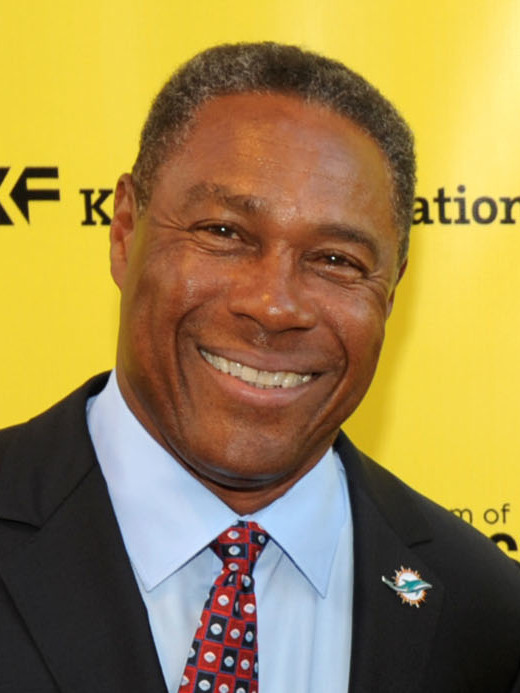 Nat Moore · Wide receiver (1974-1986)
Durable, clutch receiver who bridged the Griese and Marino eras; longtime Dolphins executive and community figure; Dolphins Honor Roll.
Photo: MiamiFilmFestival, CC BY-SA 2.0 (Wikimedia Commons)
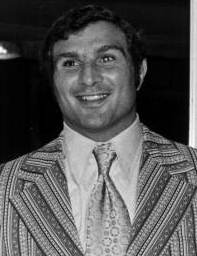 Nick Buoniconti · Linebacker (1969-1974, 1976)
Undersized, cerebral leader of the 'No-Name Defense'; two-time Super Bowl champion; Hall of Fame 2001.
Photo: Roy Erickson, public domain (Wikimedia Commons)
 Dwight Stephenson · Center (1980-1987)
Regarded as one of the greatest centers ever; anchored a line that led the NFL in fewest sacks allowed for six straight years; Hall of Fame 1998.
Photo: public domain (1984 card, Wikimedia Commons)
 Paul Warfield · Wide receiver (1970-1974)
Elegant deep threat with the highest career yards-per-catch (20.1) of any 300-reception receiver; two-time champion in Miami; Hall of Fame 1983.
Photo: Erik Drost, CC BY 2.0 (Wikimedia Commons)
Record book
- Passing yardsDan Marino (61,361)
- Passing TDsDan Marino (420)
- Rushing yardsLarry Csonka (6,737)
- Receiving yardsMark Duper (8,869)
- ReceptionsMark Clayton (550)
- SacksJason Taylor (131.0)
- InterceptionsJake Scott (35)
- PointsOlindo Mare (1,048)
Team Tips
Playing As
Under new HC Jeff Hafley and OC Bobby Slowik, both from the Kyle Shanahan/49ers tree, Miami is transitioning to a run-first, outside-zone rushing attack built around Pro Bowl RB De'Von Achane and the dual-threat mobility of QB Malik Willis. In 2025 Achane ran for 1,350 yards and 8 TDs while catching 67 passes, leading the NFL at 5.7 yards per carry. Lean on wide-zone runs to get him into space, play-action, and read-option looks exploiting Willis's legs, a more physical, ball-control approach than the McDaniel-era speed-and-motion horizontal passing game. On defense, Hafley (who calls the plays) favors versatility, disguised coverages, simulated pressures, disciplined tackling, and more four-man fronts.
Playing Against
Miami's roster is young and thin, especially at wide receiver after moving on from Tyreek Hill. Willis is a boom-or-bust arm who struggled starting for Tennessee. Load the box against Achane, force Willis to win consistently from the pocket, and dare an unproven receiver group to beat you. Historically the Dolphins are vulnerable in cold weather and on the road, physical, cold-weather opponents and defenses that take away the run and Achane's screen game are the blueprint.
Coaching · Jeff Hafley
Head coach entering 2026-2027 (first season, hired January 19, 2026) and the 12th head coach in Dolphins history. A defensive specialist and former Green Bay Packers defensive coordinator (2024-25) and Boston College head coach (2020-23), known for adaptable, versatile defense tailored to personnel. He calls the defensive plays himself while relying on DC Sean Duggan. It is his first NFL head-coaching job, tasked with a ground-up rebuild alongside OC Bobby Slowik.
Coming soon
- Playbook Matches
- Key Plays & Audibles
Upgrade to Team Hub Rookie
- Salary cap breakdown
- Depth chart analysis
- Roster needs & scheme fit
- Cut candidates & 5-year outlook
- Full sortable roster