Team Hub

AFC West
Denver Broncos
Team Snapshot
As they enter the 2026-2027 season, the Denver Broncos are a rising AFC power: fresh off a 14-3 regular season and their first AFC Championship Game appearance in a decade, they return nearly their entire roster around the NFL's top-ranked defense and quarterback Bo Nix, with Super Bowl-winning head coach Sean Payton signed through 2030 and expectations firmly set on a Super Bowl run.
Franchise Difficulty
How hard this franchise is to run well: where the team stands, what the roster gives you, what the cap allows, and what you hold in the draft.
A young franchise quarterback in Bo Nix, one of the game's premier cornerbacks in Pat Surtain II, a stout defensive front, a clean dead-cap situation of just $1.0M, and $32.7M in cap room combine to hand you a competitive, well-resourced roster with clear but manageable holes to address.
Star Players
Scheme Fit
The schemes this team is set to run in-game, and how its roster grades in them.
- West Coast Power RunoffensiveGood
- Base 3-4defensiveGood
Build the playbook for this roster.
Playbook Genius ranks the schemes that fit the Denver Broncos and builds a playbook and call sheet around them.
Salary Cap
Denver sits with $32.7M in cap room ranked 11th leaguewide and a league-best $1.0M in dead money, giving the front office real spending power right now, though next year's room tightens sharply to $2.0M.
24 contracts expiring
Depth Chart
Madden Tools Analysis
Six starting spots have weak depth behind the starter.
Draft Capital
Denver holds eight picks in the next draft including six first-rounders spread across rounds one through seven, and 22 picks over three years with three first-rounders, giving the front office genuine draft leverage to accelerate or reshape the roster.
- Acquired: Round 7 from Saints, this draft
Team Ratings
Denver's top strength is a defense headlined by one of the league's best cornerbacks and a loaded defensive front, while the weakest spot is a WILL linebacker room that ranks near the bottom of the league in both starter and depth quality.
Strengths
- CB
- LT
- REDGE
- RG
- SS
Weak spots
- HB
- WILL
- LG
- TE
Offense
Defense
Special teams
Roster Needs
- HBhigh
J.K. Dobbins starts at 81 overall but the position ranks 28th in starter quality leaguewide, making an upgrade at running back the team's most pressing offensive need.
- WILLhigh
Justin Strnad starts at WILL but ranks 25th at the position leaguewide, and the depth behind him ranks 30th, making this the thinnest spot on the entire roster.
- LGlow
Ben Powers holds the starting left guard job at 74 overall, ranking 21st leaguewide, and his release economics make him a natural cut or upgrade target.
- TElow
Evan Engram starts at 78 overall but the position ranks 22nd leaguewide in starter quality and 19th in depth, leaving tight end as a secondary but real roster gap.
Cut Candidates
5-Year Outlook
Denver is built around a strong defensive identity, anchored by Pat Surtain II, Zach Allen, Nik Bonitto, and Jonathon Cooper, and a young quarterback in Bo Nix who has room to grow alongside a genuinely elite offensive line. Quinn Meinerz at 27 and Nik Bonitto at 26 give the franchise premium Superstar-trait talents in the prime of their careers, while Talanoa Hufanga and Jaylen Waddle add youth and depth on both sides of the ball. The immediate concerns are the running back and WILL linebacker positions, both of which rank near the bottom of the league. Garett Bolles and Alex Singleton are dependable starters now but are entering the late stages of their careers, so succession planning at left tackle and middle linebacker will become necessary within the next couple of seasons. With $32.7M in cap room ranked 11th in the league and the lowest dead cap in the league at $1.0M, Denver has the financial flexibility to patch those holes in free agency while Bo Nix develops into the long-term centerpiece of the offense.
5-Year Plan
Year 1Trim the fat, plug the gaps
- Release Jarrett Stidham, Sam Ehlinger, Ben Powers, and Evan Engram to recapture meaningful cap room on top of the existing $32.7M and target a starter-quality running back and WILL linebacker through free agency or trade.
- Clear low-value depth pieces like Michael Deiter, Devon Key, Karene Reid, and Jordan Jackson to free additional budget and roster spots for competitive depth signings.
- Establish Bo Nix as the clear franchise quarterback under the Air Raid scheme while building the run game around J.K. Dobbins and RJ Harvey as a short-term timeshare.
Year 2Develop the young core
- Prioritize contract extensions for Nik Bonitto and Quinn Meinerz, both 27 or younger in this window, to lock in cornerstone Superstar talents before they enter the open market.
- Give Troy Franklin, Jahdae Barron, and Jonah Coleman expanded roles to determine which young contributors can step into permanent starting or featured spots.
- Begin identifying a left tackle successor as Garett Bolles moves deeper into the late stage of his career, using one of the team's eight upcoming draft picks to add a developmental lineman.
Year 3Raise the ceiling
- With next-year committed salary dropping to $270.2M and three first-round picks over the three-year draft window, use premium picks to address the WILL linebacker room and any remaining offensive line succession needs.
- Elevate Bo Nix by surrounding him with a legitimate number-one running back, ensuring the offense can threaten defenses both through the Air Raid passing attack and a credible ground game.
- Transition Alex Singleton's MIKE role to a younger, higher-upside option as Singleton enters a point in his career where relying on him as the long-term answer becomes a risk.
Year 4Contend or commit
- With committed salary falling to $141.5M by the third season out, leverage the cap flexibility to add proven contributors around Bo Nix and the defensive core for a legitimate playoff push.
- Ensure Pat Surtain II and Nik Bonitto are locked up long-term as the twin pillars of the defense, and evaluate the defensive tackle room with Zach Allen still in his prime.
- Confirm Mike McGlinchey's successor at right tackle is ready, as McGlinchey will be well into the late stage of his career at this point in the plan.
Year 5Sustain the window
- With the three-year draft stockpile of 22 picks largely replenishing the roster, assess which young contributors from seasons 2 and 3 have grown into starters and restructure depth accordingly.
- Commit to Bo Nix as the long-term quarterback of record and build contract architecture around keeping the Surtain, Meinerz, and Bonitto core together through the back half of the decade.
- Evaluate wide receiver depth as Courtland Sutton moves into the later years of his career and determine whether Troy Franklin or another young receiver has developed into a true number-one complement to Jaylen Waddle.
Full Roster
| Player | Pos | OVR | Age | Dev |
|---|---|---|---|---|
| Age 26 | CB | 97 | 26 |  |
| Age 34 | LT | 96 | 34 |  |
| Age 27 | RG | 96 | 27 | |
| Age 26 | REDGE | 91 | 26 | |
| Age 29 | DT | 89 | 29 | |
| Age 26 | SS | 89 | 26 |  |
| Age 30 | WR | 86 | 30 | |
| Age 32 | MIKE | 85 | 32 | |
| Age 27 | WR | 85 | 27 | |
| Age 28 | LEDGE | 84 | 28 | |
| Age 28 | FS | 83 | 28 | |
| Age 31 | RT | 82 | 31 | |
Franchise History
The Denver Broncos were founded on August 14, 1959, when minor-league baseball owner Bob Howsam was awarded a charter franchise in the upstart American Football League (AFL), and they began play in 1960 in Denver, Colorado. Denver won the first-ever AFL game, a 13-10 victory over the Boston Patriots on September 9, 1960, but the decade that followed was bleak: the Broncos compiled a 39-97-4 record across the AFL's ten seasons, the worst of any original AFL club, and were the only original AFL team never to post a winning season or reach the league title game. The franchise nearly relocated in 1965 before a local ownership group led by the Phipps brothers stepped in, and the 1967 signing of Syracuse running back Floyd Little, nicknamed 'The Franchise', helped stabilize the club. Denver joined the NFL in the 1970 AFL-NFL merger. The Broncos' first sustained success arrived in the mid-1970s: Denver posted its first winning season in 1973 under John Ralston, and in 1977, first-year head coach Red Miller and the vaunted 'Orange Crush' 3-4 defense, anchored by linebacker Randy Gradishar, carried the team to a 12-2 record and its first Super Bowl (XII), a loss to the Dallas Cowboys. The defining modern era began in 1983 with the arrival of quarterback John Elway, who reached five Super Bowls and authored signature moments such as 'The Drive.' Under owner Pat Bowlen and head coach Mike Shanahan, Elway and MVP running back Terrell Davis finally broke through, winning back-to-back titles: Super Bowl XXXII over the Green Bay Packers (31-24, Davis MVP) and Super Bowl XXXIII over the Atlanta Falcons (34-19, Elway MVP in his final game). After a playoff drought, the Peyton Manning era (2012-2015) delivered a defense-driven 24-10 win over the Carolina Panthers in Super Bowl 50, the franchise's third championship. The Broncos hired Super Bowl-winning coach Sean Payton in 2023, drafted Bo Nix in 2024, and rapidly returned to contention, going 14-3 and reaching the AFC Championship Game in 2025.
Notable figures
 John Elway · Quarterback (1983-1998), later GM & President of Football Operations
Five-time Super Bowl starter, two-time champion, Hall of Famer and the franchise's all-time passing leader; arguably the greatest Bronco.
Photo: All-Pro Reels, CC BY-SA 2.0 (Wikimedia Commons)
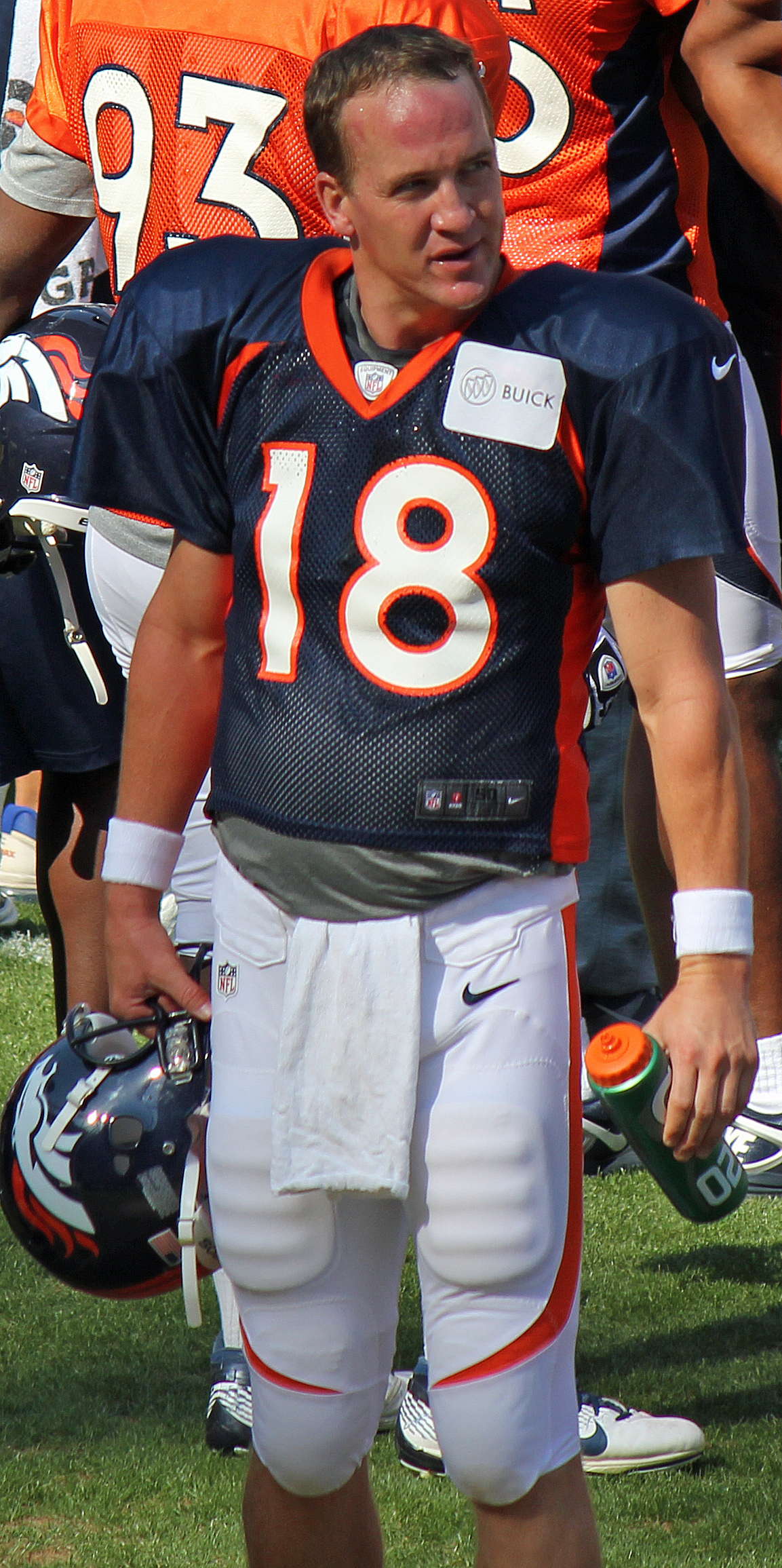 Peyton Manning · Quarterback (2012-2015)
Five-time NFL MVP who set single-season passing records in 2013 and won Super Bowl 50 in his final season; Hall of Famer.
Photo: Jeffrey Beall, CC BY-SA 3.0 (Wikimedia Commons)
 Terrell Davis · Running back (1995-2001)
Super Bowl XXXII MVP, 1998 NFL MVP, 2,000-yard rusher and the franchise's all-time leading rusher; Hall of Famer.
Photo: Jeffrey Beall, CC BY 4.0 (Wikimedia Commons)
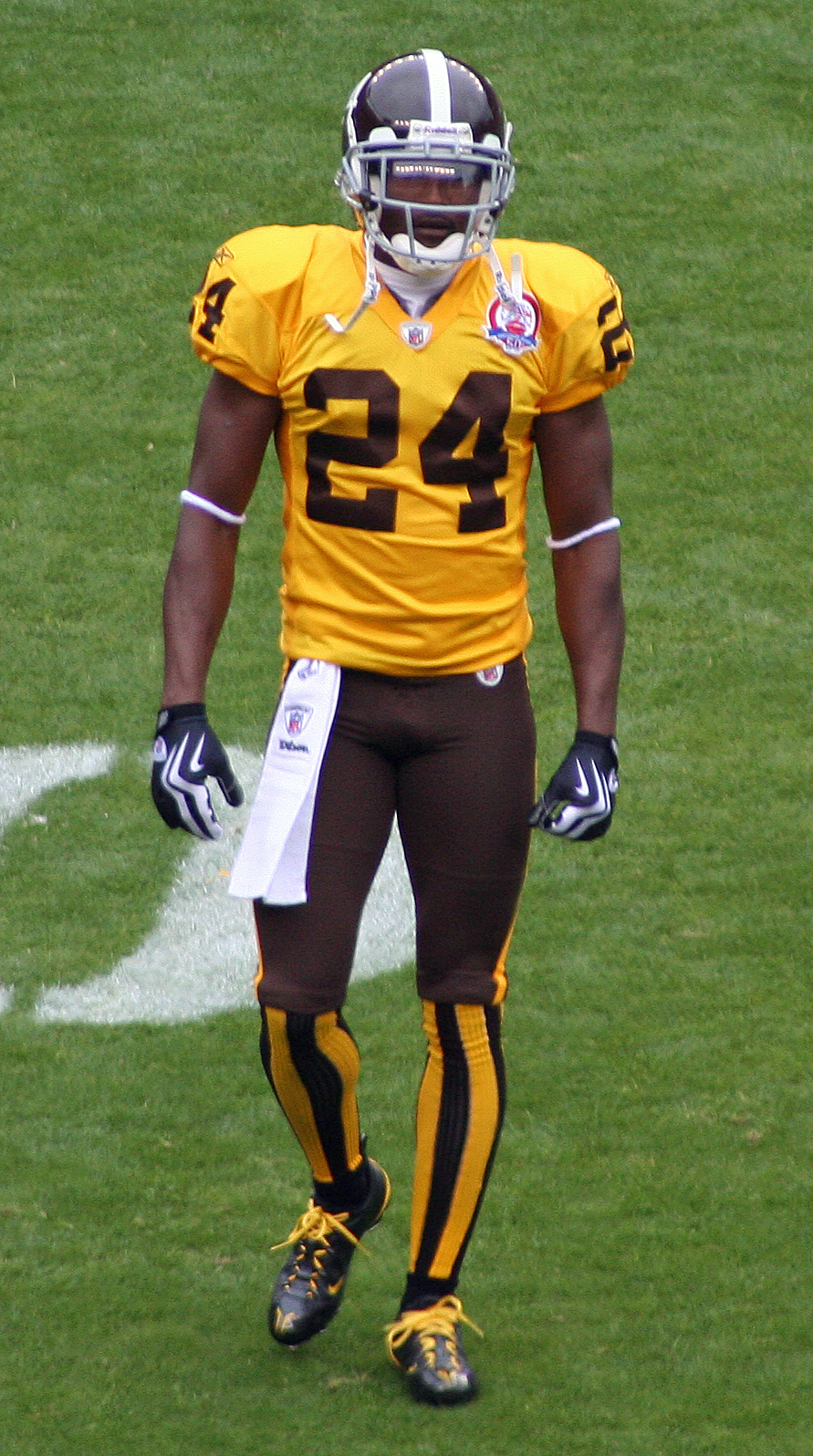 Champ Bailey · Cornerback (2004-2013)
One of the greatest cover corners ever; a fixture of Denver's defense and a Hall of Famer.
Photo: Jeffrey Beall, CC BY-SA 3.0 (Wikimedia Commons)
 Von Miller · Outside linebacker (2011-2021)
Super Bowl 50 MVP and the franchise's all-time sacks leader (110.5 with Denver).
Photo: Jeffrey Beall, CC BY-SA 3.0 (Wikimedia Commons)
 Shannon Sharpe · Tight end (1990-1999, 2002-2003)
Three-time Super Bowl champion (two with Denver), one of the most prolific receiving tight ends ever; Hall of Famer.
Photo: U.S. Air Force (Staff Sgt. Kristi Machado), public domain (Wikimedia Commons)
 Floyd Little · Running back (1967-1975)
'The Franchise' whose signing helped keep the team in Denver; five-time Pro Bowler and Hall of Famer.
Photo: Jeffrey Beall, CC BY-SA 3.0 (Wikimedia Commons)
 Steve Atwater · Safety (1989-1998)
Hard-hitting safety, two-time Super Bowl champion and Hall of Famer.
Photo: U.S. Marine Corps (Lance Cpl. Taylor Vo), public domain (Wikimedia Commons)
 Randy Gradishar · Linebacker (1974-1983)
Leader of the 'Orange Crush' defense, 1978 NFL Defensive Player of the Year and Hall of Famer (Class of 2024).
Photo: Howdythere, public domain (Wikimedia Commons)
 Rod Smith · Wide receiver (1995-2006)
Undrafted-to-star receiver and the franchise's all-time leader in receptions and receiving yards.
Photo: Jeffrey Beall, CC BY-SA 3.0 (Wikimedia Commons)
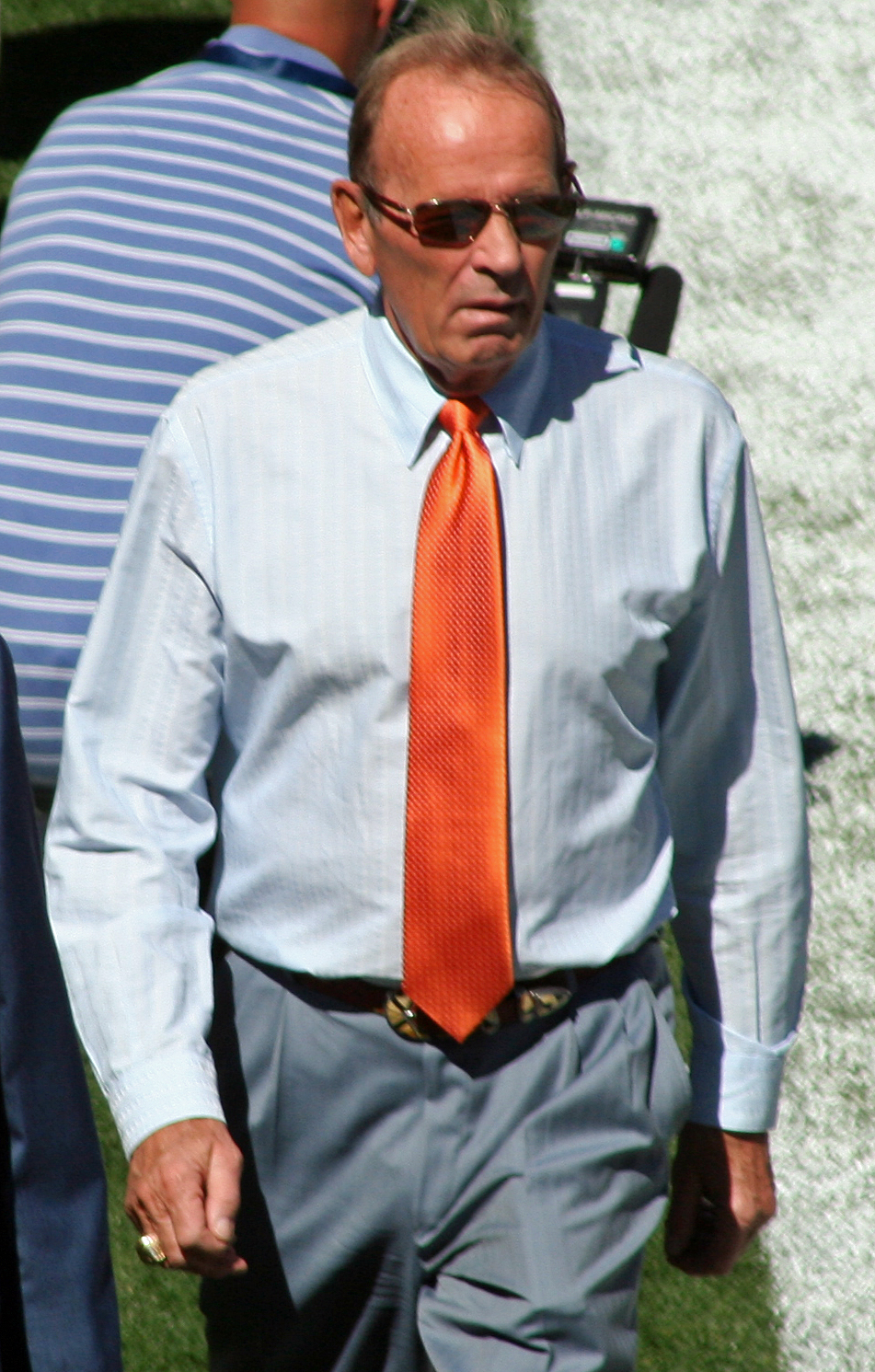 Pat Bowlen · Owner (1984-2019)
Guided the franchise through its championship eras; Hall of Famer.
Photo: Jeffrey Beall, CC BY-SA 3.0 (Wikimedia Commons)
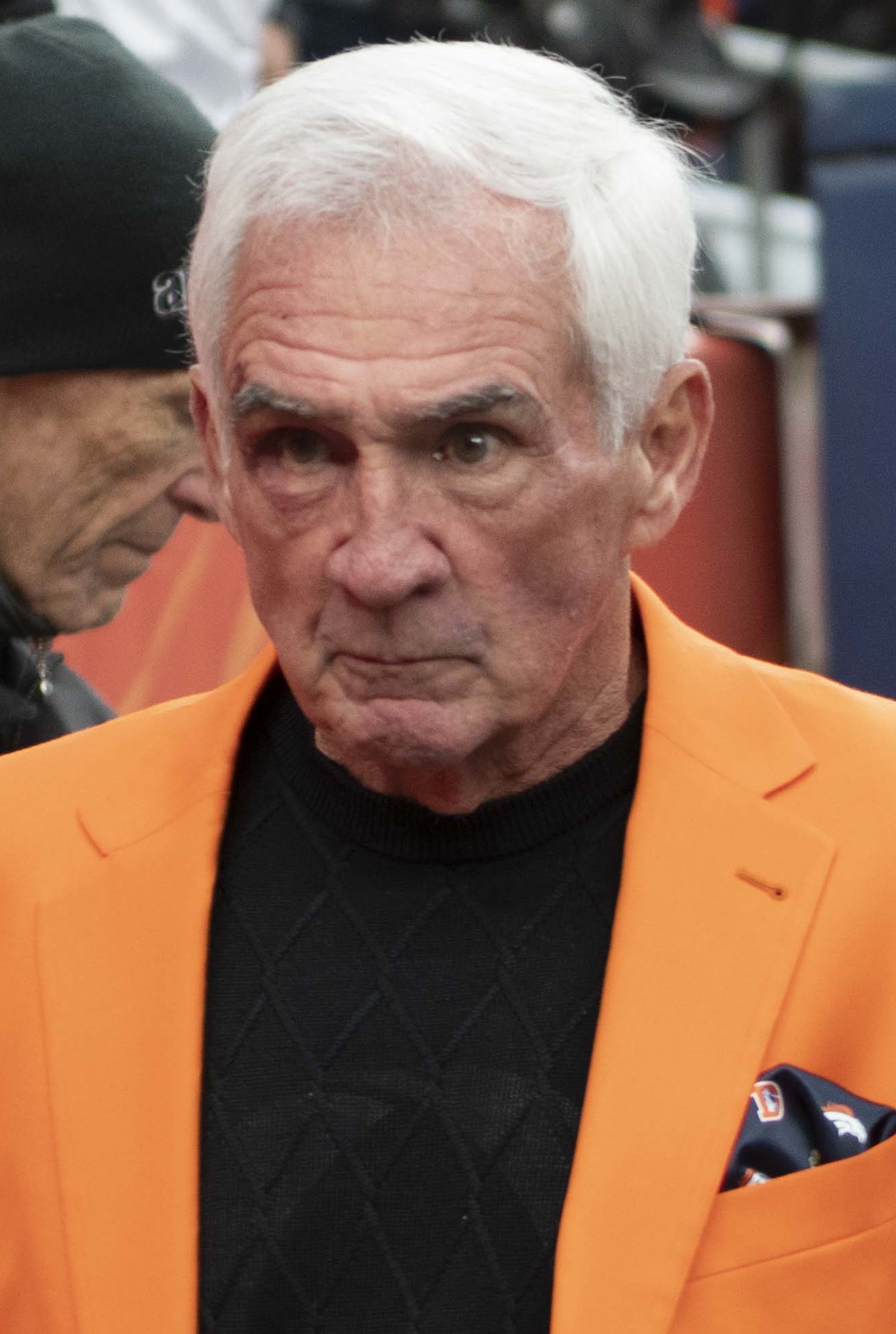 Mike Shanahan · Head coach (1995-2008)
Franchise's all-time winningest coach (146-91 including playoffs); led back-to-back Super Bowl titles.
Photo: All-Pro Reels, CC BY-SA 2.0 (Wikimedia Commons)
Record book
- Passing yardsJohn Elway (1983-1998) (51,475)
- Passing TDsJohn Elway (300)
- Rushing yardsTerrell Davis (1995-2001) (7,607)
- Receiving yardsRod Smith (1995-2006) (11,389)
- ReceptionsRod Smith (849)
- SacksVon Miller (110.5 (official since 1982))
- InterceptionsSteve Foley (1976-1986) (44)
- PointsJason Elam (1,786)
Team Tips
Playing As
Lean on a dominant, pressure-heavy defense, Denver led the NFL with a franchise-record 68 sacks in 2025 and finished 3rd in scoring defense. Generate pressure from edge rushers Nik Bonitto and Jonathon Cooper and interior rusher Zach Allen behind lockdown corner Pat Surtain II, using Vance Joseph's blitz-happy scheme to force turnovers and short fields. On offense, ride efficient, mistake-limiting QB play from Bo Nix behind an elite pass-protecting line (Quinn Meinerz, Garrett Bolles), a committee run game, and new explosiveness from Jaylen Waddle paired with Courtland Sutton. Trust the team in the clutch, they set an NFL record with 12 comeback wins in 2025.
Playing Against
Run the ball to neutralize the pass rush and control the clock, the Bills exposed Denver in the 2024 Wild Card round with 210 rushing yards. Because the front is so aggressive, use mobile quarterbacks and quick-rhythm passing to beat the blitz, and attack through the air when the secondary is banged up. On offense, make Nix win from behind against pressure and limit the run game, betting the offense is less proven than the defense.

Coaching · Sean Payton
Head coach since 2023 and a Super Bowl XLIV winner with the New Orleans Saints, Payton is an offensive innovator and QB developer who engineered a rapid Denver turnaround: 8-9 in 2023, 10-7 and a playoff berth in 2024, and 14-3 with the AFC's No. 1 seed in 2025. He is signed through the 2030 season and handed play-calling duties to OC Davis Webb in February 2026, the first time in his head-coaching career he will not call plays. His career record entering 2026 is 194-118 (.622).
Photo: All-Pro Reels, CC BY-SA 2.0 (Wikimedia Commons)
Coming soon
- Playbook Matches
- Key Plays & Audibles
Upgrade to Team Hub Rookie
- Salary cap breakdown
- Depth chart analysis
- Roster needs & scheme fit
- Cut candidates & 5-year outlook
- Full sortable roster