Playbooks
At a Glance
In 1 playbook
Overview
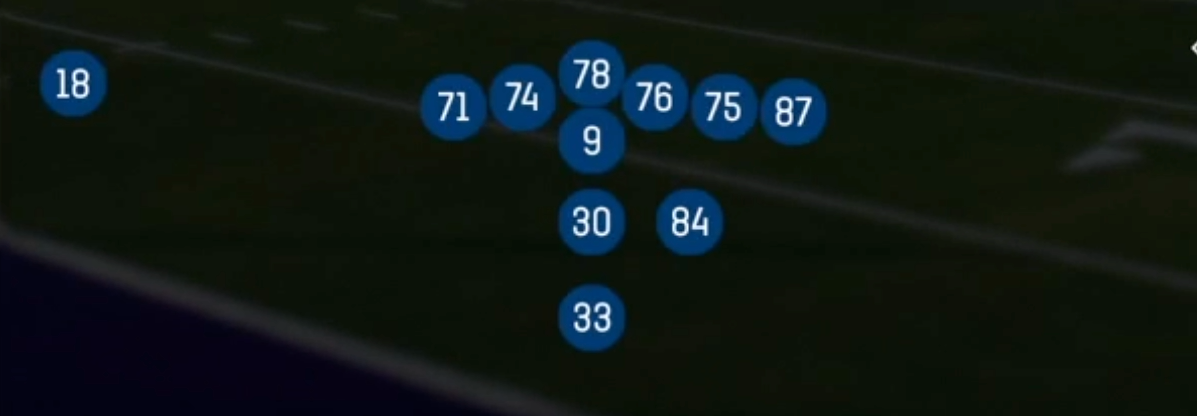
The Tight set in the Power I formation is one of the heaviest looks in Madden NFL, built around 32 personnel: three running backs, two tight ends, and zero wide receivers. Both tight ends align snug to the core of the formation, and the backfield stacks the HB behind a fullback with an extra back in a power alignment. Other Power I sets may split a tight end or bring a receiver onto the field. Tight condenses all eleven players inside the numbers, which forces the defense to match with its own heavy package or risk getting outmanned at the point of attack.
This compression is the whole point. With two inline tight ends and multiple lead blockers, every run concept in the set (Power O, HB Blast, HB Lead Dive, HB Toss) gets an extra hat at the point of attack, and the pulling guard on Power O often meets a linebacker who has no help. Defenses facing this look almost always respond with goal line or heavy base personnel. That trade removes cover defenders from the field and sets up the play-action shots.
The Gadget tag reflects how the set weaponizes its own tendency. PA Power O and PA FB Flat use identical backfield action to their run counterparts, so the fullback or a tight end leaks into space while the linebackers crash downhill. Because there are no receivers to isolate, the matchup advantage comes from getting a fullback or tight end matched on a linebacker or safety who has already committed to the run fit. That makes it one of the most effective short-yardage and red zone packages in the game.
Strengths
- Power O gets a pulling guard plus multiple lead backs at the point of attack, creating a numbers advantage against 4-3 and 3-4 base fronts that do not load the box.
- PA Power O and PA FB Flat mirror the run play art exactly, so aggressive users who crash the A and B gaps leave the flat and seam wide open for the fullback or tight end.
- Heavy 32 personnel forces most opponents into goal line or jumbo defensive packages, which strips out cornerbacks and slot defenders and weakens their ability to match any play-action release.
- HB Toss punishes defenses that pinch everyone inside to stop Power O and Blast, attacking the edge with the tight end and fullback as lead blockers.
- In short yardage and at the goal line, HB Lead Dive and HB Blast hit downhill fast with lead blockers already in the hole, making it tough to generate a clean run stop without a perfect user read.
Weaknesses
- With zero wide receivers on the field there is no true man beater or vertical threat, so a defense that commits to run fits can sell out with 9 or 10 in the box without fearing a deep shot.
- The limited playbook (six plays, mostly runs) creates obvious tendencies, and a sharp opponent will quickly recognize whether you are running inside, outside, or play-action based on down and distance.
- Edge blitzes and run commit adjustments on the play side can blow up HB Toss and the pulling guard on Power O before the lead blockers reach the second level.
- A user-controlled linebacker or safety sitting in the flat can take away PA FB Flat, and without receivers to hot route, your checkdown options on play-action are minimal.
- It is very difficult to come back from a deficit or run a two minute drill from this set because it cannot stretch the field or stop the clock efficiently.
Usage Tips
Use Tight on 3rd and 1, 4th and short, and inside the 5 yard line where the extra blockers matter most, and avoid it on long yardage downs where the lack of receivers becomes a liability.
Read the box count pre-snap: if the defense stays in base with a light box, run Power O or HB Blast inside, and if they crowd the middle with goal line, audible to HB Toss to attack the edge.
Establish Power O two or three times before calling PA Power O, and wait until you see the user linebacker cheating downhill toward the line before you pull the trigger.
On PA FB Flat, watch the flat defender right after the fake: if he bites on the run action, hit the fullback immediately, and if he stays home, look for the tight end leaking behind the linebackers.
Mix run direction by flipping plays pre-snap so the defense cannot key on strength of formation, and use the set sparingly enough that your opponent never settles into a comfortable counter.