Team Hub
NFC West
San Francisco 49ers
Team Snapshot
The San Francisco 49ers enter the 2026-2027 season as a battle-tested NFC contender looking to bounce back from a 12-5, injury-marred 2025 campaign that ended in a lopsided Divisional Round defeat, banking on a healthier core (Brock Purdy, Christian McCaffrey, George Kittle, Fred Warner, Nick Bosa) and a new defensive coordinator, Raheem Morris, to get back over the hump after two Super Bowl near-misses under Kyle Shanahan.
Franchise Difficulty
How hard this franchise is to run well: where the team stands, what the roster gives you, what the cap allows, and what you hold in the draft.
A Superstar quarterback in Brock Purdy, a roster stacked with elite talent at skill positions, the most cap room in the league at $64.5M, and three first-round picks over the next three years make this franchise very forgiving to run, despite a projected cap crunch next season and real holes at DT, FS, and LG.
Star Players
Scheme Fit
The schemes this team is set to run in-game, and how its roster grades in them.
- Multiple Zone RunoffensiveGood
- Base 4-3defensivePassable
Salary Cap
The 49ers sit on a league-best $64.5M in cap room right now, but committed salary explodes to $351.8M next season, turning that surplus into a projected $25.7M deficit that demands careful spending in Year 1.
27 contracts expiring
Depth Chart
Madden Tools Analysis
Two starting spots have weak depth behind the starter.
Biggest gaps behind a starter
- HB
- DT
Draft Capital
Eight picks in the upcoming draft, including six in the first round, and 22 total picks over three years give this franchise an extraordinary rebuild and reload runway that most contenders can only dream about.
- Acquired: Round 7 from Chiefs, this draft
- Acquired: Round 6 from Ravens, this draft
- Traded away: Round 6 to Chiefs, this draft
Team Ratings
The roster's top strength is a historically elite offensive line and skill-position core headlined by three players 96 overall or better, while the defensive interior is the weakest spot, ranking last in the league in DT depth.
Strengths
- HB
- LEDGE
- LT
- MIKE
- QB
Weak spots
- DT
- FS
- LG
- SS
- REDGE
Offense
Defense
Special teams
Roster Needs
- DThigh
The defensive tackle room ranks 28th at the starter level and dead last in depth, with Osa Odighizuwa (77 overall) leading a group that drops off sharply behind him.
- FShigh
Ji'Ayir Brown (74 overall) starts at free safety on a unit ranked 29th at the position, making an upgrade here one of the most pressing priorities on the roster.
- LGhigh
Connor Colby (68 overall) is the starter at left guard on an offense ranked last in the league at that spot, creating an immediate hole in an otherwise strong offensive line.
- SSmedium
Marques Sigle (76 overall) holds the starting strong safety job, but the unit ranks 25th at the starter level and depth behind him is thin at best.
- REDGElow
Mykel Williams (77 overall, 22 years old, Star) starts opposite Nick Bosa, and while the long-term potential is promising, the unit ranks 23rd at the starter level right now.
Cut Candidates
5-Year Outlook
The 49ers hand you one of the most talent-dense rosters in the game, built around Brock Purdy at quarterback and bookended by 97 and 98 overall stars at left tackle, tight end, halfback, and linebacker. The window is wide open right now, but it comes with built-in urgency. Trent Williams is playing at an extraordinary level entering the very late stage of his career, and George Kittle, Mike Evans, and Kyle Juszczyk are all players you cannot count on anchoring the roster four or five seasons from now. Christian McCaffrey is a generational talent, but succession at halfback needs to be part of the medium-term conversation. On defense, Nick Bosa and Fred Warner are true cornerstones, while Mykel Williams is an exciting young piece developing behind Bosa on the other edge. The glaring weaknesses at DT, FS, and LG are real and need to be addressed quickly, because the cap room to do it, $64.5M ranking first in the league, is available now. The catch is that committed salary balloons to $351.8M next season, turning that surplus into a projected $25.7M deficit, so spending must be surgical and forward-looking. With eight picks in the upcoming draft, including six in the first round, the rebuild runway is longer than most contenders can claim.
5-Year Plan
Year 1Spend smart, fix the foundation
- Use the league-leading $64.5M in cap room to sign upgrades at DT and FS, the two positions ranked 28th or worse at the starter level.
- Cut cap-inefficient depth pieces like Naquan Jones, Austen Pleasants, and Jarrett Patterson to recover over $5M in clean cap space.
- Deploy the six first-round picks available in the upcoming draft across the roster's thinnest spots, prioritizing the interior defensive line and left guard.
Year 2Develop the young core, brace for the cap wall
- Manage the projected $25.7M cap deficit by restructuring or releasing aging contributors who have declined in on-field impact.
- Give Mykel Williams (22, Star) and Romello Height (25, Star) expanded roles on the edge as they develop toward their potential.
- Establish Connor Colby or a free-agent acquisition as a legitimate starter at LG to eliminate the league's worst guard rating.
Year 3Build a bridge, plan succession
- With Trent Williams now even deeper into the late stage of his career, identify and develop a long-term left tackle replacement from within the roster or via free agency.
- Elevate Deommodore Lenoir (26, Star) and Renardo Green (25, Star) into a cornerback tandem capable of carrying the secondary as older contributors phase out.
- Use available picks from the three-year 22-pick stockpile to reinforce the defensive interior, which remains the roster's structural weakness.
Year 4Purdy's prime, push for the title
- Lock in Brock Purdy as the long-term franchise quarterback with a contract that provides team-friendly value through the contention window.
- Build the offensive skill group around younger contributors as twilight-stage receivers cycle off the roster naturally.
- Ensure Nick Bosa (now 31) still anchors the pass rush with legitimate rotational depth behind him in Mykel Williams and a developed edge rusher.
Year 5Contend or reload with assets
- If the window remains open, make an aggressive win-now move using the cap flexibility earned from prior restructuring.
- If aging attrition has thinned the roster, use the remaining draft capital from the 22-pick three-year stockpile to begin a controlled reload.
- Fred Warner, now entering the very back end of his career, should have a clear successor developing at MIKE to avoid a gap in defensive leadership.
Full Roster
| Player | Pos | OVR | Age | Dev |
|---|---|---|---|---|
| Age 29 | MIKE | 98 | 29 |  |
| Age 32 | TE | 97 | 32 | |
| Age 38 | LT | 97 | 38 |  |
| Age 30 | HB | 96 | 30 | |
| Age 28 | LEDGE | 93 | 28 | |
| Age 26 | QB | 90 | 26 | |
| Age 33 | WR | 89 | 33 | |
| Age 35 | FB | 88 | 35 | |
| Age 29 | WILL | 85 | 29 |  |
| Age 26 | CB | 83 | 26 | |
| Age 26 | RG | 83 | 26 | |
| Age 30 | RT | 82 | 30 |  |
Franchise History
Founded in 1946 as a charter member of the All-America Football Conference (AAFC), the 49ers were the first major-league professional sports franchise based in San Francisco, started for roughly $25,000 by lumber magnate Tony Morabito and his brother Vic, with a name honoring the prospectors of the 1849 California Gold Rush. When the AAFC dissolved, the team joined the NFL in 1950. Competitive but title-less through the 1950s and 1960s despite Hall of Famers like Y.A. Tittle, Joe Perry, Hugh McElhenny, John Henry Johnson, and Leo Nomellini, the franchise entered its golden era after Edward J. DeBartolo Jr. bought the team in 1977 and hired Bill Walsh in 1979. Walsh installed the West Coast offense and drafted Joe Montana; the dynasty launched with 'The Catch' in the January 10, 1982 NFC Championship Game against Dallas. San Francisco won Super Bowls XVI, XIX, XXIII, and XXIV behind Montana, Jerry Rice, and Ronnie Lott, then a fifth title in Super Bowl XXIX with Steve Young. The team reached the postseason in 15 of 16 seasons from 1983 to 1998 before declining in the 2000s. Jim Harbaugh's revival (2011-2014) produced three straight NFC title-game appearances and a Super Bowl XLVII loss, and the Kyle Shanahan/John Lynch era (since 2017) reached Super Bowls LIV and LVIII, both losses to Kansas City. The franchise remains tied with New England for the most playoff wins in NFL history.
Notable figures
 Joe Montana · Quarterback (1979-1992)
Four-time Super Bowl champion and three-time Super Bowl MVP; on-field architect of the dynasty and the franchise's all-time passing leader.
Photo: Sean L. Dickinson, CC BY 2.0 (Wikimedia Commons)
 Jerry Rice · Wide receiver (1985-2000)
Widely regarded as the greatest receiver in NFL history; franchise leader in receiving yards, receptions, and points, and the NFL's all-time touchdown leader (208).
Photo: U.S. Army (Sgt. 1st Class John Brown), public domain (Wikimedia Commons)
 Steve Young · Quarterback (1987-1999)
Hall of Famer and Super Bowl XXIX MVP who emerged from Montana's shadow to win a title and multiple league MVPs.
Photo: Marianne O'Leary, CC BY 2.0 (Wikimedia Commons)
 Ronnie Lott · Defensive back (1981-1990)
Hall of Fame safety/cornerback, the franchise's all-time interceptions leader (51) and a four-time champion regarded as one of the hardest-hitting defenders ever.
Photo: Mullethair, CC BY-SA 4.0 (Wikimedia Commons)
 Bill Walsh · Head coach (1979-1988)
'The Genius' who created the West Coast offense and won three Super Bowls; one of the most influential coaches in football history.
Photo: Sjsualum, public domain (Wikimedia Commons)
 Eddie DeBartolo Jr. · Owner (1977-2000)
Hall of Famer who presided over all five Super Bowl titles and built one of the great dynasties in pro sports.
Photo: public domain (Wikimedia Commons)
 Frank Gore · Running back (2005-2014)
The franchise's all-time leading rusher with 11,073 yards, comfortably ahead of Hall of Famer Joe Perry; the NFL's No. 3 all-time rusher overall.
Photo: BrokenSphere, CC BY-SA 4.0 (Wikimedia Commons)
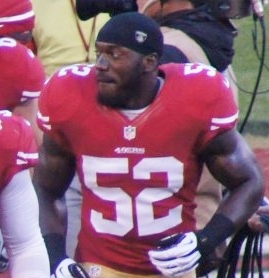 Patrick Willis · Linebacker (2007-2014)
Hall of Fame linebacker and defensive cornerstone of the Harbaugh-era teams; a seven-time Pro Bowler who retired early due to injuries.
Photo: Steven Bowles, CC BY 2.0 (Wikimedia Commons)
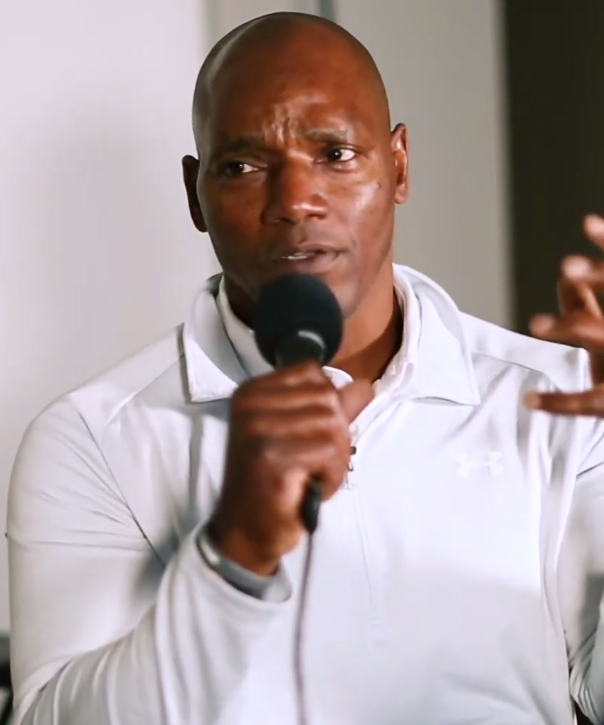 Bryant Young · Defensive lineman (1994-2007)
The franchise's all-time sacks leader (89.5; sacks official since 1982), a one-club Hall of Famer and a Super Bowl XXIX champion as a rookie.
Photo: Sports Spectrum, CC BY 3.0 (Wikimedia Commons)
Record book
- Passing yardsJoe Montana (35,124)
- Passing TDsJoe Montana (244)
- Rushing yardsFrank Gore (11,073)
- Receiving yardsJerry Rice (19,247)
- ReceptionsJerry Rice (1,281)
- SacksBryant Young (89.5 (sacks official since 1982))
- InterceptionsRonnie Lott (51)
- PointsJerry Rice (1,130)
Team Tips
Playing As
Lean into Shanahan's wide-zone running scheme with heavy pre-snap motion, condensed/bunched formations, and play-action to put defenders in run/pass conflict. Use versatile skill players like Christian McCaffrey, George Kittle, and fullback Kyle Juszczyk to show the same personnel in many formations, forcing defenses to declare and then exploiting matchups. On defense, run a Wide-9 front built on a fast four-man rush paired with two-high, split-field quarters and weak-rotation Cover-3 coverages.
Playing Against
Load the box and win on early downs to make the offense one-dimensional and force Purdy to throw from behind the chains, the blueprint Seattle used to hold San Francisco to 173 total yards in December 2025 and then rout them 41-6 in the playoff rematch. Explosive special-teams and field-position swings plus physical, downhill running games stress the defense, especially when the front is depleted by injury. Pressuring Purdy when the offensive line is patched together is the most direct path to slowing the offense.
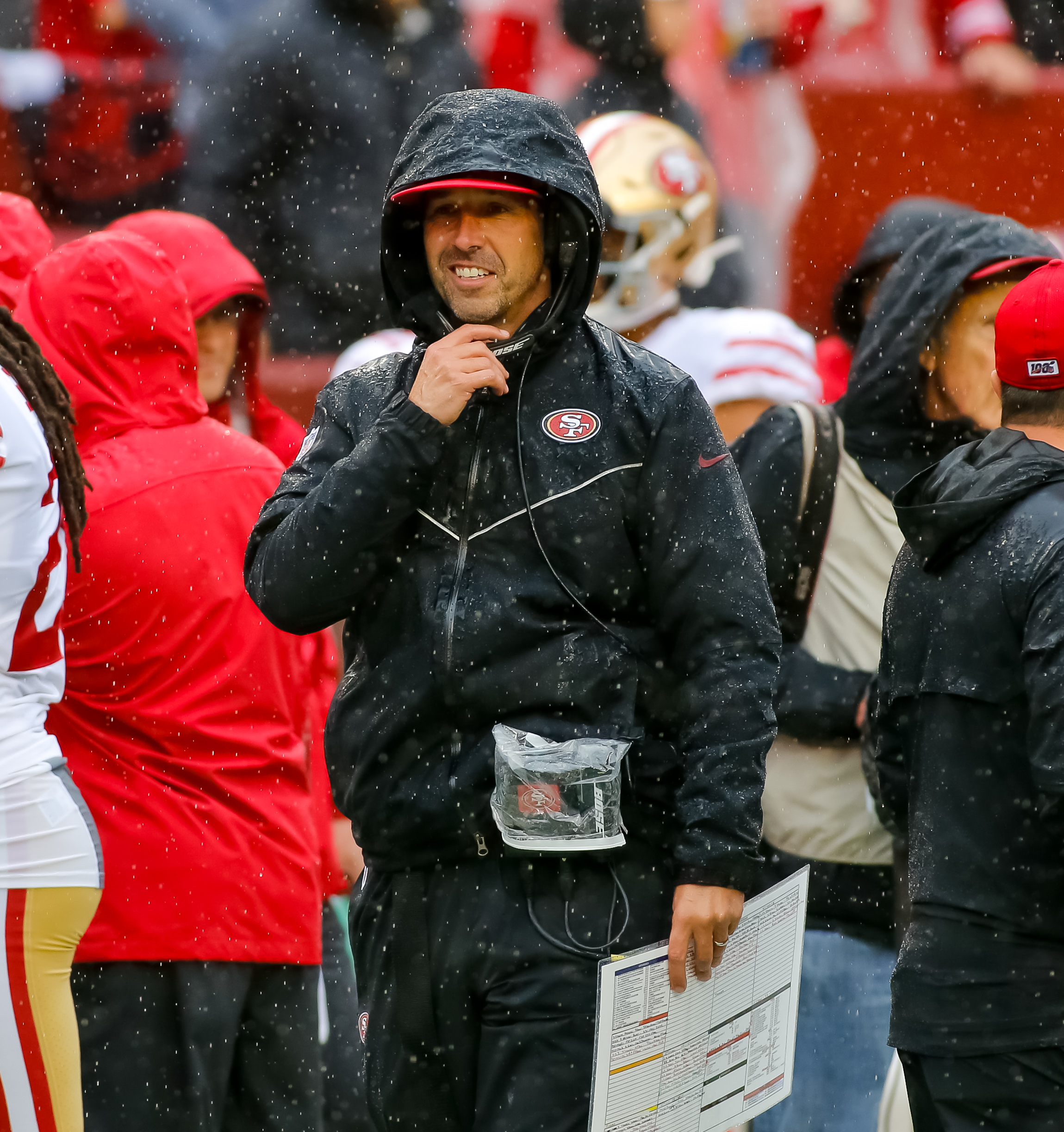
Coaching · Kyle Shanahan
Head coach since 2017, entering his 10th season in 2026. An offensive innovator and elite play-caller (AP Assistant Coach of the Year, 2016) who has led the 49ers to two Super Bowls (LIV and LVIII), multiple NFC Championship Game appearances, and division titles while calling the offensive plays himself. He will pass Bill Walsh for the most games coached in franchise history during 2026. The 2026 staff retained offensive coordinator Klay Kubiak and added defensive coordinator Raheem Morris, a longtime Shanahan friend and architect of the Rams' Super Bowl LVI defense, replacing Robert Saleh, who left to become the Tennessee Titans' head coach.
Photo: All-Pro Reels, CC BY-SA 2.0 (Wikimedia Commons)
Coming soon
- Playbook Matches
- Key Plays & Audibles
Upgrade to Team Hub Rookie
- Salary cap breakdown
- Depth chart analysis
- Roster needs & scheme fit
- Cut candidates & 5-year outlook
- Full sortable roster