Team Hub

AFC South
Houston Texans
Team Snapshot
Entering their 25th season (2026-2027), the Houston Texans are a rising AFC contender built on the NFL's best defense under head coach DeMeco Ryans, coming off a 12-5 wild-card season in 2025. Their ceiling now hinges almost entirely on whether quarterback C.J. Stroud and a rebuilt offensive line can play up to the standard the defense has set.
Franchise Difficulty
How hard this franchise is to run well: where the team stands, what the roster gives you, what the cap allows, and what you hold in the draft.
A developing quarterback still outside the top half of starters league-wide, a left tackle situation that ranks last in the NFL, a dead-cap load of $60.8M ranking sixth-most in the league, a projected cap deficit of $17.8M next season, and key pass rushers and skill players entering the back halves of their careers all combine to make this franchise genuinely challenging to run well.
Star Players
Scheme Fit
The schemes this team is set to run in-game, and how its roster grades in them.
- West Coast Zone RunoffensivePassable
- Base 4-3defensiveGood
Salary Cap
With $29.2M in current room but $60.8M in dead money and a projected deficit of $17.8M next season, Houston is walking a financial tightrope that demands disciplined roster management right now.
28 contracts expiring
Depth Chart
Madden Tools Analysis
Two starting spots have weak depth behind the starter.
Biggest gaps behind a starter
- DT
- QB
Draft Capital
Six picks this year including three first-rounders, with 20 total picks across the next three years, gives Houston real rebuild currency even in a difficult cap environment.
- Acquired: Round 6 from Browns, this draft
- Acquired: Round 7 from Patriots, this draft
- Acquired: Round 7 from Saints, next draft
- Traded away: Round 6 to Patriots, this draft
- Traded away: Round 7 to Browns, this draft
- Traded away: Round 5 to Browns, this draft
- Traded away: Round 6 to Saints, next draft
Team Ratings
The secondary is the roster's clear top strength, with three cornerbacks and two young safeties rated among the better groups in the league, while the offensive line, particularly left tackle, is the glaring weak spot.
Strengths
- CB
- LEDGE
- REDGE
- SAM
- RT
Weak spots
- LT
- HB
- C
- DT
- LG
Offense
Defense
Special teams
Roster Needs
- LThigh
Trent Brown, a twilight-stage player, is the current starter at left tackle, ranking dead last among starters league-wide, making this the most urgent address on the roster.
- HBmedium
David Montgomery starts at halfback but ranks 24th among starters, and depth behind him is thin despite ranking second in the league at that level.
- Clow
Evan Brown is a serviceable starter at center but ranks 22nd among starters, and the position needs an upgrade to shore up the interior.
- DTlow
Sheldon Rankins leads a defensive tackle group that ranks 21st among starters and 22nd in depth, leaving the interior line exposed.
- LGlow
Keylan Rutledge starts at left guard and the depth chart is the best in the league at that tier, but the 21st-ranked starter means the top of the position still needs attention.
- QBlow
C.J. Stroud is the starter but ranks 23rd among quarterbacks league-wide, making continued development at the position a quiet but real priority.
- WILLlow
Henry To'oTo'o holds the Will linebacker spot but ranks 22nd among starters, with the depth behind him ranking 23rd, creating a thin situation across the board.
Cut Candidates
5-Year Outlook
The Texans carry a legitimate defensive identity built around Will Anderson Jr and Derek Stingley Jr, with Danielle Hunter providing elite production on the right edge, though Hunter is entering the later stage of his career and succession planning will become necessary. C.J. Stroud is the long-term answer at quarterback but still has ground to cover before he ranks among the league's elite, and the offense is held back by the worst left tackle starter in the league in Trent Brown, who is among the oldest at his position and cannot be counted on long-term. Nico Collins gives Stroud a genuine No. 1 target, and Dalton Schultz is a dependable tight end, though Schultz is also entering a later career window. The cap picture is complicated, with $60.8M in dead money ranking sixth-most in the league and a projected shortfall of $17.8M next season, meaning roster-building moves will require creativity. Three first-round picks in the current draft cycle provide meaningful rebuild currency, and the young secondary pairing of Kamari Lassiter and Calen Bullock gives the defense a bright future alongside Anderson. This is a team with a real defensive core and some offensive weapons, but the offensive line, quarterback ceiling, and cap constraints keep it short of contention until those pieces come together.
5-Year Plan
Year 1Cut the dead weight, fix the blind side
- Release Davis Mills, Jake Andrews, Xavier Hutchinson, and Graham Mertz to recover cap savings and clear the roster of low-impact contributors.
- Use the three available first-round picks and remaining draft capital to target a high-upside left tackle, as Trent Brown is the 32nd-ranked starter at the position and cannot be a long-term anchor.
- Evaluate the cap situation proactively given the $60.8M in dead money and a projected $17.8M shortfall next season, restructuring or extending key contributors where the math works.
Year 2Develop the young core, stabilize the offense
- Give Kamari Lassiter and Calen Bullock expanded roles in the secondary as both 23-year-old Star-trait players are entering their peak development windows.
- Commit to C.J. Stroud's continued growth as the franchise quarterback, building the offensive system around his developing skillset and the weapons in Collins, Boutte, and Dell.
- Address the cap shortfall that arrives this offseason by identifying which aging contributors can be restructured or released without compromising the defensive core.
Year 3The defense ascends, build around the next wave
- Establish Kamari Lassiter alongside Derek Stingley Jr as a premier cornerback tandem, leaning on both as the foundation of the secondary for years ahead.
- Begin planning succession at tight end as Dalton Schultz moves deeper into the back half of his career, with Marlin Klein as a 23-year-old Star-trait developmental option behind him.
- Push the offensive line investment into a second wave, ensuring any picks used in season one at left tackle are developing into capable starters.
Year 4Contention window opens
- With Will Anderson Jr at his prime age and Stingley Jr still under 30, target a playoff run by pairing the elite defensive front with an offense that has had time to develop under Stroud.
- Plan for life after Danielle Hunter on the right edge, as he will be well into the late stage of his career, and build depth at REDGE through the draft capital accumulated in the three-year window.
- Use financial flexibility from expiring contracts and dead-money burn-off to pursue targeted upgrades at halfback and the interior offensive line.
Year 5Sustain the core, reload the edges
- Extend Will Anderson Jr and Derek Stingley Jr as the twin pillars of the franchise before their contracts demand premium market rates.
- Reload the pass-rush depth with the three-year draft capital pool of 20 picks, focusing late-round resources on developing edge rushers to fill any void left by aging contributors.
- Evaluate C.J. Stroud's contract situation and, if his development has tracked upward, commit to him on a long-term deal that keeps the offense stable through the next cycle.
Young core
Full Roster
| Player | Pos | OVR | Age | Dev |
|---|---|---|---|---|
| Age 24 | LEDGE | 94 | 24 |  |
| Age 31 | REDGE | 92 | 31 | |
| Age 25 | CB | 92 | 25 |  |
| Age 27 | WR | 90 | 27 | |
| Age 30 | TE | 87 | 30 |  |
| Age 23 | CB | 86 | 23 | |
| Age 27 | CB | 86 | 27 | |
| Age 29 | MIKE | 83 | 29 | |
| Age 29 | HB | 82 | 29 | |
| Age 30 | RT | 82 | 30 | |
| Age 23 | FS | 81 | 23 | |
| Age 33 | LEDGE | 81 | 33 |  |
Franchise History
The Houston Texans were awarded to Houston businessman Bob McNair on October 6, 1999 for a then-record $700 million expansion fee, restoring pro football to a city that lost the Oilers to Tennessee in 1997. They began play in 2002 under head coach Dom Capers, drafting QB David Carr first overall, and beat the Dallas Cowboys 19-10 in their debut, the first expansion team to win its opener since the 1961 Vikings. Early years were rough, but the franchise turned in the 2010s: native Houstonian Gary Kubiak (2006-2013) built a balanced roster around Andre Johnson and Arian Foster, and after drafting J.J. Watt 11th overall in 2011 and hiring Wade Phillips as defensive coordinator, Houston won its first AFC South title in 2011 and first playoff game (31-10 over Cincinnati), repeating as champs in 2012. Under Bill O'Brien (2014-2020) they added four more division titles but never advanced past the divisional round. After a rebuild under David Culley (2021) and Lovie Smith (2022), the hiring of DeMeco Ryans and drafting of C.J. Stroud in 2023 sparked a fast turnaround with division titles in 2023 and 2024 and a wild-card berth in 2025. The Texans have won eight AFC South titles but have never reached a conference championship game or Super Bowl, the only franchise never to appear in a conference title game. In the 2025 playoffs, Houston won its first-ever road playoff game, 30-6 over Pittsburgh, before losing 28-16 to New England in the divisional round.
Notable figures
 Andre Johnson · Wide receiver (2003-2014)
The franchise's greatest player and first Pro Football Hall of Famer (Class of 2024); all-time Texans leader in receptions and receiving yards.
Photo: Lbking, CC BY 3.0 (Wikimedia Commons)
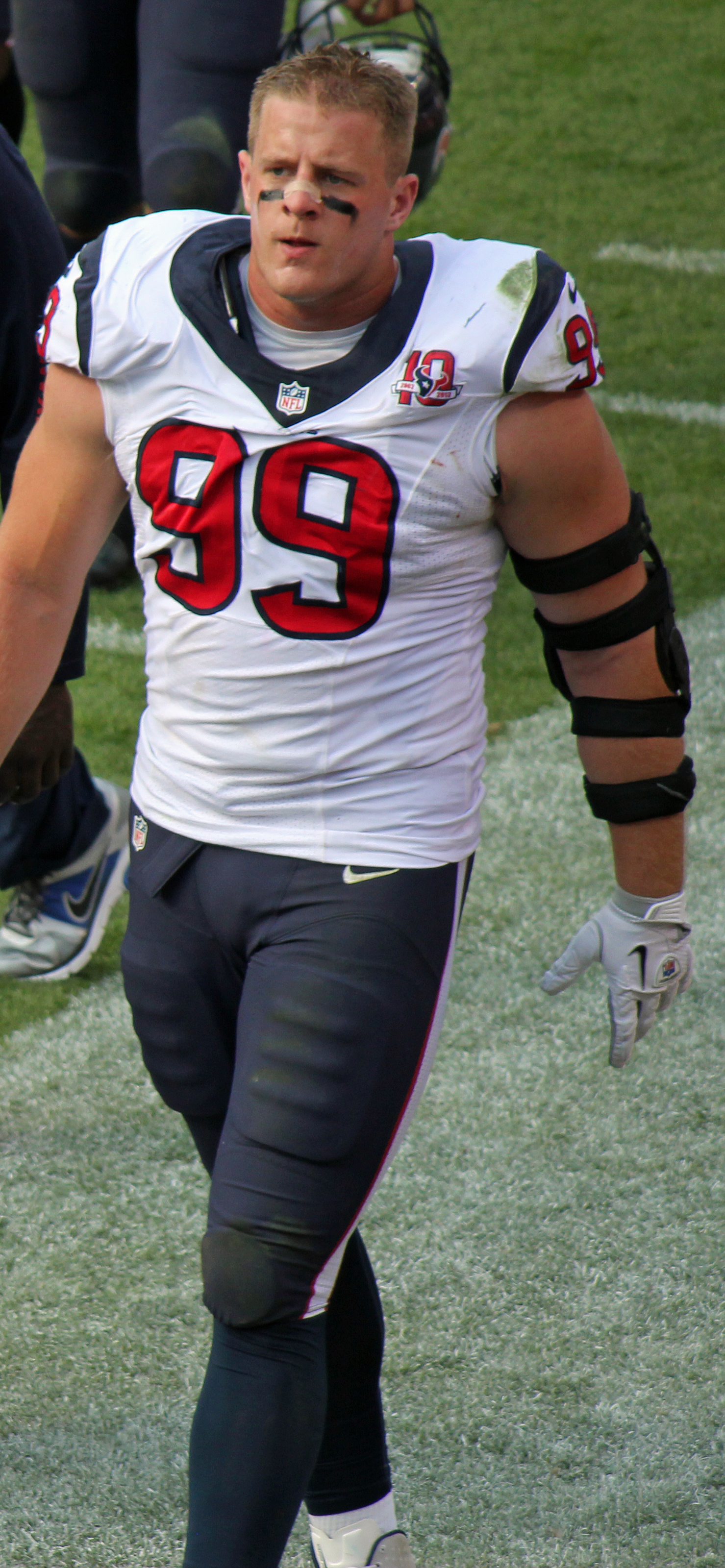 J.J. Watt · Defensive end (2011-2020)
Three-time NFL Defensive Player of the Year and franchise all-time sack leader (101); Ring of Honor member and the face of the franchise's 2010s peak.
Photo: Jeffrey Beall, CC BY-SA 3.0 (Wikimedia Commons)
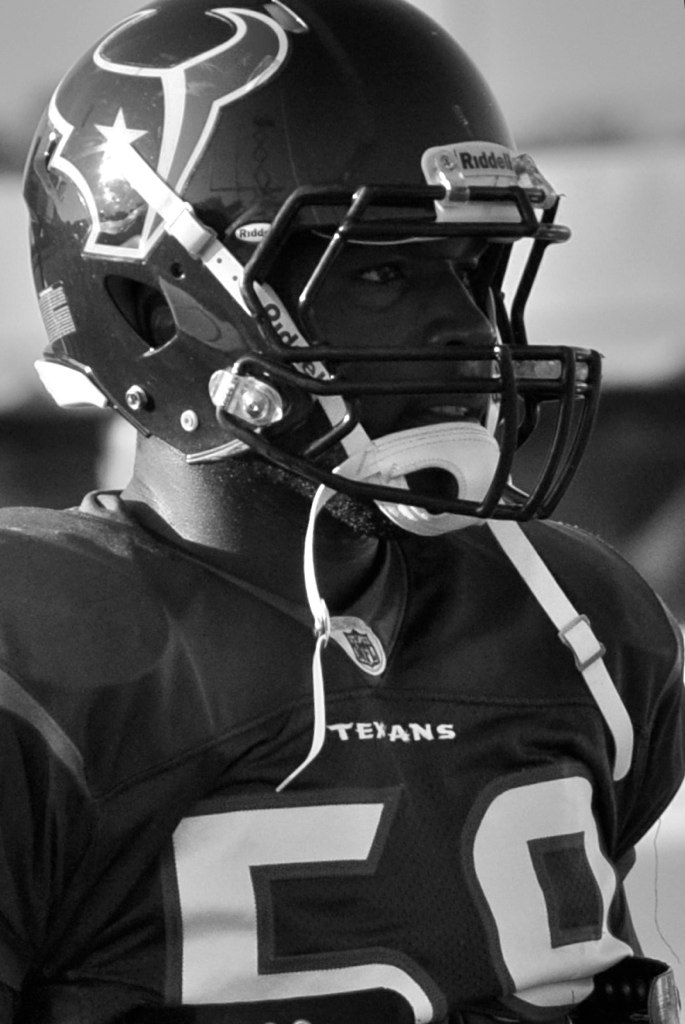 DeMeco Ryans · Linebacker (2006-2011) / Head coach (2023-present)
Defensive Rookie of the Year as a player, now the head coach who returned Houston to contention with an elite defense.
Photo: Christopher Brown, CC BY 2.0 (Wikimedia Commons)
 C.J. Stroud · Quarterback (2023-present)
2023 Offensive Rookie of the Year and franchise cornerstone quarterback; the key swing factor for the team's championship hopes.
Photo: Maize & Blue Nation, CC BY 2.0 (Wikimedia Commons)
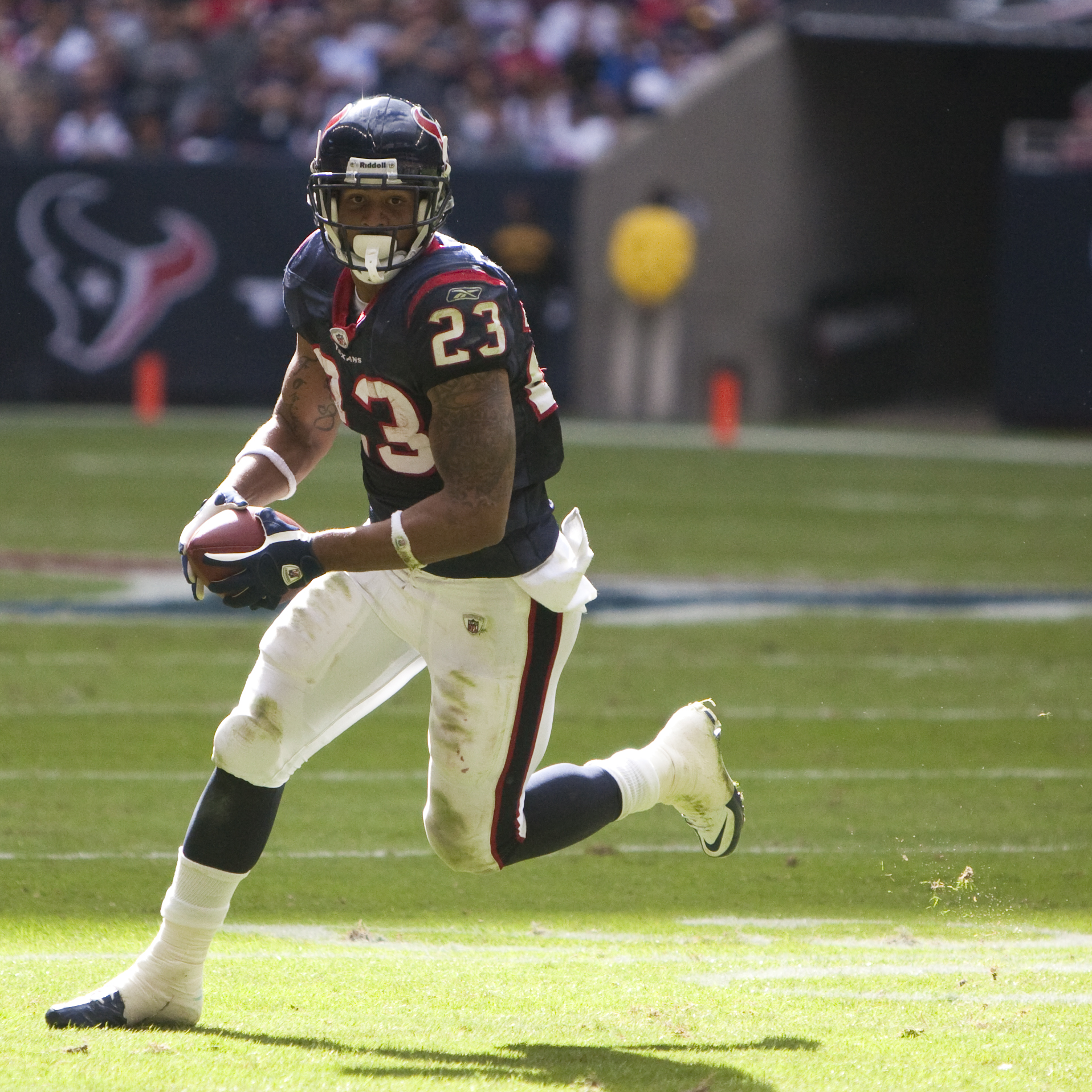 Arian Foster · Running back (2009-2015)
Undrafted breakout star; franchise all-time leader in rushing yards (6,472) and total touchdowns (68), and led the NFL in rushing in 2010.
Photo: AJ Guel, CC BY 2.0 (Wikimedia Commons)
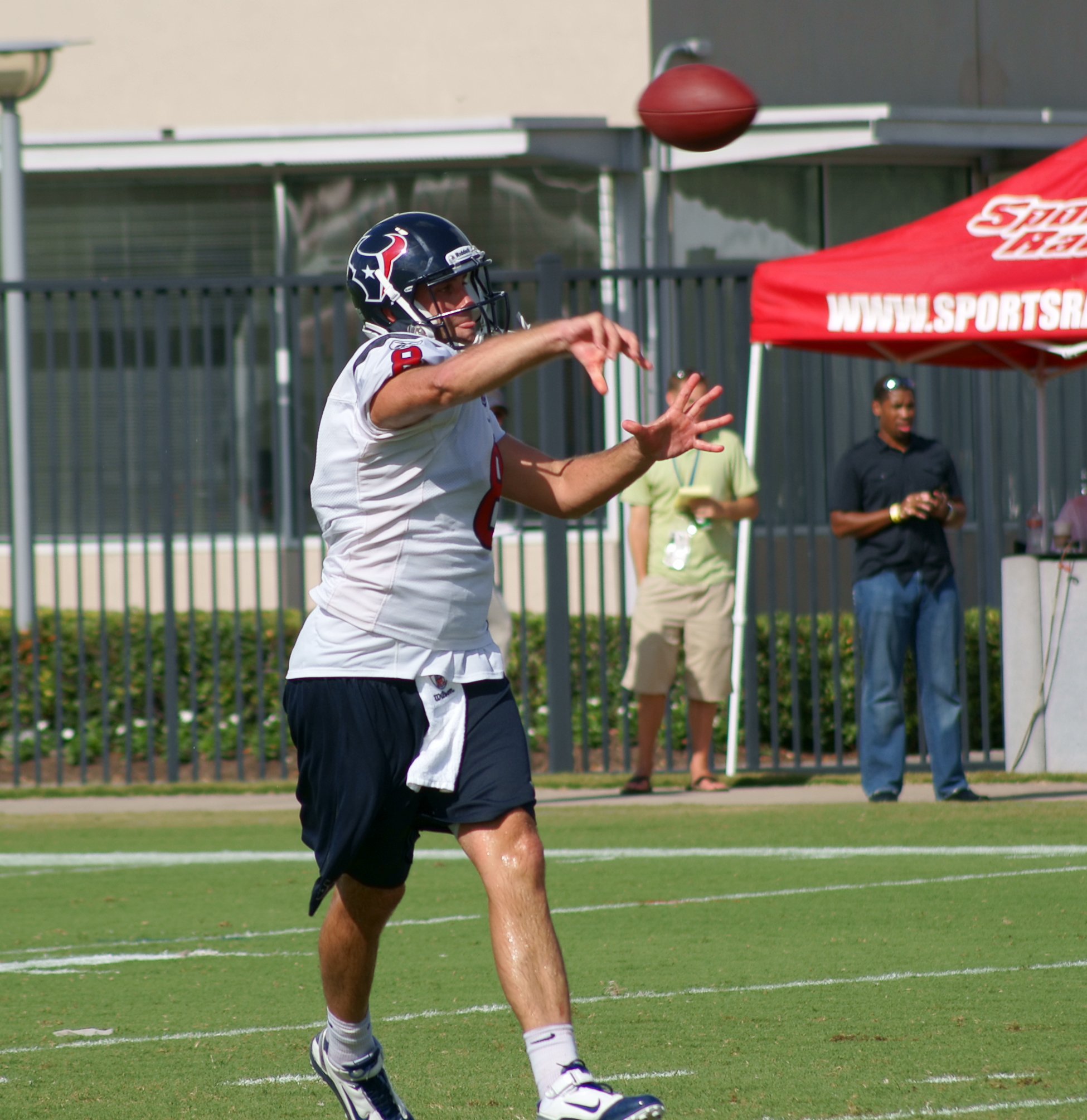 Matt Schaub · Quarterback (2007-2013)
Franchise all-time passing leader (23,221 yards, 124 TD); two-time Pro Bowler who quarterbacked the first playoff teams.
Photo: Lbking, CC BY 3.0 (Wikimedia Commons)
 DeAndre Hopkins · Wide receiver (2013-2019)
Star receiver and franchise all-time #2 in receiving yards (8,602); multiple-time All-Pro before his trade to Arizona.
Photo: Jeffrey Beall, CC BY 3.0 (Wikimedia Commons)
 Brian Cushing · Linebacker (2009-2017)
2009 Defensive Rookie of the Year and hard-hitting emotional leader of the defense during the division-title years.
Photo: Jeffrey Beall, CC BY-SA 3.0 (Wikimedia Commons)
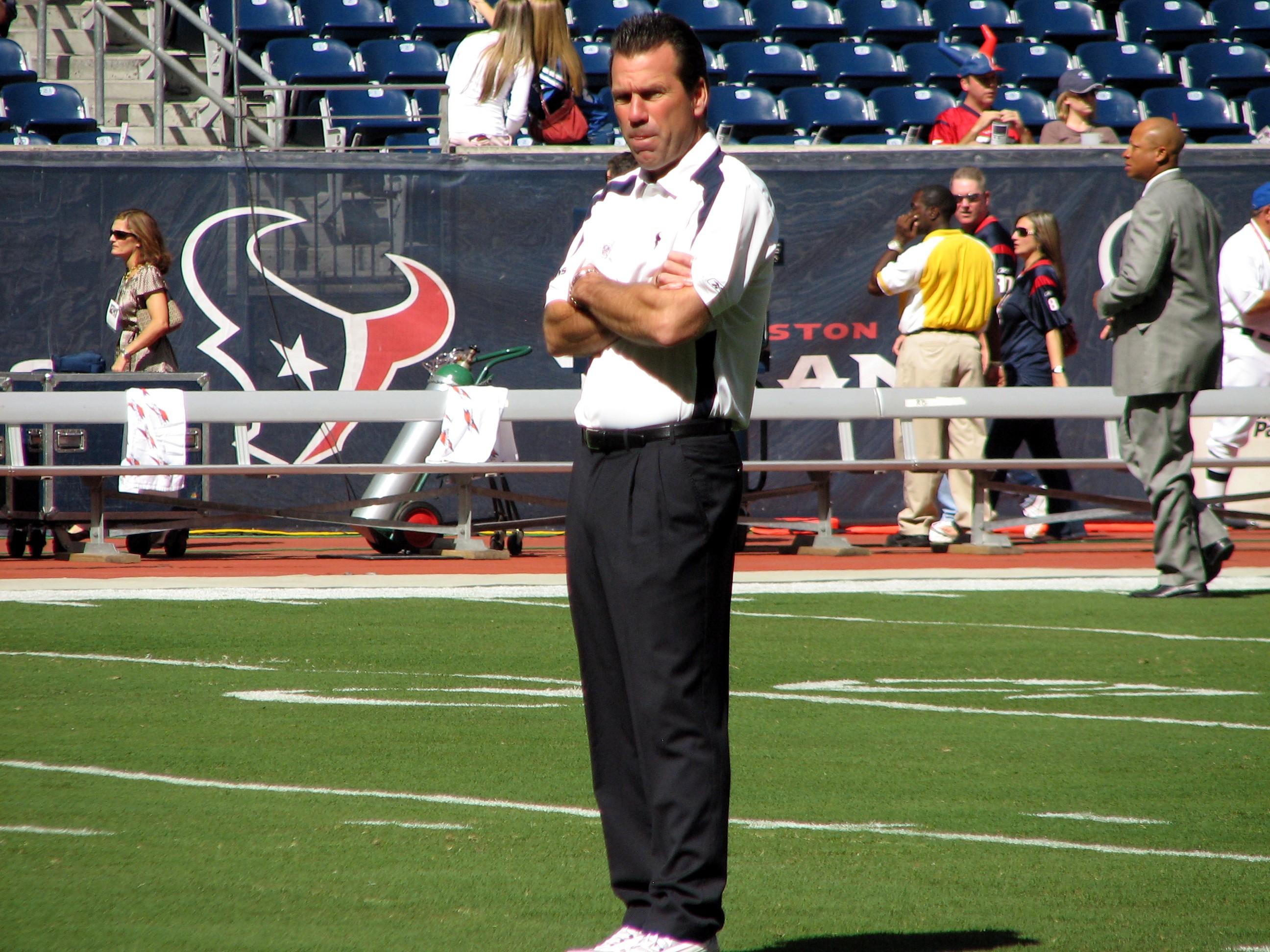 Gary Kubiak · Head coach (2006-2013)
Native Houstonian who led the franchise to its first two playoff berths and remains its winningest coach.
Photo: Brit, CC BY 2.0 (Wikimedia Commons)
 Bob McNair · Founding owner (1999-2018)
Brought the NFL back to Houston and owned the team until his death in 2018; Ring of Honor member.
Photo: dskillzhtown, CC BY 2.0 (Wikimedia Commons)
Record book
- Passing yardsMatt Schaub (23,221)
- Passing TDsMatt Schaub (124)
- Rushing yardsArian Foster (6,472)
- Receiving yardsAndre Johnson (13,597)
- ReceptionsAndre Johnson (1,012)
- SacksJ.J. Watt (101.0)
- InterceptionsJohnathan Joseph (17)
- PointsKa'imi Fairbairn (1,033)
- Total touchdownsArian Foster (68)
Team Tips
Playing As
Lean on defense. In 2025 Houston ranked No. 1 in total defense and second in scoring defense, both franchise records. Ryans and coordinator Matt Burke run a deliberately simple, execution-based 4-3 scheme that blitzes rarely and plays little disguise, relying on elite personnel: the cornerback tandem of Derek Stingley Jr. and Kamari Lassiter, nickel Jalen Pitre, and edge rushers Will Anderson Jr. and Danielle Hunter. Play balanced, physical offense with two-tight-end sets under OC Nick Caley and, above all, keep Stroud upright.
Playing Against
Attack the offense, not the defense. Houston's offensive line has been a chronic weak link and Stroud struggles when blitzed and in adverse conditions, in the 2025 divisional-round loss to New England he threw a career-high four first-half interceptions with a 28 passer rating, including a pick-six. The run game has ranked near the bottom of the league, so load up to pressure Stroud and force turnovers. Because the defense doesn't disguise much, elite quarterbacks who win one-on-ones downfield present the biggest threat.
Coaching · DeMeco Ryans
Enters his fourth season in 2026 (head coach since 2023), with DC Matt Burke and OC Nick Caley retained. A former Texans All-Rookie linebacker and San Francisco 49ers defensive coordinator, Ryans has led Houston to the playoffs in all three of his seasons and built the league's top-ranked defense on a philosophy of simplicity, speed, physicality, and the 'S.W.A.R.M.' culture. His central challenge is getting the offense to match the defense; the franchise is winless in the divisional round under him (0-for-3).
Photo: Christopher Brown, CC BY 2.0 (Wikimedia Commons)
Coming soon
- Playbook Matches
- Key Plays & Audibles
Upgrade to Team Hub Rookie
- Salary cap breakdown
- Depth chart analysis
- Roster needs & scheme fit
- Cut candidates & 5-year outlook
- Full sortable roster