Team Hub
NFC North
Detroit Lions
Team Snapshot
As they enter the 2026-2027 season, the Detroit Lions are a loaded-but-pressured team coming off a disappointing 9-8, playoff-less 2025 that followed their best-ever 15-2 campaign in 2024. Head coach Dan Campbell remains in charge with a retooled coaching staff and a core of Pro Bowl talent expected to push back into contention in a brutal NFC North.
Franchise Difficulty
How hard this franchise is to run well: where the team stands, what the roster gives you, what the cap allows, and what you hold in the draft.
A deep nucleus of elite young stars, a proven franchise quarterback in Jared Goff, strong rollover capital, and a haul of eight upcoming picks including five first-rounders spread across three years combine to create a franchise that is genuinely close to winning now with clear tools to close the remaining gaps.
Star Players
Scheme Fit
The schemes this team is set to run in-game, and how its roster grades in them.
- Multiple Power RunoffensiveGood
- Base 4-3defensiveGood
Build the playbook for this roster.
Playbook Genius ranks the schemes that fit the Detroit Lions and builds a playbook and call sheet around them.
Salary Cap
Detroit is squeezed at $12.9M in current cap room, ranking 28th in the league, but relief arrives quickly with $76.8M projected to open next year.
35 contracts expiring
Depth Chart
Madden Tools Analysis
One starting spot has weak depth behind the starter.
Biggest gaps behind a starter
- CB
Draft Capital
Detroit holds eight picks in the upcoming draft including six in the first two rounds, and 22 selections across a three-year window with three first-rounders, giving the rebuild genuine ammunition to address every positional need.
- Acquired: Round 7 from Chargers, this draft
Team Ratings
The roster's top strength is its collection of elite young skill players and pass rushers headlined by four players rated 95 or above, while the weakest spot is the interior offensive line and right edge depth, where starter-level ratings rank near the bottom of the league.
Strengths
- FS
- HB
- LEDGE
- LT
- MIKE
Weak spots
- LG
- REDGE
- CB
- WILL
- C
Offense
Defense
Special teams
Roster Needs
- LGhigh
Christian Mahogany starts at 73 overall, ranking 27th among starting guards league-wide, and the depth behind him offers little insurance despite a decent group overall.
- REDGEhigh
Derrick Moore starts opposite Hutchinson at 77 overall, ranked 25th at the position, and the depth behind him ranks 28th in the league, making this the most urgent two-way need on defense.
- CBmedium
D.J. Reed starts at 80 overall but the group behind him is thin, ranking 28th in depth league-wide, and cutting Rock Ya-Sin or Khalil Dorsey further thins a position already ranked 23rd at the starter level.
- WILLmedium
Malcolm Rodriguez starts at 74 overall, ranked 25th among starting WILLs, though the depth group behind him ranks a respectable 7th and offers coverage options in a pinch.
- Clow
Cade Mays starts at 74 overall and ranks 20th at center, a manageable gap that becomes more pressing if depth options like Juice Scruggs are deployed elsewhere on the line.
- RTlow
Blake Miller starts at 75 overall and ranks 20th at right tackle, a position that could benefit from investment as Larry Borom, the backup, is a cut candidate who frees $2.4M if released.
Cut Candidates
5-Year Outlook
Detroit enters this era with one of the most exciting young cores in the league: Penei Sewell, Jahmyr Gibbs, Amon-Ra St. Brown, Aidan Hutchinson, Brian Branch, and Kerby Joseph are all 26 or younger and playing at a high level, giving the franchise a legitimate window to contend deep into the decade. Jared Goff at 89 overall pilots the offense efficiently, and Sam LaPorta at 88 overall gives him a dynamic tight end to work with. The biggest concerns are structural rather than talent-driven: the guard and right edge rusher spots are notably weak, the cornerback depth is thin, and the cap sits at just $12.9M in room this season, ranking 28th in the league, with $30.5M in dead money on the books. Relief is on the horizon, though, as next year's cap room opens to $76.8M, ranking 10th league-wide, and commitments drop sharply to $186.6M three seasons out. Chuck Clark, entering the late stage of his career behind Kerby Joseph at safety, and Tyler Conklin, serving as the TE2 while carrying aging legs, represent succession conversations the team will need to address gradually. With eight upcoming picks including six in the first two rounds, Detroit has both the talent foundation and the draft resources to patch its holes and push for a championship before this window closes.
5-Year Plan
Year 1Trim the fat, patch the trenches
- Release Joshua Dobbs, Amen Ogbongbemiga, Tom Kennedy, and Trevor Nowaske to collect roughly $3.5M in clean cap savings and clear developmental roster spots.
- Use available picks and freed cap space to address the right edge rusher depth, ranked 28th in the league, by targeting a starter-caliber upgrade opposite Aidan Hutchinson.
- Monitor the Larry Borom situation closely since his release creates more dead money than savings, and plan the timing of that move to minimize cap damage.
Year 2Spend smart, build the secondary
- With $76.8M in projected cap room opening up, prioritize multi-year investments at left guard and cornerback depth, the two positions with the worst combined starter and depth rankings.
- Lean on Jahmyr Gibbs and Brian Branch, both entering their prime development windows as an X Factor and Superstar respectively, as the offensive and defensive engines of the team.
- Identify a long-term answer at right edge rusher to take the pressure off Derrick Moore, who is the starter at 77 overall opposite a 95-overall Hutchinson.
Year 3Develop the depth, plan for succession
- Begin planning succession at free safety as Chuck Clark, who is entering the late stage of his career, continues to age behind Kerby Joseph, ensuring the position stays strong when that transition arrives.
- Invest in Ennis Rakestraw Jr., currently 72 overall at 24 years old, to develop him into a reliable CB2 alongside D.J. Reed, whose own age will make durability a concern going forward.
- Use the team's three first-round picks across the three-year window to address the offensive line interior, ensuring the protection around Goff and the running lanes for Gibbs remain elite.
Year 4Push the window open
- With commitments dropping to $186.6M by this point in the plan, reallocate savings toward retaining core players approaching contract years, particularly within the receiving corps and defensive line.
- Build the linebacker corps around Jack Campbell as the MIKE anchor and find a long-term WILL starter to replace the aging group currently behind Malcolm Rodriguez.
- Establish Tyleik Williams and Derrick Moore, both 23 overall or younger with room to develop, as the next generation of the defensive line alongside whoever steps in at REDGE.
Year 5Contend or reload with resources intact
- By season five, the core of Sewell, Gibbs, St. Brown, Hutchinson, Branch, and Joseph should all still be in their prime, positioning the franchise to make a legitimate championship push.
- Evaluate Jared Goff's standing as the starter and determine whether the team needs to develop a long-term successor behind him, using available picks from the three-year haul of 22 total selections.
- Ensure the right edge position has been resolved through internal development or acquisition so the defensive front presents a two-sided pass rush threat built to sustain a deep playoff run.
Young core
Full Roster
| Player | Pos | OVR | Age | Dev |
|---|---|---|---|---|
| Age 25 | LT | 98 | 25 |  |
| Age 24 | HB | 97 | 24 |  |
| Age 26 | WR | 96 | 26 | |
| Age 26 | LEDGE | 95 | 26 | |
| Age 24 | SS | 91 | 24 | |
| Age 25 | FS | 91 | 25 | |
| Age 31 | QB | 89 | 31 | |
| Age 25 | TE | 88 | 25 | |
| Age 26 | MIKE | 87 | 26 |  |
| Age 26 | DT | 86 | 26 | |
| Age 25 | WR | 85 | 25 | |
| Age 29 | CB | 80 | 29 |  |
Franchise History
The Lions are one of the NFL's oldest franchises, beginning as the Portsmouth Spartans in Portsmouth, Ohio, who joined the NFL on July 12, 1930. The financially struggling team was purchased and relocated to Detroit in 1934, renamed the Lions in a nod to the city's baseball Tigers. They won their first Detroit game 9-0 over the New York Giants on September 23, 1934, and launched their enduring Thanksgiving Day home-game tradition that same year. Behind Dutch Clark, the Lions won the 1935 NFL Championship. The 1950s were the high-water mark: led by Bobby Layne, Doak Walker, Joe Schmidt and a dominant defense, Detroit won NFL titles in 1952, 1953 and 1957, the 1957 crown a 59-14 rout of Cleveland that stands as the Lions' last championship. The 'Curse of Bobby Layne' became shorthand for decades of futility. The wilderness years that followed featured individual brilliance from Hall of Famers like Barry Sanders and Calvin Johnson, but the team won only a single playoff game between 1958 and 2023, and bottomed out at 0-16 in 2008, the first winless 16-game season in NFL history. The recent resurgence arrived under Dan Campbell (hired January 2021): the Lions won the NFC North in 2023, beat the Rams for their first playoff win since 1991, reached the NFC Championship Game, and posted a franchise-record 15-2 mark in 2024 before a Divisional-round upset by Washington. The 2025 season was a step back: a 9-8 finish, last in the NFC North, and no playoffs.
Notable figures
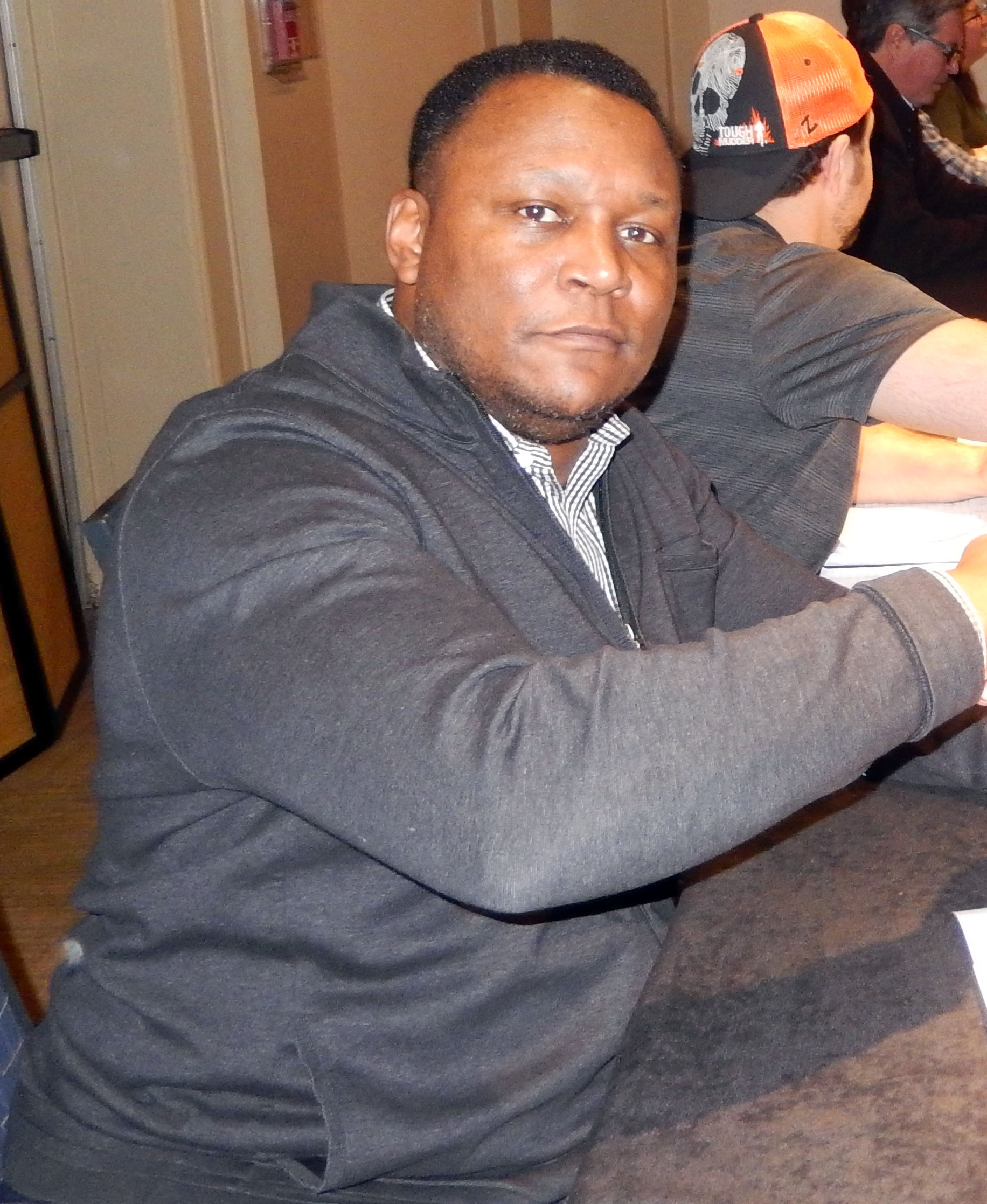 Barry Sanders · Running back (1989-1998)
One of the greatest runners in NFL history; franchise's all-time leading rusher (15,269 yards) and 1997 NFL MVP who retired abruptly at his peak.
Photo: Greg2600, CC BY-SA 2.0 (Wikimedia Commons)
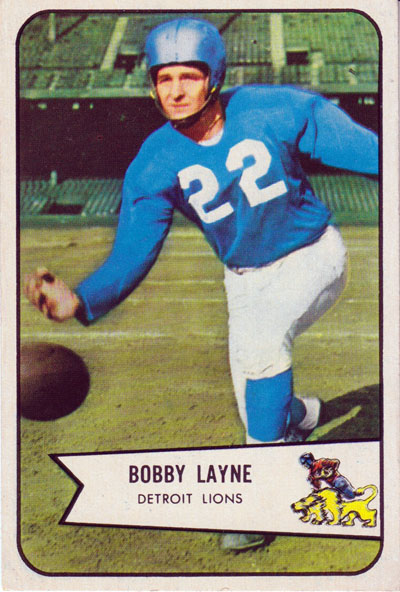 Bobby Layne · Quarterback (1950-1958)
Hall of Fame field general who led Detroit to three NFL titles (1952, 1953, 1957); his number 22 is retired.
Photo: Bowman Gum, public domain (Wikimedia Commons)
 Calvin Johnson · Wide receiver (2007-2015)
"Megatron"; Hall of Famer and franchise all-time receiving leader (731 receptions, 11,619 yards) who set the NFL single-season receiving-yards record of 1,964 yards in 2012.
Photo: Kevind810, CC BY-SA 3.0 (Wikimedia Commons)
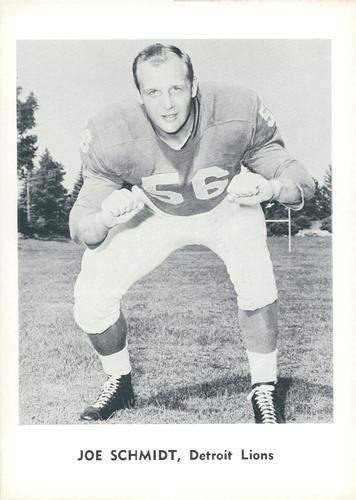 Joe Schmidt · Linebacker (1953-1965) and head coach (1967-1972)
Hall of Fame middle linebacker who helped revolutionize the position, won two titles as a player, was a 10-time consecutive Pro Bowler and 1960 NFL MVP; number 56 retired.
Photo: Jay Publishing, public domain (Wikimedia Commons)
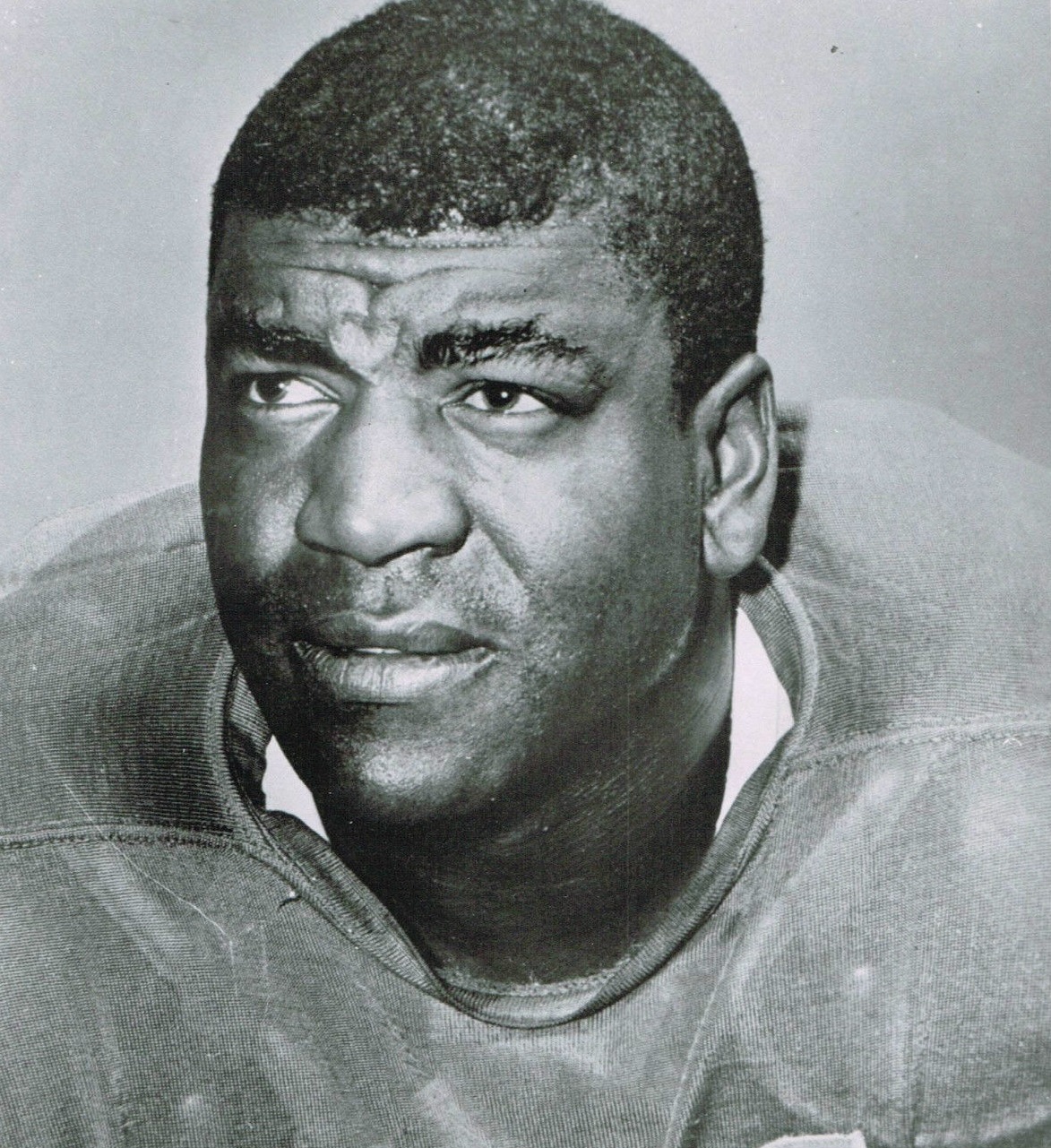 Dick "Night Train" Lane · Cornerback (1960-1965 with Detroit)
Hall of Famer; among the most feared tacklers ever and holder of the NFL single-season interception record (14, set as a 1952 rookie).
Photo: Detroit Lions / NFL, public domain (Wikimedia Commons)
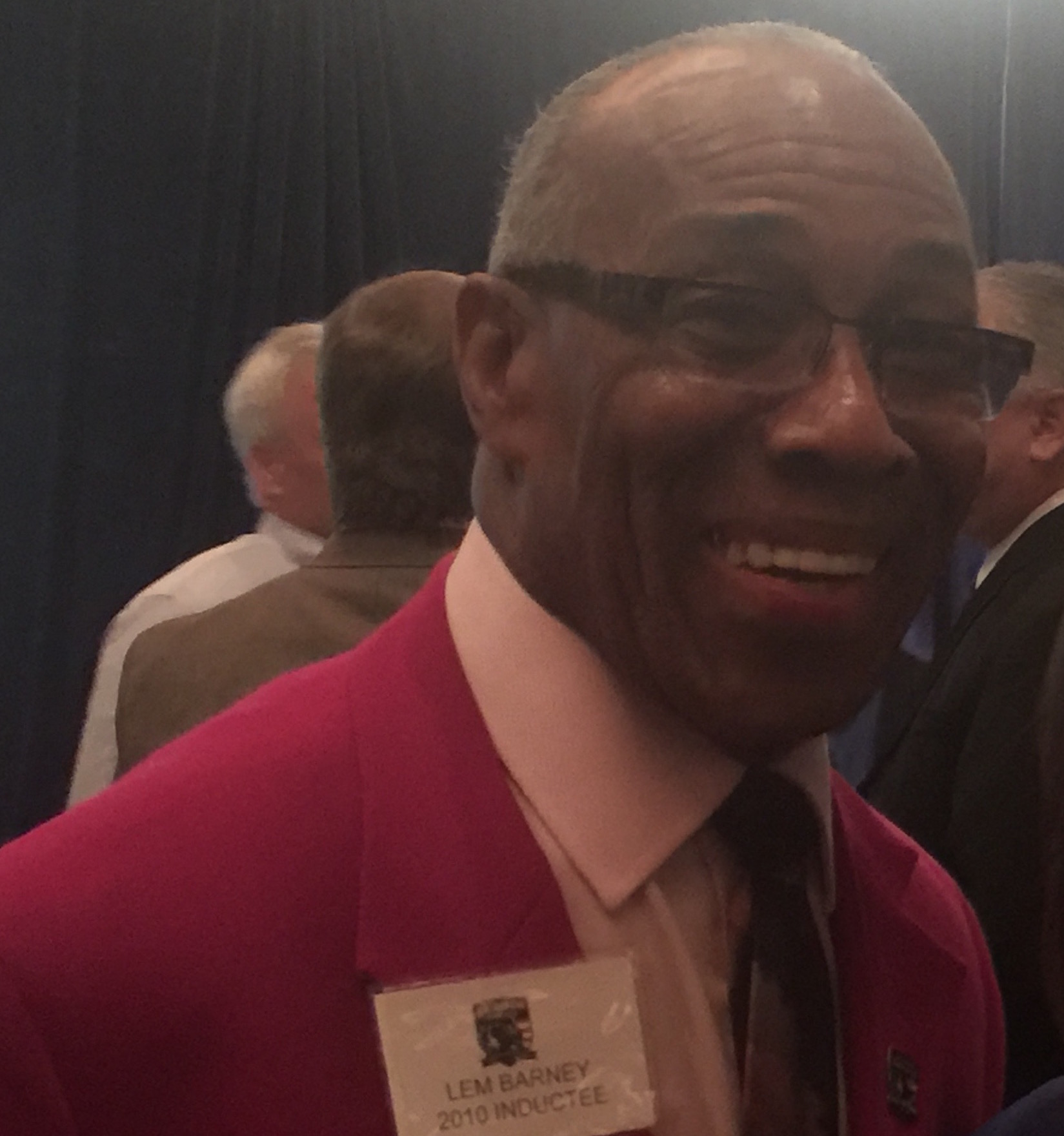 Lem Barney · Cornerback (1967-1977)
Hall of Famer, 1967 Defensive Rookie of the Year, seven-time Pro Bowler; 56 career interceptions (second in franchise history).
Photo: Renee530, CC BY-SA 4.0 (Wikimedia Commons)
 Dick LeBeau · Cornerback (1959-1972)
Hall of Famer (inducted as a player); franchise all-time interceptions leader with 62, later a legendary defensive coordinator.
Photo: AxsDeny, CC BY-SA 3.0 (Wikimedia Commons)
 Doak Walker · Halfback/kicker (1950-1955)
Hall of Fame do-everything star, 1948 Heisman winner, key to the 1952 and 1953 titles; first Lion to have his number (37) retired. The college Doak Walker Award is named for him.
Photo: SMU Central University Libraries (Laughead Photographers), no known copyright restrictions (Wikimedia Commons)
 Earl "Dutch" Clark · Quarterback/tailback (1931-1938) and player-coach
Charter Pro Football Hall of Fame inductee (1963), led Detroit to the 1935 title; first Lions number retired (No. 7).
Photo: public domain (Wikipedia)
- Robert Porcher · Defensive end (1992-2003)
Three-time Pro Bowler and franchise all-time sack leader (95.5); the Lions' "Man of the Year" community award bears his name.
Record book
- Passing yardsMatthew Stafford (2009-2020) (45,109)
- Passing TDsMatthew Stafford (282)
- Rushing yardsBarry Sanders (1989-1998) (15,269)
- Receiving yardsCalvin Johnson (2007-2015) (11,619)
- ReceptionsCalvin Johnson (731)
- SacksRobert Porcher (95.5)
- InterceptionsDick LeBeau (62)
- PointsJason Hanson (1992-2012) (2,150)
Team Tips
Playing As
Under Dan Campbell the Lions are built on physical, downhill football and aggressive decision-making, including high fourth-down aggression. New coordinator Drew Petzing preserves the 'Run The Damn Ball' core: under-center, heavy personnel (two- and three-tight-end sets) and play-action that marries the run and pass. With Jared Goff at quarterback, Jahmyr Gibbs at running back, Amon-Ra St. Brown and Jameson Williams at receiver, and Sam LaPorta at tight end, Detroit wins by establishing the run, controlling tempo, and hitting explosive play-action passes.
Playing Against
The vulnerability is on defense. In 2025 Detroit finished 22nd in scoring defense (24.3 points/game), 18th in total defense, and 20th against the pass, undone largely by secondary injuries. Opponents attack through the air, and offensively, when the Lions' run game stalls the attack becomes one-dimensional and reliant on 'home-run' plays, so opponents who can stuff the run and stay disciplined against play-action can force Detroit into obvious passing situations.

Coaching · Dan Campbell
Returns for his sixth season entering 2026-2027. Hired January 20, 2021, Campbell is a former NFL tight end known for relentless energy, aggressive fourth-down play-calling, and culture-building. He led the Lions to their first division title in 30 years (2023), their first playoff win since 1991, an NFC Championship Game appearance, and a franchise-record 15-win season (2024). His regular-season record entering 2026 is 48-36-1. After the 2025 miss he graded his own season 'a freaking F,' but he remains firmly in place. For 2026 Drew Petzing was hired as offensive coordinator and Kelvin Sheppard was retained as defensive coordinator.
Photo: Chrisjnelson, CC BY 3.0 (Wikimedia Commons)
Coming soon
- Playbook Matches
- Key Plays & Audibles
Upgrade to Team Hub Rookie
- Salary cap breakdown
- Depth chart analysis
- Roster needs & scheme fit
- Cut candidates & 5-year outlook
- Full sortable roster