Team Hub
AFC North
Cleveland Browns
Team Snapshot
The Cleveland Browns enter 2026-2027 in a full rebuild: coming off a 5-12 last-place finish in the AFC North, they fired two-time Coach of the Year Kevin Stefanski, hired first-time NFL head coach Todd Monken, traded franchise cornerstone Myles Garrett to the Los Angeles Rams, overhauled the offensive line, and head into camp with an unsettled quarterback competition. This is a franchise with a glorious pre-Super-Bowl past attempting to escape a quarter-century of post-1999 futility.
Franchise Difficulty
How hard this franchise is to run well: where the team stands, what the roster gives you, what the cap allows, and what you hold in the draft.
A last-ranked starting quarterback, a dead-last left defensive end, a receiver corps near the bottom of the league, and a crippling $99.0M in dead cap money that nearly erases what would otherwise be comfortable spending room all combine to make this one of the most demanding rebuilding situations in franchise mode.
Star Players
Scheme Fit
The schemes this team is set to run in-game, and how its roster grades in them.
- Vertical Power RunoffensivePassable
- Base 4-3defensiveGood
Salary Cap
The $99.0M dead cap burden, third-worst in the league, is a near-term anchor, but $161.1M in projected next-year cap room ranked second in the league means the financial handcuffs come off soon.
22 contracts expiring
Depth Chart
Madden Tools Analysis
Four starting spots have weak depth behind the starter.
Biggest gaps behind a starter
- TE
- FB
- MIKE
- SS
Draft Capital
Eleven picks in the immediate draft, four first-rounders across the next three years, and 26 total selections in that window give Cleveland one of the richest rebuild arsenals in the league.
- Acquired: Round 4 from Giants, this draft
- Acquired: Round 3 from Rams, the third draft
- Acquired: Round 2 from Rams, next draft
- Acquired: Round 1 from Rams, this draft
- Acquired: Round 4 from Seahawks, this draft
- Acquired: Round 7 from Texans, this draft
- Acquired: Round 5 from Texans, this draft
- Traded away: Round 7 to Rams, next draft
- Traded away: Round 6 to Texans, this draft
Team Ratings
The roster's clearest strength is a deep, talented defensive secondary and pass-rush core led by Ward, Verse, and Graham, while the quarterback room, at a 70 overall starter ranking last in the league, is the most glaring weakness on the entire depth chart.
Strengths
- CB
- WILL
- REDGE
- C
- SS
Weak spots
- LEDGE
- QB
- WR
- FS
- HB
Offense
Defense
Special teams
Roster Needs
- LEDGEhigh
Isaiah McGuire starts at LEDGE and ranks dead last among starters league-wide, making an upgrade at left defensive end the single most urgent priority.
- QBhigh
Deshaun Watson starts at 70 overall and ranks last among starting quarterbacks, with Shedeur Sanders as the only developmental backup of note.
- WRhigh
KC Concepcion Jr. starts as the top wideout but the unit ranks 30th in starter quality and 28th in depth, leaving the passing game dangerously thin.
- FSmedium
Ronnie Hickman holds the starting free safety role but the position ranks 26th among starters, and a true upgrade here would solidify an otherwise strong secondary.
- HBmedium
Quinshon Judkins leads the backfield and is a legitimate young piece, but the group ranks only 24th at starter level with modest depth behind him.
- DTlow
Mason Graham is a Superstar dev talent at the position, but the group ranks 21st in starter quality and a rotational upgrade behind him would help the interior.
- LTlow
Spencer Fano starts at left tackle at just 21 years old with Star dev, giving the team a promising long-term answer, though the unit still ranks 22nd overall.
Cut Candidates
5-Year Outlook
Cleveland arrives at a genuine crossroads. The defense has real building blocks: Denzel Ward remains an elite cornerback, Jared Verse is a rising Superstar pass rusher on the right edge, Carson Schwesinger and Mason Graham are young cornerstones with exceptional development traits, and Jeremiah Owusu-Koramoah gives the linebacking corps a quality piece. The secondary is further shored up by Grant Delpit and Tyson Campbell. The offense is a far grimmer picture. Deshaun Watson is a last-ranked starter at quarterback, and his contract situation is the single largest drag on the franchise, with $99.0M in dead cap sitting at third-worst in the league. The wide receiver group is threadbare despite Jerry Jeudy's presence, and the left edge is the worst in football by starter rank. The good news is that next-year cap room is projected at $161.1M, ranking second in the league, which means the financial straitjacket loosens significantly in the near future. Harold Fannin Jr. at 22 and Quinshon Judkins give the offense genuine young contributors to build around. Elgton Jenkins anchors the center position but is entering the later stage of his career, so succession at that spot will matter by mid-plan. Spencer Fano at left tackle is only 21 with Star dev, giving the team a potential franchise cornerstone up front. With 11 picks in the upcoming draft, including four first-rounders across the next three years and 26 total picks in that window, Cleveland has the resources to accelerate a rebuild quickly if the front office is aggressive.
5-Year Plan
Year 1Stabilize the foundation
- Release Blake Whiteheart to clear $1.1M in dead money-free cap savings and use the $30.8M in current cap room to target an upgrade at left defensive end, the team's most critical positional weakness.
- Address the quarterback situation by evaluating whether Shedeur Sanders can develop into a long-term starter or whether a free-agent option is available within the cap.
- Use the two first-round picks and additional selections this draft to inject talent at receiver and left edge, where the roster ranks last and near-last league-wide.
Year 2Spend into the window
- Leverage the projected $161.1M in next-year cap room, ranked second in the league, to sign a legitimate franchise quarterback or a top-tier wide receiver in free agency.
- Allow Mason Graham and Carson Schwesinger, both with premium development traits and still only in their early 20s, to take on expanded leadership roles as their ratings climb.
- Extend Jared Verse and lock up the young defensive core before the market resets around them.
Year 3Build the young offense
- Quinshon Judkins and Harold Fannin Jr., both Star dev players still in their early 20s, should be the offensive focal points as the new quarterback situation matures.
- Monitor Elgton Jenkins at center and begin developing Parker Brailsford or another option as his eventual successor at the position.
- Use the Rams' third-round pick acquired for this year as additional depth or trade currency as the roster tightens toward contention.
Year 4Push for the postseason
- With the dead cap burden from the Watson contract now cleared from the books, committed money drops to $99.1M giving the front office full flexibility to build a complete 53-man roster.
- Denzel Ward will be in the later stage of his career by this point, so identify and develop a successor at cornerback while he remains a quality starter for as long as possible.
- Establish a succession plan at center and right tackle, where Elgton Jenkins and Tytus Howard, both aging starters, will be well into the back end of their careers.
Year 5Contend or reload
- With Mason Graham, Jared Verse, and Carson Schwesinger entering their primes and the cap fully liberated, position the roster to make a legitimate Super Bowl run.
- The 26 total draft picks accumulated over the three-year window should have provided enough depth and star power that the team is no longer reliant on any single aging veteran.
- Assess the quarterback room honestly: if the starter acquired in years one or two is not a franchise-level player, use the remaining draft capital and cap flexibility to find the answer.
Young core
Full Roster
| Player | Pos | OVR | Age | Dev |
|---|---|---|---|---|
| Age 29 | CB | 94 | 29 |  |
| Age 25 | REDGE | 88 | 25 | |
| Age 23 | MIKE | 83 | 23 |  |
| Age 27 | SS | 82 | 27 | |
| Age 30 | C | 82 | 30 | |
| Age 22 | HB | 82 | 22 | |
| Age 26 | WILL | 82 | 26 | |
| Age 22 | DT | 81 | 22 | |
| Age 22 | TE | 80 | 22 | |
| Age 30 | RT | 80 | 30 |  |
| Age 27 | WR | 80 | 27 | |
| Age 29 | P | 79 | 29 | |
Franchise History
The Browns were founded in 1944 (organized in 1945) by taxicab magnate Arthur B. "Mickey" McBride as a charter member of the All-America Football Conference (AAFC), beginning play in 1946 in Cleveland. Named after their first coach, the innovative Paul Brown, they were instantly dominant: quarterback Otto Graham, fullback Marion Motley, and tackle-kicker Lou Groza led Cleveland to all four AAFC championships (1946-1949), including a perfect 15-0 season in 1948. Paul Brown pioneered modern coaching methods and, by signing Motley and Bill Willis in 1946, helped reintegrate professional football a year before Jackie Robinson debuted in baseball. When the AAFC folded, the Browns joined the NFL in 1950 and immediately won the NFL Championship, reaching the title game in each of their first six NFL seasons (1950-1955) and winning in 1950, 1954, and 1955. In 1957 the Browns drafted Jim Brown, who led the NFL in rushing in eight of nine seasons and retired as the all-time rushing leader. Owner Art Modell bought the team in 1961 and controversially fired Paul Brown before 1963; under Blanton Collier, the Browns won their fourth and most recent NFL championship in 1964. After Jim Brown's 1966 retirement, the team declined but revived with the "Kardiac Kids" of 1979-80 behind MVP quarterback Brian Sipe and again with Bernie Kosar leading three AFC Championship Game appearances in the late 1980s. In 1995 Modell announced relocation to Baltimore; the settlement created the Baltimore Ravens as a new franchise in 1996 while the Browns' name, colors, and history stayed in Cleveland for a reactivated team that returned in 1999. Since then the franchise has been defined by instability and losing: just three playoff appearances (2002, 2020, 2023), one playoff win, a franchise-scarring 0-16 season in 2017, and a revolving door at quarterback.
Notable figures
 Jim Brown · Running back (1957-1965)
Widely considered the greatest RB ever and possibly the greatest football player; franchise's all-time leading rusher (12,312 yards) who led the NFL in rushing in eight of nine seasons.
Photo: Topps (1959 card), public domain (Wikimedia Commons)
 Otto Graham · Quarterback (1946-1955)
"Automatic Otto" led the Browns to 10 straight championship games and seven titles; franchise leader in career passing TDs (174); Hall of Fame 1965.
Photo: public domain (Wikimedia Commons); Graham (left) with Paul Brown at the 1951 Pro Bowl
 Paul Brown · Founding head coach & general manager (1946-1962)
Namesake of the franchise; innovator of modern coaching; winningest coach in team history (158-48-8) who won all seven AAFC/NFL titles from 1946-1955.
Photo: public domain (Wikimedia Commons, 1952 football card)
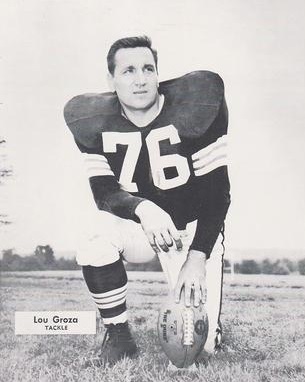 Lou Groza · Tackle/placekicker (1946-1959, 1961-1967)
"The Toe"; franchise all-time scoring leader with 1,608 points; Hall of Fame 1974.
Photo: public domain (Wikimedia Commons)
- Marion Motley · Fullback (1946-1953)
Bruising power runner and integration pioneer; his 5.7 career yards per carry remain an NFL record among backs with 750+ carries; Hall of Fame 1968.
 Ozzie Newsome · Tight end (1978-1990)
"The Wizard of Oz"; franchise all-time leader in receptions (662) and receiving yards (7,980); Hall of Fame 1999; later a pioneering NFL general manager.
Photo: Marylandstater, CC BY-SA 4.0 (Wikimedia Commons)
 Bernie Kosar · Quarterback (1985-1993)
Ohio-raised fan favorite who led the Browns to three AFC Championship Games; fourth in franchise passing TDs (111).
Photo: Erik Drost, CC BY 2.0 (Wikimedia Commons)
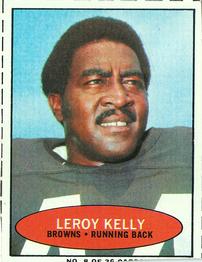 Leroy Kelly · Running back (1964-1973)
Successfully succeeded Jim Brown and led the NFL in rushing; second in franchise rushing yards (7,274); Hall of Fame 1994.
Photo: public domain (Wikimedia Commons)
 Joe Thomas · Offensive tackle (2007-2017)
Played a record 10,363 consecutive snaps; 10 Pro Bowls; first expansion-era Brown elected to the Hall of Fame (2023).
Photo: Erik Drost, CC BY 2.0 (Wikimedia Commons)
- Clay Matthews Jr. · Linebacker (1978-1993)
Heart of the 1980s defense; recorded 1,430 tackles and 76.5 sacks as a Brown; the franchise's all-time Approximate Value leader.
Record book
- Passing yardsBrian Sipe (23,713)
- Passing TDsOtto Graham (174)
- Rushing yardsJim Brown (12,312)
- Receiving yardsOzzie Newsome (7,980)
- ReceptionsOzzie Newsome (662)
- SacksMyles Garrett (125.5 (2017-2025))
- InterceptionsThom Darden (45)
- PointsLou Groza (1,608)
Team Tips
Playing As
For the last several seasons Cleveland's identity has been defense-first. Under coordinator Jim Schwartz the unit ranked among the NFL's best, the 2025 Browns allowed the fourth-fewest total yards per game (283.6) and third-fewest passing yards (167.2), anchored by an elite pass rush. When the Browns win, they do it by generating front-four pressure, playing sound coverage, and leaning on ball control rather than explosive passing. Historically, the franchise identity was a punishing ground game (Jim Brown, Leroy Kelly, Nick Chubb) behind strong offensive lines.
Playing Against
The Browns' persistent weakness is offense, the unit ranked last in scoring over the previous two seasons (15.8 ppg), and the 2025 team finished 31st of 32 in scoring (16.4 ppg). Quarterback instability is the chronic vulnerability; opponents pack the box, force Cleveland's unsettled quarterbacks to win from the pocket, and play with leads that neutralize the run. Entering 2026 the defense loses its centerpiece with Myles Garrett traded to the Rams, so attacking a young offensive line and a quarterback room in flux, a competition between the returning-from-injury Deshaun Watson and 2025 rookies Shedeur Sanders and Dillon Gabriel, is the clear blueprint against Cleveland.
Coaching · Todd Monken
Head coach entering 2026-2027 (first season). Hired January 28, 2026 on a five-year deal to replace the fired Kevin Stefanski, Monken is a longtime offensive play-caller making his NFL head-coaching debut at age 60. He previously served as Browns offensive coordinator (2019), won two national championships as Georgia's OC (2021-22), and spent 2023-25 as Baltimore's OC, where he directed the offensive transformation that helped Lamar Jackson win his second NFL MVP in 2023. Monken will call the offensive plays himself; his mandate is to install a winning culture and fix a bottom-ranked offense while developing a young quarterback.
Coming soon
- Playbook Matches
- Key Plays & Audibles
Upgrade to Team Hub Rookie
- Salary cap breakdown
- Depth chart analysis
- Roster needs & scheme fit
- Cut candidates & 5-year outlook
- Full sortable roster