Team Hub

AFC North
Cincinnati Bengals
Team Snapshot
The Cincinnati Bengals enter 2026-2027 as a team whose Super Bowl ceiling rests almost entirely on a healthy Joe Burrow and one of the NFL's most dangerous passing attacks, while a historically poor defense, addressed aggressively this offseason, and a make-or-break season for coach Zac Taylor define the stakes.
Franchise Difficulty
How hard this franchise is to run well: where the team stands, what the roster gives you, what the cap allows, and what you hold in the draft.
An elite quarterback and two premier receivers soften what is otherwise a messy situation, with five high-severity offensive line and linebacker holes, a cap room of $20.4M (rank 20 of 32), an aging or twilight label on several starters, and a linebacking corps that ranks at or near the bottom of the league at every level.
Star Players
Scheme Fit
The schemes this team is set to run in-game, and how its roster grades in them.
- West Coast Power RunoffensivePassable
- Base 4-3defensiveGood
Salary Cap
At $20.4M in current cap room (rank 20 of 32), the Bengals have enough to make moves now, and a projected $48.9M next season creates a meaningful spending window to fix the offensive line.
25 contracts expiring
Depth Chart
Madden Tools Analysis
Six starting spots have weak depth behind the starter.
Draft Capital
Seven picks in the upcoming draft, all concentrated in a single class, give the Bengals a rare opportunity to flood the roster with competition at their weakest positions in one cycle.
Team Ratings
The roster's clear strength is the pass-catcher group headlined by a 99-overall Chase and 97-overall Burrow, while the weakest spot is an offensive line that lacks quality starters at left guard, right guard, and left tackle and ranks near or at the bottom of the league at each.
Strengths
- DT
- QB
- WR
Weak spots
- LEDGE
- LG
- LT
- MIKE
- RG
Offense
Defense
Special teams
Roster Needs
- LEDGEhigh
Cashius Howell starts at left defensive end, but the position ranks 31st at the starter level, making a significant upgrade the single most urgent defensive priority.
- LGhigh
Dylan Fairchild is the starter at 71 overall, with the unit ranking 29th among starters, leaving Joe Burrow dangerously exposed on the left interior.
- LThigh
Orlando Brown Jr holds the starting spot but the position ranks 27th leaguewide at the starter level, and the backup depth behind him is thin.
- MIKEhigh
Barrett Carter starts at middle linebacker with the position ranked dead last among starters, and the depth behind him offers little improvement.
- RGhigh
Dalton Risner mans the right guard spot, but the group ranks 24th at the starter level and last in depth across the league, making the interior line a critical rebuild target.
- SAMhigh
Oren Burks starts at SAM linebacker and the position ranks 11th of 13 tested, exposing a clear weak link in the linebacking corps.
- WILLhigh
Demetrius Knight Jr starts at WILL linebacker but ranks 28th leaguewide at that spot, compounding a linebacker situation that is a concern at every level.
- SSlow
Jordan Battle holds the starting strong safety role, though the position ranks 23rd, flagging a modest but real opportunity to upgrade the back end.
- TElow
Mike Gesicki starts at tight end at 79 overall, but the depth behind him is ranked 26th in the league, leaving the position fragile beyond the starter.
Cut Candidates
5-Year Outlook
Cincinnati's franchise sits on a genuinely split identity: an offense anchored by one of the best quarterback-receiver combinations in the game in Joe Burrow and Ja'Marr Chase, yet consistently undermined by an offensive line that is among the worst in the league at multiple positions. Tee Higgins adds a second elite weapon, and Chase Brown provides a capable rushing attack, but the trenches must be fixed for the skill talent to reach its potential. Defensively, Dexter Lawrence II and Jonathan Allen form a formidable interior, though Jonathan is entering the later stage of his career and a succession plan will be necessary. The linebacker corps is a significant liability, with the MIKE ranking last in the league among starters and the SAM and WILL slots nearly as bad. The cap picture offers $20.4M in current room with $48.9M projected next season, creating a real window to invest, but the dead cap of $3.3M is among the lowest in the league, meaning prior commitments are manageable. With Joe Burrow in his prime and Ja'Marr Chase at peak production, the franchise's ceiling is high, but the floor depends entirely on whether the offensive line and linebacker needs are addressed before the window narrows.
5-Year Plan
Year 1Patch the trenches, clear the deadweight
- Release Tanner Hudson, Swayze Bozeman, and Drew Sample to reclaim their combined cap savings and roll those dollars toward offensive line and linebacker upgrades in free agency.
- Prioritize signing a starting-caliber left guard and middle linebacker, the two positions ranked last or near-last in the league, to give Burrow a protected pocket and the defense a functional base.
- Use the team's seven draft picks, all in the same class, to add competition at right guard, LEDGE, and linebacker depth where starter-level grades rank 24th or worse.
Year 2Develop the young core, solidify the line
- Feature Amarius Mims at right tackle and Dylan Fairchild at left guard as full-time starters, using their Star dev traits and early-career windows to accelerate their development with heavy snap counts.
- Expand roles for Cashius Howell and Kris Jenkins Jr. on the defensive line, letting their Star dev traits grow alongside the established Dexter Lawrence II, who anchors the group in his peak years.
- Evaluate whether the offensive line additions from Season 1 are holding, and if right guard depth is still ranked last in the league, address it with the team's next draft class and projected $48.9M in next-year cap room.
Year 3Accelerate the contention window
- With committed salary dropping to $245.9M by the third season, use the additional flexibility to extend Ja'Marr Chase and Tee Higgins on terms that keep the receiver group intact through Burrow's prime.
- Begin transitioning linebacker responsibilities to Barrett Carter and Demetrius Knight Jr. as primary starters, reducing reliance on veterans whose production windows are closing.
- Target a long-term answer at MIKE linebacker as the top priority in the draft class for this year, using one of the team's three first-round picks across the three-year window if available.
Year 4Push for the championship window
- With committed salary falling sharply to $126.4M by Season 4, aggressively pursue impact free agents at the positions that remain below league average, particularly along the defensive edge.
- Begin building succession at the defensive tackle position, as Jonathan Allen will be well into the later stage of his career and a next-generation complement to Dexter Lawrence II is necessary.
- Lean on the three first-round picks accumulated over the three-year draft horizon to add blue-chip talent that keeps the roster competitive without exhausting cap flexibility.
Year 5Sustain or reload around the core
- Assess whether Joe Burrow's supporting cast, particularly the offensive line and linebacker corps, has reached a level that maximizes his elite production, and make targeted additions if gaps remain.
- With Ted Karras and Kyle Dugger well past the veteran stages of their careers by this point, ensure Connor Lew and younger depth at center and safety are ready to take over as full starters.
- Use the financial runway created by prior cap management to lock in the next wave of young contributors, particularly Cashius Howell, DJ Turner II, and Jordan Battle, before they hit open market.
Full Roster
| Player | Pos | OVR | Age | Dev |
|---|---|---|---|---|
| Age 26 | WR | 99 | 26 |  |
| Age 29 | QB | 97 | 29 | |
| Age 28 | DT | 93 | 28 |  |
| Age 27 | WR | 88 | 27 | |
| Age 31 | DT | 87 | 31 | |
| Age 26 | HB | 84 | 26 |  |
| Age 25 | CB | 84 | 25 | |
| Age 27 | K | 82 | 27 | |
| Age 26 | FS | 80 | 26 |  |
| Age 30 | TE | 79 | 30 | |
| Age 25 | CB | 78 | 25 | |
| Age 27 | REDGE | 78 | 27 | |
Franchise History
The Bengals were founded in 1968 by legendary coach Paul Brown, who had been fired by the Cleveland Browns in 1963. Brown's ownership group received AFL approval on May 23, 1967, the team began play in 1968, and joined the NFL in the 1970 merger. Brown chose the same shade of orange as Cleveland and named the team 'Bengals' to link it to earlier Cincinnati pro teams of the 1930s-40s. The franchise's golden era came in the 1980s: after adopting the iconic orange tiger-striped helmets in 1981, the Bengals, led by QB Ken Anderson (1981 NFL MVP), reached Super Bowl XVI, losing 26-21 to the 49ers. Under QB Boomer Esiason (1988 NFL MVP) and coach Sam Wyche, they returned to Super Bowl XXIII after 1988, losing 20-16 to the 49ers on a late Joe Montana-to-John Taylor touchdown. After a 1990 playoff appearance, the team collapsed into 14 consecutive non-winning seasons, earning the nickname 'The Bungles.' A 2-14 finish in 2002 led to the hiring of Marvin Lewis in 2003, who restored respectability but never won a playoff game across 16 seasons. The drafting of Joe Burrow first overall in 2020 transformed the franchise: in 2021 the Bengals won their first playoff game since 1990 and reached Super Bowl LVI, losing 23-20 to the Los Angeles Rams. They returned to the AFC Championship Game in 2022 but missed the playoffs in 2023, 2024, and 2025.
Notable figures
 Paul Brown · Founder & first head coach (1968-1975), team president until 1991
One of football's greatest innovators; the team's stadium was named in his honor. Pro Football Hall of Fame (1967).
Photo: public domain (Wikimedia Commons)
 Anthony Muñoz · Offensive tackle (1980-1992)
Widely regarded as the greatest offensive tackle in NFL history and the greatest Bengal; 11 Pro Bowls, Hall of Fame 1998.
Photo: Cheryle Rivas, public domain (Wikimedia Commons)
- Ken Anderson · Quarterback (1971-1986)
Franchise's all-time passing leader (32,838 yards, 197 TD); 1981 NFL MVP who led the team to Super Bowl XVI.
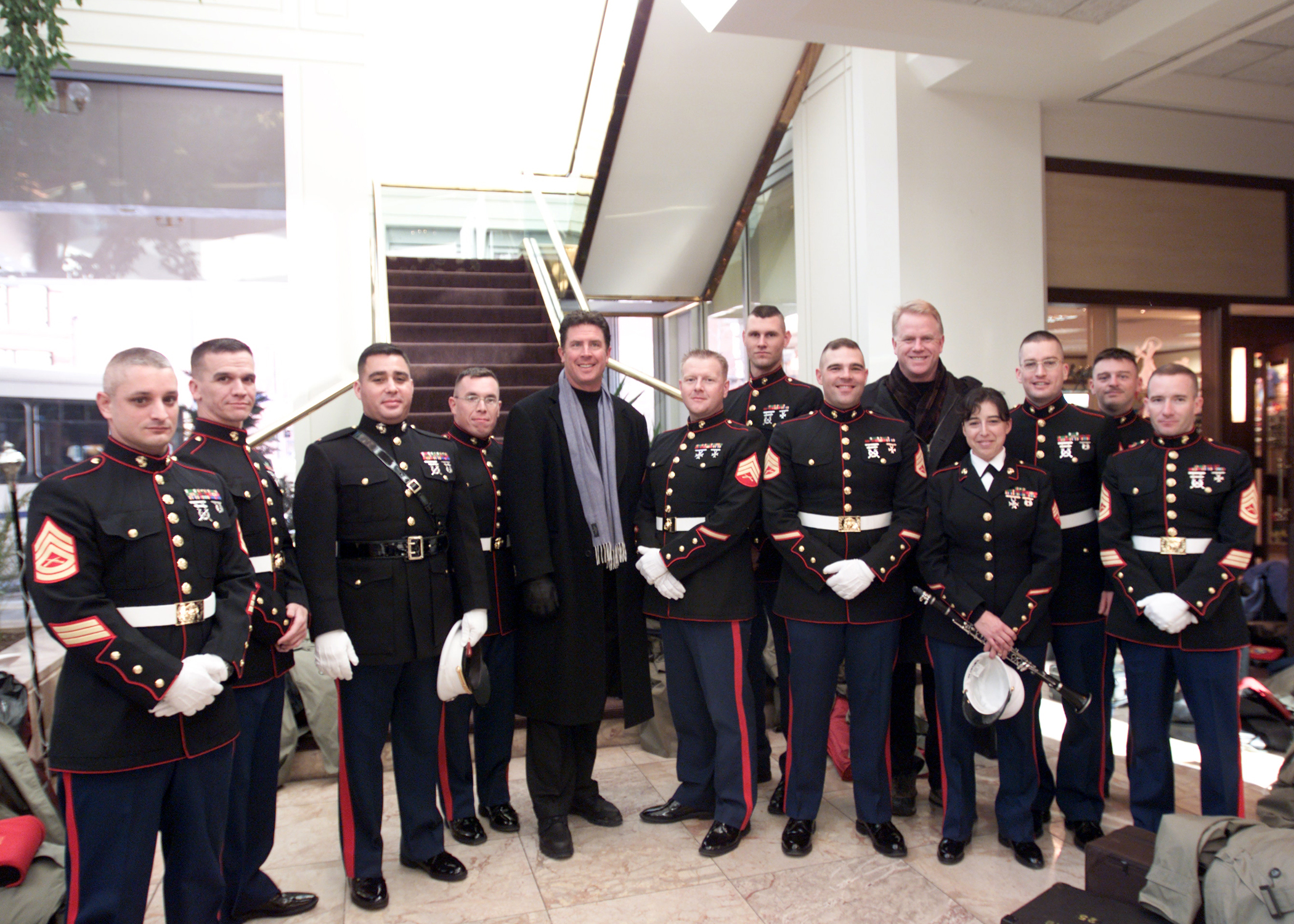 Boomer Esiason · Quarterback (1984-1992, 1997)
Left-handed 1988 NFL MVP who ran the no-huddle and led the team to Super Bowl XXIII; Bengals Ring of Honor (2023).
Photo: U.S. Marine Corps (Staff Sgt. Matthew A. Butler), public domain (Wikimedia Commons)
 Chad Johnson ("Ochocinco") · Wide receiver (2001-2010)
Franchise's all-time receiving leader (10,783 yards, 751 receptions), six-time Pro Bowler known for flamboyant celebrations.
Photo: Emeybee, public domain (Wikimedia Commons)
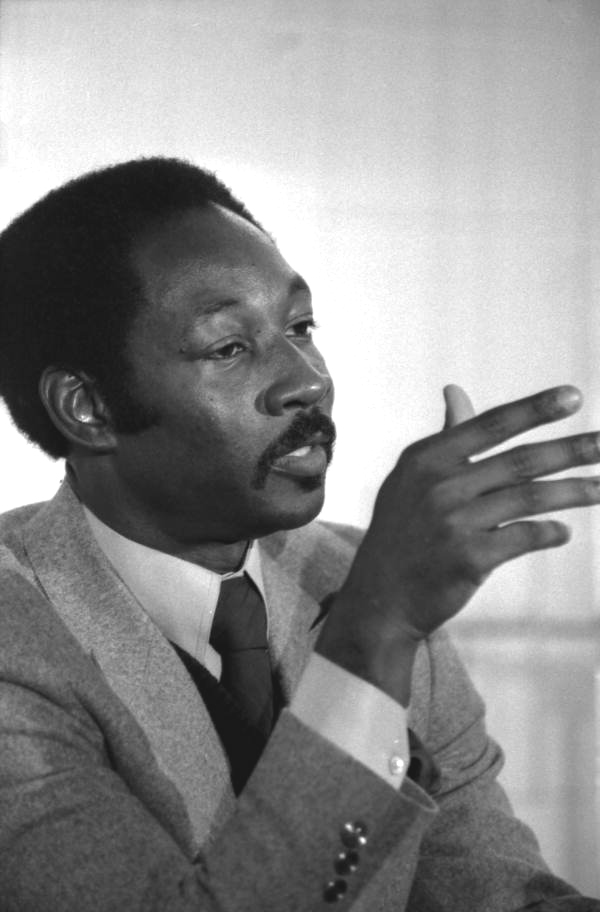 Ken Riley · Cornerback (1969-1983)
Franchise's all-time interceptions leader (65, tied 5th in NFL history); posthumously elected to the Pro Football Hall of Fame in 2023.
Photo: Deborah Thomas / State Archives of Florida, public domain (Wikimedia Commons)
 Geno Atkins · Defensive tackle (2010-2020)
Dominant interior pass-rusher with 75.5 career sacks (most ever by a Bengals defensive tackle, 3rd in franchise history); eight-time Pro Bowler.
Photo: Navin Rajagopalan, CC BY-SA 2.0 (Wikimedia Commons)
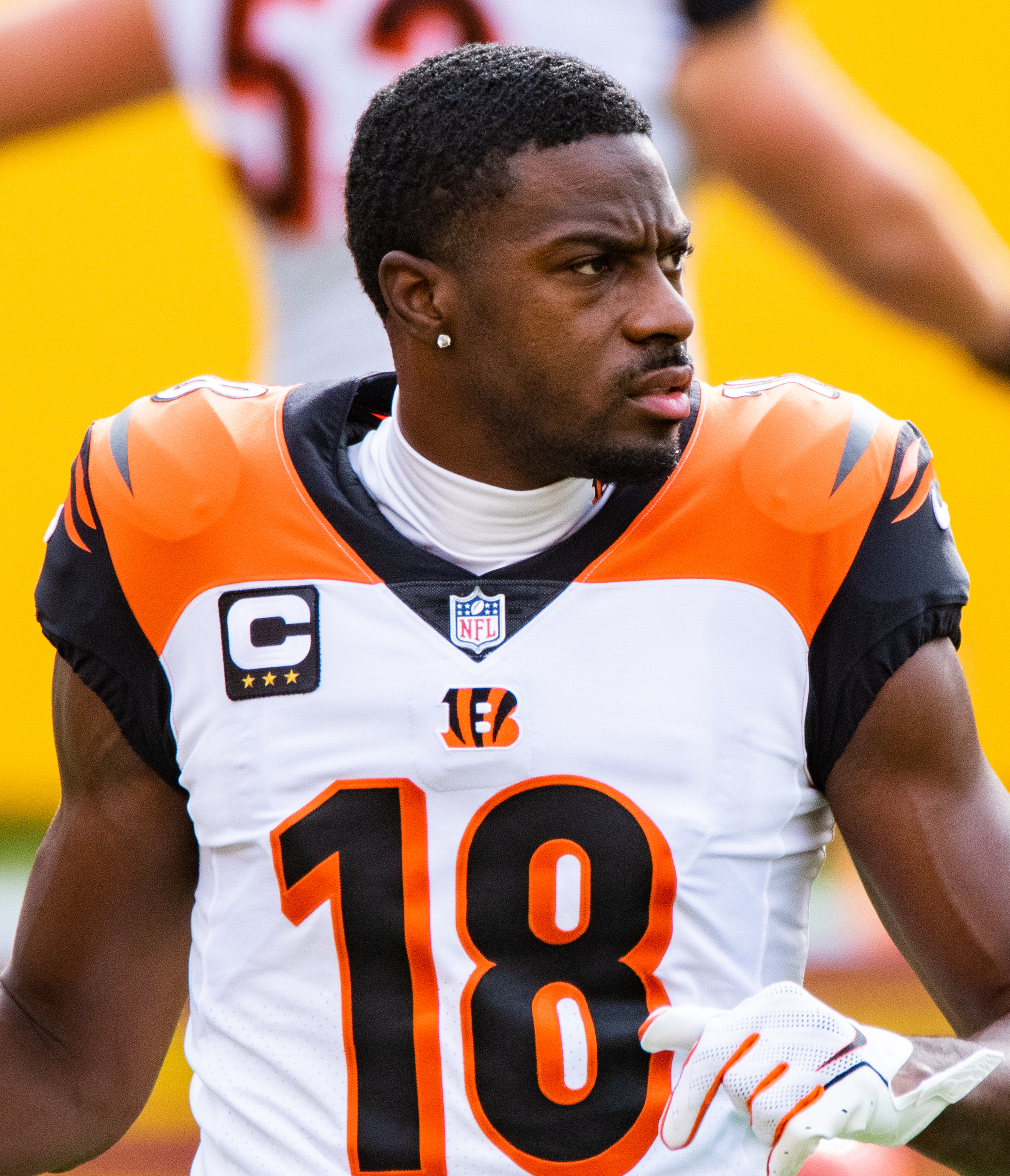 A.J. Green · Wide receiver (2011-2020)
Seven-time Pro Bowl receiver, one of the most productive wideouts in franchise history.
Photo: AlexanderJonesi, CC BY-SA 2.0 (Wikimedia Commons)
 Joe Burrow · Quarterback (2020-present)
No. 1 overall pick who revived the franchise and led them to Super Bowl LVI; multiple-time Pro Bowler rewriting the team record book.
Photo: AlexanderJonesi, CC BY-SA 2.0 (Wikimedia Commons)
 Ja'Marr Chase · Wide receiver (2021-present)
2021 Offensive Rookie of the Year and 2024 receiving Triple Crown winner; among the most explosive receivers in the NFL.
Photo: All-Pro Reels, CC BY-SA 2.0 (Wikimedia Commons)
Record book
- Passing yardsKen Anderson (32,838)
- Passing TDsKen Anderson (197)
- Rushing yardsCorey Dillon (8,061)
- Receiving yardsChad Johnson (10,783)
- ReceptionsChad Johnson (751)
- SacksCarlos Dunlap (82.5 (official; Eddie Edwards often cited at 83.5 incl. unofficial pre-1982 sacks))
- InterceptionsKen Riley (65)
- PointsJim Breech (1,151 (only 1,000-point scorer in franchise history))
Team Tips
Playing As
Win through an explosive, pass-heavy aerial attack. With Burrow healthy, Cincinnati led the NFL and set a team single-season record with 272.9 net passing yards per game in 2024. The Burrow-Chase-Higgins trio is the only group in the league that can credibly claim two WR1-caliber talents, and Chase Brown (a 2025 1,000-yard rusher) adds dual-threat balance from the backfield. Lean into Taylor's West Coast scheme as a perennial top-five passing offense with one of the league's highest pass rates.
Playing Against
The defense is the glaring weakness, ranked 31st in total defense and 32nd (dead last) against the run in 2025. Attack with the run game and exploit the middle of the field with tight ends and running backs. Pressuring Burrow is the other key: the offensive line grades mid-pack in pass protection, and Burrow's injury history (significant time missed in three of six seasons) makes hitting him viable. When Burrow misses time the offense's ceiling drops sharply (1-8 without him in 2025).

Coaching · Zac Taylor
Head coach since 2019, entering his eighth season in 2026. Retained by owner/president Mike Brown in April 2026 despite a 6-11 finish and a third straight playoff miss. An offensive-minded coach from the Sean McVay tree, Taylor runs a pass-heavy West Coast offense and serves as the Bengals' play-caller. His career regular-season record is 52-63-1 with a 5-2 postseason mark; he led Cincinnati to Super Bowl LVI and back-to-back AFC Championship Games (2021-22). The Bengals overhauled the defense this offseason (trading for DT Dexter Lawrence and signing Boye Mafe, Bryan Cook, and Jonathan Allen) while returning their offensive core.
Photo: Erik Drost, CC BY 2.0 (Wikimedia Commons)
Coming soon
- Playbook Matches
- Key Plays & Audibles
Upgrade to Team Hub Rookie
- Salary cap breakdown
- Depth chart analysis
- Roster needs & scheme fit
- Cut candidates & 5-year outlook
- Full sortable roster