Team Hub

NFC North
Chicago Bears
Team Snapshot
The Bears enter 2026-2027 as a rising NFC contender, coming off an 11-6 breakthrough in 2025 under first-year head coach Ben Johnson, their first NFC North title since 2018 and first playoff win since the 2010 season, with franchise quarterback Caleb Williams and a young, ascending roster.
Franchise Difficulty
How hard this franchise is to run well: where the team stands, what the roster gives you, what the cap allows, and what you hold in the draft.
An elite franchise quarterback in Caleb Williams on a contention-ready offensive core, bolstered by premium interior line talent and a three-year draft haul of 20 picks including three first-rounders, offsets the historically thin cap room and the glaring holes at left tackle and right edge.
Star Players
Scheme Fit
The schemes this team is set to run in-game, and how its roster grades in them.
- Multiple Power RunoffensiveGood
- Base 4-3defensivePassable
Salary Cap
The Bears are squeezed to $7.5M in cap room, ranking last in the league, but committed money falls off a cliff after next season, setting up a real spending window ahead.
22 contracts expiring
Depth Chart
Madden Tools Analysis
Six starting spots have weak depth behind the starter.
Draft Capital
Six picks this year including four selections in the first four rounds, plus 20 total across three years and three first-rounders in that span, gives Chicago one of the stronger draft pipelines available to a team in this competitive position.
- Traded away: Round 5 to Patriots, this draft
Team Ratings
The roster's top strength is its interior offensive line headlined by the 96-overall Thuney and 90-overall Wright, while the right defensive edge, where the starter ranks 31st in the league, is the clearest weakness on the team.
Strengths
- LG
- RT
- HB
- MIKE
- QB
Weak spots
- LT
- REDGE
- DT
- WR
- FS
Offense
Defense
Special teams
Roster Needs
- LThigh
Ozzy Trapilo starts at left tackle ranked 29th among starters league-wide, making elite blindside protection for Williams the team's most urgent priority.
- REDGEhigh
Dayo Odeyingbo starts at right edge with a 31st-ranked starter grade, leaving the right side of the pass rush dangerously thin against competent offenses.
- DTmedium
Grady Jarrett is the starter at 81 overall, but the Bears rank last in the league in defensive tackle depth, meaning any injury would expose a dramatic drop-off.
- WRmedium
Rome Odunze and Luther Burden III are promising starters but the group ranks 26th in starter grade, and Williams needs more reliable weapons in the passing game.
- FSlow
Xavier Woods holds the starting free safety spot at 78 overall, and while the starter is adequate, depth behind him is thin enough to flag as a low-severity concern.
- SSlow
Dillon Thieneman starts at strong safety at 77 overall, and while the position is not a crisis, the starter ranks 23rd and depth is middling at 11th.
Cut Candidates
5-Year Outlook
The Bears are built around one of the most exciting young quarterbacks in the game in Caleb Williams, and the surrounding infrastructure is more developed than it first appears. Darnell Wright and Joe Thuney give him a strong right side and interior, Rome Odunze and Luther Burden III are ascending Star receivers, and Colston Loveland profiles as a long-term mismatch tight end. The challenge is that Thuney is entering the late stage of his career and will need a succession plan at guard within the next few seasons, and Jonah Jackson at right guard is also aging. The left tackle situation is the most pressing concern, with Ozzy Trapilo and Braxton Jones representing a placeholder solution rather than a legitimate answer. Defensively, Montez Sweat anchors the left edge but is in the aging window himself, Grady Jarrett provides veteran experience at defensive tackle but cannot be counted on as a long-term piece, and the right edge is the weakest position on the team. Cap space is at its tightest right now, sitting at $7.5M ranked last in the league, but committed money drops sharply after the next two seasons, opening a meaningful runway to re-invest. With three first-round picks in the next three years and 20 total selections across that span, the Bears have the draft resources to address every hole without sacrificing the young core.
5-Year Plan
Year 1Patch the blindside, clear the clutter
- Release Brittain Brown and Tyson Bagent immediately, as both carry zero or minimal dead money and free up combined cap space to apply toward the offensive line need.
- Target a left tackle upgrade through free agency or trade, as Ozzy Trapilo ranks 29th among starters and Caleb Williams needs legitimate blindside protection.
- Use the team's six picks this year, spread across four of the first four rounds and two later rounds, to address right edge depth behind the struggling Odeyingbo starter slot.
Year 2Develop the young core, reload the front
- Focus development resources on Colston Loveland (Star, 22) and Luther Burden III (Star, 22), both of whom should be entering breakout development windows as primary targets for Williams.
- Reassess Dayo Odeyingbo's cut, as the $11.0M dead money penalty is easier to absorb once the next-year cap room of $21.6M (ranked 19th) becomes available.
- Continue building edge and defensive tackle depth through the team's three first-round picks across the three-year horizon, prioritizing the positions ranked last in league depth.
Year 3Establish a true pass rush identity
- Montez Sweat is in the aging window at left edge, so evaluate whether his backup Austin Booker (73 overall, 23 years old) is ready to take over primary reps.
- With committed money dropping to $122.9M two seasons out, use the financial flexibility to sign or extend a right edge presence to complement whoever emerges opposite Sweat.
- Rome Odunze (Star, 24 now) and Caleb Williams should be entering their prime synchronization years, so invest in the passing game's infrastructure rather than patching it.
Year 4Contend with a complete roster
- Joe Thuney will need a successor at left guard by this point, and Jordan McFadden (66 overall) at backup must either have developed or been replaced through the draft.
- Grady Jarrett, entering the latest stage of his career, should be replaced by a developed interior player sourced from the team's deep three-year draft stockpile.
- With Caleb Williams in the prime of his X Factor development arc, align the entire cap structure around extending the pieces of the young core that have earned it.
Year 5Sustain the window, extend the stars
- Committed money drops to $59.8M three seasons out from now, creating a major re-signing window to lock up Jaylon Johnson, Darnell Wright, and any other core pieces approaching free agency.
- Dillon Thieneman (Star, 22) and Kyler Gordon (Star, 26) should be entering or in their prime defensive seasons, providing a secondary capable of complementing an improved pass rush.
- Use the final picks from the three-year 20-selection haul to fill any last depth gaps and ensure the roster has no single-point-of-failure positions remaining.
Young core
Full Roster
| Player | Pos | OVR | Age | Dev |
|---|---|---|---|---|
| Age 33 | LG | 96 | 33 |  |
| Age 24 | QB | 91 | 24 |  |
| Age 25 | RT | 90 | 25 |  |
| Age 27 | CB | 87 | 27 | |
| Age 27 | HB | 87 | 27 | |
| Age 28 | MIKE | 86 | 28 | |
| Age 26 | CB | 83 | 26 | |
| Age 29 | RG | 83 | 29 |  |
| Age 22 | TE | 82 | 22 | |
| Age 24 | WR | 82 | 24 | |
| Age 30 | WILL | 81 | 30 | |
| Age 33 | DT | 81 | 33 | |
Franchise History
The Bears are one of pro football's two surviving charter franchises. Founded in Decatur, Illinois, in 1920 as the Decatur Staleys, sponsored by the A.E. Staley Manufacturing Company, the team joined the American Professional Football Association (renamed the NFL in 1922) on September 17, 1920, for a $100 franchise fee. In 1921 owner A.E. Staley handed the club to player-coach George "Papa Bear" Halas, who moved the team to Chicago's Wrigley Field and renamed them the Chicago Bears in 1922. Halas served the franchise as owner, player, coach and executive from 1920 until his death in 1983, retiring as coach after the 1967 season with a then-record 324 wins. The early Bears dominated the young NFL behind Red Grange and Bronko Nagurski, and the Sid Luckman-led T-formation teams of the 1940s won four championships. In all, the Bears have won nine NFL championships, eight before the AFL-NFL merger (1921, 1932, 1933, 1940, 1941, 1943, 1946, 1963) plus Super Bowl XX, second only to the Green Bay Packers. The modern high point came in 1985: Mike Ditka's 15-1 team deployed Buddy Ryan's "46 defense," recorded "The Super Bowl Shuffle," and demolished the New England Patriots 46-10 in Super Bowl XX behind MVP Richard Dent. The Bears returned to the Super Bowl in the 2006 season under Lovie Smith and Brian Urlacher, losing 29-17 to the Indianapolis Colts in Super Bowl XLI. Lean years followed a 2010 NFC Championship Game appearance, and the Bears did not win a playoff game between the 2010 and 2024 seasons, a drought finally broken in January 2026 with a wild-card win over Green Bay.
Notable figures
 George Halas · Founder, owner, player and head coach
"Papa Bear" co-founded the NFL and built the Bears into a dynasty across six decades; the NFC Championship trophy bears his name.
Photo: public domain (Wikimedia Commons, 1922 photo)
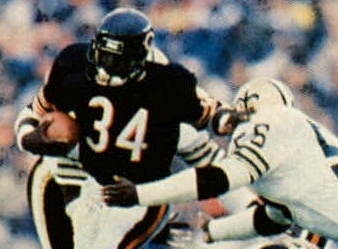 Walter Payton · Running back (1975-1987)
"Sweetness," a nine-time Pro Bowler and Super Bowl XX champion, is the franchise's all-time leading rusher and long held the NFL career rushing record.
Photo: Jeno's, public domain (Wikimedia Commons)
 Dick Butkus · Middle linebacker (1965-1973)
The ferocious eight-time Pro Bowler is widely regarded as the standard by which middle linebackers are measured; No. 51 retired; Hall of Fame 1979.
Photo: Alan Light, CC BY 2.0 (Wikimedia Commons)
 Gale Sayers · Running back (1965-1971)
The "Kansas Comet," inducted into the Pro Football Hall of Fame in 1977 at age 34 and still one of the youngest ever enshrined; scored six TDs in a single 1965 game; No. 40 retired.
Photo: public domain (Wikimedia Commons, U.S. military/USO)
 Mike Ditka · Tight end (1961-1966) and head coach (1982-1992)
"Iron Mike" is the only person to win a Bears title as both player (1963) and head coach (Super Bowl XX); Hall of Fame 1988.
Photo: Jeff Morey, CC BY-SA 2.5 (Wikimedia Commons)
 Sid Luckman · Quarterback (1939-1950)
Led the Bears to four NFL titles and helped revolutionize pro football with the T-formation; 1943 NFL MVP; No. 42 retired.
Photo: public domain (Wikimedia Commons)
 Bronko Nagurski · Fullback/tackle (1930-1937, 1943)
Bruising two-way star and NFL icon of the 1930s who won three NFL titles; No. 3 retired; charter-era Hall of Famer.
Photo: public domain (Wikimedia Commons, 1935 National Chicle card)
 Brian Urlacher · Middle linebacker (2000-2012)
Face of the 2000s Bears, 2005 NFL Defensive Player of the Year, eight-time Pro Bowler and Super Bowl XLI starter; Hall of Fame 2018.
Photo: U.S. Army Africa, CC BY 2.0 (Wikimedia Commons)
 Mike Singletary · Middle linebacker (1981-1992)
"Samurai Mike," heart of the 1985 champions, 1985 NFL Defensive Player of the Year and Hall of Famer (1998).
Photo: Maria L. Taylor (U.S. military), public domain (Wikimedia Commons)
 Devin Hester · Return specialist/wide receiver (2006-2013)
The greatest return man in NFL history and first to return a Super Bowl opening kickoff for a TD; Hall of Fame 2024.
Photo: RMelon, CC BY-SA 3.0 (Wikimedia Commons)
Record book
- Passing yardsJay Cutler (23,443)
- Passing TDsJay Cutler (154)
- Rushing yardsWalter Payton (16,726)
- Receiving yardsJohnny Morris (5,059)
- ReceptionsWalter Payton (492)
- SacksRichard Dent (124.5 (sacks official since 1982))
- InterceptionsGary Fencik (38)
- PointsRobbie Gould (1,207)
Team Tips
Playing As
Chicago is historically a defense-and-running-game franchise, from its linebacker tradition to the record-setting 1985 "46 defense" and a run-first offensive lineage from Nagurski to Payton to Forte. That identity resurfaced in 2025, when the Bears led the NFL with 33 takeaways and a +22 turnover differential, their best turnover margin since 1985, and finished third in rushing at 144.5 yards per game. Under Ben Johnson, build the run to set up the pass with heavy 12 personnel, zone-run schemes, constant pre-snap motion and play-action. Lean into late-game poise, the 2025 team won six games in which it trailed in the final two minutes, the most since the 1970 merger.
Playing Against
The soft spot is pass defense and passing-game consistency: in 2025 the Bears ranked 23rd in points allowed (24.4/game) and surrendered chunk plays through the air. Caleb Williams was markedly less effective under duress, around 42% completion when pressured versus roughly 66% from a clean pocket, so pressure the quarterback and force him off-script. Take away the run to make the offense one-dimensional, and attack the middle of a defense that can be gashed when its front fails to generate pressure.
Coaching · Ben Johnson
Head coach entering 2026-2027 (second season). Hired January 21, 2025, as the franchise's 18th full-time head coach after coordinating Detroit's top-ranked offense, Johnson led the Bears to 11-6, the 2025 NFC North title, and their first playoff win since 2010 in his debut year, finishing as an AP Coach of the Year finalist. A detail-obsessed, aggressive play-caller known for creative run-game design, heavy motion and fourth-down aggression, his 2026 staff promoted Press Taylor to offensive coordinator and retained defensive coordinator Dennis Allen.
Coming soon
- Playbook Matches
- Key Plays & Audibles
Upgrade to Team Hub Rookie
- Salary cap breakdown
- Depth chart analysis
- Roster needs & scheme fit
- Cut candidates & 5-year outlook
- Full sortable roster