Team Hub
NFC North
Minnesota Vikings
Team Snapshot
The Minnesota Vikings enter the 2026 (2026-2027) season as a defense-first contender trying to climb back into the playoff race after a 9-8 finish in 2025 (which they closed on a five-game winning streak), with the franchise's biggest question being who wins the starting quarterback job, third-year J.J. McCarthy or veteran free-agent signing Kyler Murray, behind one of the NFL's most aggressive defenses. Head coach Kevin O'Connell returns for his fifth season alongside defensive coordinator Brian Flores, but with a new general manager (Nolan Teasley) and intensifying pressure to finally win a playoff game.
Franchise Difficulty
How hard this franchise is to run well: where the team stands, what the roster gives you, what the cap allows, and what you hold in the draft.
A functional but unspectacular starting quarterback, pressing needs at center and halfback, $41.2M in dead cap money eating into a modest $30.7M in current cap room, and a secondary reliant on players entering the late stages of their careers all combine to make this franchise genuinely challenging to run well.
Star Players
Scheme Fit
The schemes this team is set to run in-game, and how its roster grades in them.
- West Coast Zone RunoffensiveGood
- Base 3-4defensiveGood
Salary Cap
With $30.7M in current room weighed against $41.2M in dead money, the cap is livable now but the real opportunity arrives next year when projected room jumps to $76.5M.
23 contracts expiring
Depth Chart
Madden Tools Analysis
Six starting spots have weak depth behind the starter.
Draft Capital
With eight picks this cycle including two first-rounders and two second-rounders, and 22 total picks projected across three years, Minnesota has genuine ammunition to accelerate a rebuild or trade up for impact players.
- Acquired: Round 3 from Eagles, this draft
- Acquired: Round 7 from Eagles, this draft
- Acquired: Round 6 from Jets, this draft
- Acquired: Round 5 from Panthers, this draft
- Traded away: Round 6 to Patriots, this draft
- Traded away: Round 7 to Falcons, this draft
- Traded away: Round 4 to Panthers, this draft
Team Ratings
The roster's top strength is its wide receiver corps, anchored by a 97 overall Justin Jefferson, while the center position, where the starter ranks among the weakest in the league, is the clearest weak spot.
Strengths
- FS
- RT
- WR
- MIKE
- LT
Weak spots
- C
- HB
- QB
Offense
Defense
Special teams
Roster Needs
- Chigh
Blake Brandel starts at center but ranks 25th among starters leaguewide, and the depth behind him, Nick Samac and Michael Jurgens, provides no meaningful upgrade.
- HBhigh
Aaron Jones Sr. is the starter at halfback but ranks 28th among starters leaguewide, and while Jordan Mason provides a capable backup, the room as a whole lacks a true featured back.
- QBmedium
Kyler Murray holds the starting job but ranks 26th among starters, and neither Carson Wentz nor Max Brosmer offers a credible backup upgrade, making the position a genuine concern.
Cut Candidates
5-Year Outlook
Minnesota possesses one of the most dominant receivers in football in Justin Jefferson, a stellar offensive line cornerstone in Christian Darrisaw, and a young edge rusher in Dallas Turner who projects as a foundational piece for years to come. The short-term ceiling, however, is constrained by a quarterback situation that ranks near the bottom of the league, thin production at center, and a halfback room led by a starter entering the final chapter of his career. Harrison Smith remains a quality contributor in the secondary but is among the oldest players at his position in the league, meaning succession at free safety must become a priority. The cap picture improves substantially next year, when the team projects $76.5M in room, giving the front office a genuine opportunity to address the quarterback and interior line needs. If those moves land, Justin Jefferson's prime years align with a window that could push Minnesota into legitimate contention.
5-Year Plan
Year 1Stabilize the foundation
- Release Tyler Batty and Michael Jurgens to recover cap space cleanly, and evaluate Carson Wentz and Max Brosmer for further cuts to streamline the roster.
- Target a veteran upgrade at center in free agency using a portion of the current $30.7M in cap room to address the 25th-ranked starter at that position.
- Use the eight picks in this draft class, including two first-rounders and two second-rounders, to add competition at halfback and quarterback depth.
Year 2Invest in the young core
- Leverage the projected $76.5M in cap room to pursue a legitimate franchise quarterback upgrade, removing the ceiling that Kyler Murray's current standing imposes.
- Extend Christian Darrisaw and begin the conversation on locking up Dallas Turner, whose Superstar dev trait makes him a cornerstone pass rusher for this defense.
- Jordan Addison, entering his prime development window as a 24-year-old Star, should be targeted for a contract extension before his value rises further.
Year 3Build around the next wave
- With Harrison Smith now well into the twilight of his career, commit to developing Theo Jackson and Jakobe Thomas as the safety room's future and reduce Smith's role accordingly.
- Dallas Turner should be entrenched as the lead pass rusher, and a complementary edge opposite Andrew Van Ginkel, who will also be aging further into his career, must be identified.
- Use the three-year draft total of 22 picks across the plan window to continuously add developmental depth along the offensive and defensive lines.
Year 4Push for contention
- Justin Jefferson remains in his prime and the offensive infrastructure built in seasons two and three should be capable of surrounding him with genuine playmakers at halfback and quarterback.
- Donovan Jackson and Caleb Banks, both 23-year-old Star dev players today, should be approaching their ceilings and anchoring the guard and interior defensive line spots.
- Consolidate the roster by moving on from aging contributors at cornerback and linebacker whose contracts no longer reflect their production.
Year 5Sustain the window
- With committed cap spending dropping to $102.8M in the third year of this plan, the team will have substantial flexibility to retain key contributors and add targeted veterans.
- Ensure succession is complete at free safety and right tackle, positions where the current starters are entering the late or final stages of their careers, so the defense and line do not regress.
- Evaluate whether a championship-caliber roster has been assembled around Justin Jefferson and Dallas Turner, and make aggressive moves at the trade deadline to capitalize on any short-term opportunity.
Young core
Full Roster
| Player | Pos | OVR | Age | Dev |
|---|---|---|---|---|
| Age 27 | WR | 97 | 27 |  |
| Age 27 | LT | 90 | 27 |  |
| Age 30 | RT | 87 | 30 |  |
| Age 37 | FS | 87 | 37 | |
| Age 28 | CB | 85 | 28 |  |
| Age 24 | WR | 84 | 24 | |
| Age 30 | MIKE | 84 | 30 | |
| Age 28 | CB | 84 | 28 | |
| Age 27 | DT | 84 | 27 | |
| Age 31 | REDGE | 84 | 31 | |
| Age 29 | TE | 83 | 29 | |
| Age 28 | SS | 83 | 28 | |
Franchise History
The Vikings were awarded the NFL's 14th franchise on January 28, 1960, after a Minnesota ownership group led by Max Winter and Bill Boyer abandoned a prior commitment to the rival AFL. Named the "Vikings" on September 27, 1960, to honor the region's Scandinavian heritage, they began play in 1961 at Metropolitan Stadium under first head coach Norm Van Brocklin, with rookie Fran Tarkenton coming off the bench to throw four touchdown passes in a 37-13 upset of the Bears on September 17, 1961. The franchise's golden age began with the 1967 hiring of Bud Grant, who built a defense-first identity around the "Purple People Eaters" (Carl Eller, Jim Marshall, Alan Page, and Gary Larsen). Minnesota won the last pre-merger NFL Championship in 1969 (beating Cleveland 27-7) and reached four Super Bowls, IV, VIII, IX, and XI, losing all four, while qualifying for the playoffs in 10 of 11 seasons between 1968 and 1978. Later eras produced more heartbreak: the 1998 team went 15-1 before a stunning NFC Championship loss to Atlanta; the 2009 Brett Favre squad fell in overtime in the NFC title game at New Orleans; and the 2017 team won on the "Minneapolis Miracle" before being routed by Philadelphia. The Vikings have lost their last six NFC Championship Game appearances dating to 1978 and remain one of the most accomplished franchises never to win a Super Bowl. They have played at Metropolitan Stadium (1961-81), the Metrodome (1982-2013), TCF Bank Stadium (2014-15), and U.S. Bank Stadium (2016-present). Under Kevin O'Connell (since 2022), the team has gone 13-4, 7-10, 14-3, and 9-8.
Notable figures
- Fran Tarkenton · Quarterback (1961-66, 1972-78)
Hall of Fame "Scrambler" and 1975 NFL MVP; franchise all-time leader in passing yards (33,098) and passing touchdowns (239).
- Bud Grant · Head coach (1967-83, 1985)
Hall of Famer who led Minnesota to all four of its Super Bowl appearances and compiled a 158-96-5 regular-season record.
- Alan Page · Defensive tackle (1967-78)
Anchor of the Purple People Eaters and the 1971 NFL MVP, the first defensive player to win the award; later an associate justice of the Minnesota Supreme Court.
- Carl Eller · Defensive end (1964-78)
Hall of Fame pass rusher and the franchise's all-time sack leader at 130.5 (including pre-1982 unofficial sacks).
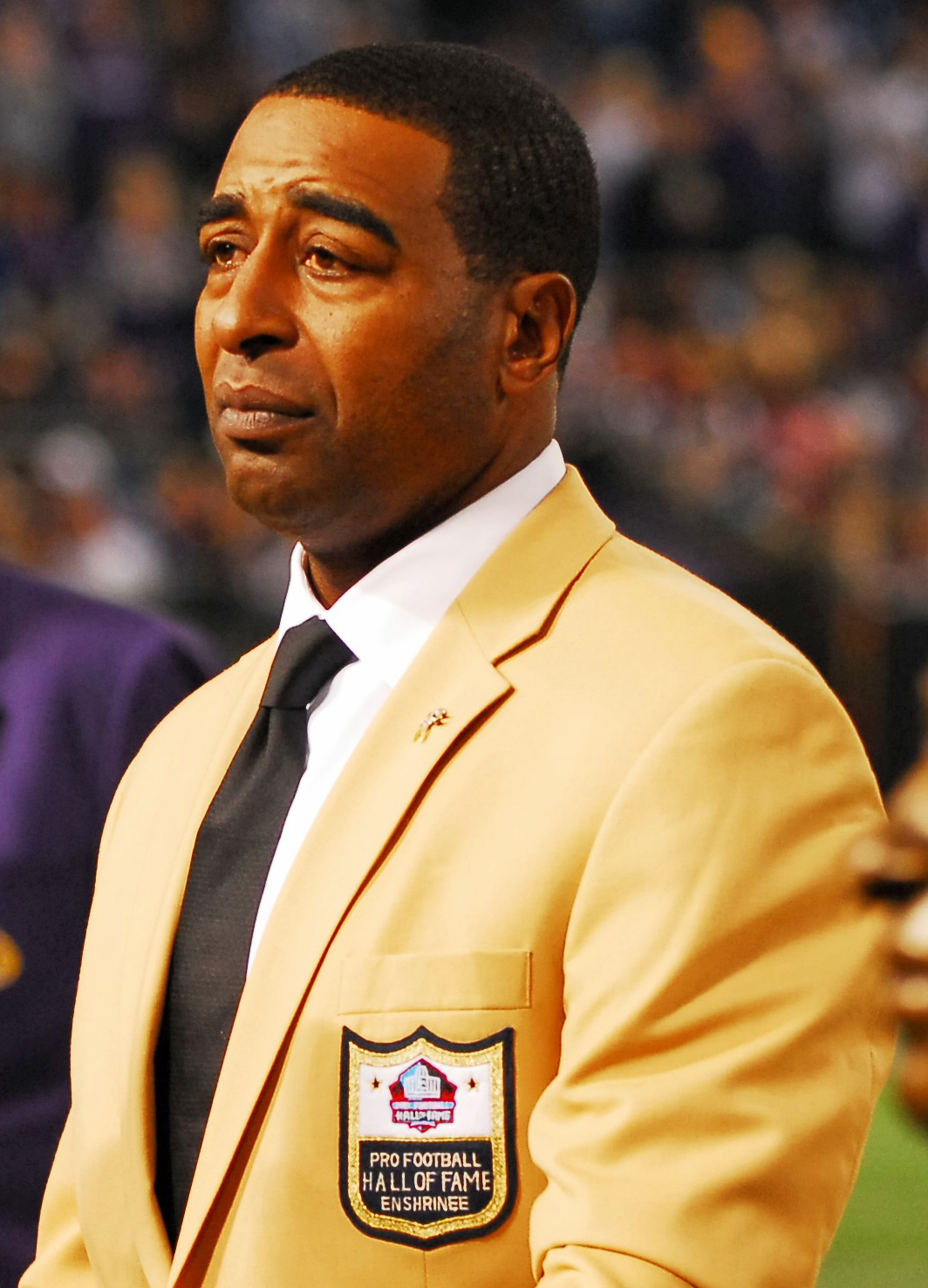 Cris Carter · Wide receiver (1990-2001)
Hall of Famer and the franchise's all-time leader in receptions (1,004) and receiving yards (12,383).
Photo: MN National Guard, CC BY 3.0, via Wikimedia Commons
 Randy Moss · Wide receiver (1998-2004, 2010)
Hall of Famer who set a rookie record with 17 touchdown catches in 1998; second in franchise receiving yards (9,316).
Photo: BrokenSphere, CC BY-SA 3.0, via Wikimedia Commons (shows Moss in a New England Patriots uniform)
 Adrian Peterson · Running back (2007-16)
Franchise's all-time leading rusher (11,747 yards) and the 2012 NFL MVP; to be inducted into the Vikings Ring of Honor in 2026.
Photo: Arvee5.0, CC BY 2.0, via Wikimedia Commons
- John Randle · Defensive tackle (1990-2000)
Undrafted Hall of Famer and the franchise's official (post-1982) sack leader with 114.0.
- Paul Krause · Safety (1968-79)
Hall of Famer who holds the NFL career interceptions record (81) and the Vikings franchise record (53).
Record book
- Passing yardsFran Tarkenton (33,098)
- Passing touchdownsFran Tarkenton (239)
- Rushing yardsAdrian Peterson (11,747)
- Receiving yardsCris Carter (12,383)
- ReceptionsCris Carter (1,004)
- SacksCarl Eller (130.5 (incl. pre-1982 unofficial; John Randle leads official post-1982 era at 114.0))
- InterceptionsPaul Krause (53)
- PointsFred Cox (1,365)
Team Tips
Playing As
Win with defense and situational discipline. Under Brian Flores, Minnesota has led the NFL in blitz rate in each of his three seasons (about 46.8% in 2025), pairing extreme pressure with heavy two-high zone coverage and pre-snap disguises, an aggressive-yet-conservative scheme (roughly three-quarters zone snaps in 2025) that confuses quarterbacks. The 2025 defense ranked third in total yards, second against the pass, and seventh in scoring, and is elite against the run (a league-low 3.9 yards per carry since 2023) while generating takeaways in bunches. On offense, O'Connell runs a McVay-style West Coast, play-action attack centered on stars Justin Jefferson and Jordan Addison, and the Vikings excel in close games (O'Connell is 26-9 in one-score games).
Playing Against
Attack the offense's quarterback inconsistency: despite the strong defense, the Vikings ranked 26th in points scored in 2025 (20.2 per game) and the McCarthy/Murray competition leaves the position unsettled. Neutralize Flores's blitz with quick-game throws, screens, and motion that isolates favorable matchups when Minnesota sends extra rushers, the Lions and Rams (who accounted for all four of Minnesota's losses in the 14-3 2024 season) provide the blueprint. Force the Vikings into obvious passing downs and dare their quarterback to win from the pocket.
Coaching · Kevin O'Connell
Head coach since February 16, 2022, entering his fifth season (2026). Hired as the 10th head coach in franchise history three days after winning Super Bowl LVI as the Rams' offensive coordinator, the former NFL quarterback is regarded as a "quarterback whisperer" and player-development specialist whose empathy-driven leadership has produced a strong regular-season record, including 13-4 in 2022 and a 14-3, AP Coach of the Year campaign in 2024, but no playoff wins yet (0-2). He signed a multi-year extension in January 2025 and retained defensive coordinator Brian Flores for 2026; offensive coordinator Wes Phillips also returns.
Coming soon
- Playbook Matches
- Key Plays & Audibles
Upgrade to Team Hub Rookie
- Salary cap breakdown
- Depth chart analysis
- Roster needs & scheme fit
- Cut candidates & 5-year outlook
- Full sortable roster